Apple Pay Is Launch & Now Live in India
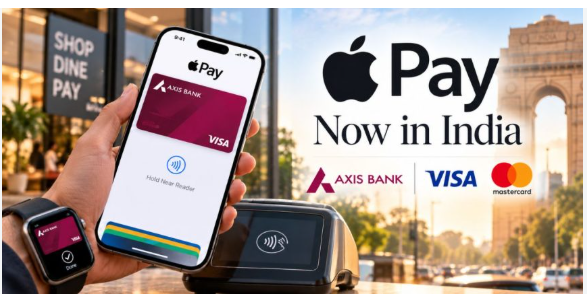
Table of Contents
Apple Pay Makes Its Debut in India
India’s digital payments ecosystem has welcomed a significant new entrant with the launch of Apple Pay. After years of speculation, Apple has officially introduced its contactless payment service in India, allowing eligible users to make secure transactions using their iPhone, iPad, and Apple Watch. The move marks Apple’s entry into one of the world’s most advanced and rapidly growing digital payments markets.
Initial Availability of Apple Pay
At launch, Apple Pay is available exclusively to Axis Bank Visa and Mastercard credit cardholders. Axis Bank has become the first Indian financial institution to partner with Apple for this service, enabling eligible customers to add their cards to Apple Wallet and begin making payments through Apple devices. Additional banks and card issuers are expected to join the platform in the coming months.
Currently Supported : Axis Bank Visa Credit Cards, Axis Bank Mastercard Credit Cards, iPhone, iPad, Apple Watch, Contactless NFC payments at physical stores and In-app and online transactions
Expected Future Expansion : More banks and card issuers, Broader card-network participation and Additional support across Apple’s ecosystem, including Mac devices
How Apple Pay Works :
Apple Pay allows users to complete transactions with a simple tap at NFC-enabled payment terminals.
Instead of manually entering card details, OTPs, or PINs during checkout, users can authenticate payments using Face ID, Touch ID, Device Passcode. The result is a faster and more seamless payment experience while maintaining a high level of security.
Strong Emphasis on Security and Privacy by Apple Pay
One of Apple Pay’s key differentiators is its focus on protecting customer information. When a card is added to Apple Wallet:
- The actual card number is never stored on the device.
- Card information is not stored on Apple’s servers.
- Merchants do not receive the customer’s real card details.
- A unique digital token, known as a Device Account Number, is created.
- This token is securely encrypted and stored within Apple’s Secure Element hardware chip.
This architecture significantly reduces the risk of exposing sensitive card information during transactions.
Why Apple’s India Launch Is Significant
Apple Pay’s arrival reflects the maturity of India’s digital commerce and payments infrastructure.
- Expansion of Contactless Payments : Over the last few years, banks, payment processors, and merchants have widely deployed NFC-enabled terminals, making tap-and-pay transactions increasingly common across urban India.
- Growth of Premium Smartphone Users : India’s expanding base of premium smartphone consumers is increasingly seeking integrated and frictionless payment experiences, making Apple Pay a natural addition to the market.
- E-Commerce and Digital Services Boom : The rise of online shopping, quick-commerce platforms, travel booking apps, and subscription-based services has increased demand for secure one-click checkout solutions.
- Rising Focus on Payment Security : As consumers become more conscious about fraud prevention and data privacy, payment solutions offering tokenisation and enhanced security are attracting greater interest.
- Apple Pay and UPI: Different Use Cases : Although Apple Pay enters India’s crowded payments landscape, it is not a direct substitute for UPI.
UPI facilitates real-time bank-to-bank transfers directly from savings or current accounts. Apple Pay, on the other hand, is primarily a card-based payment solution built around credit card transactions and contactless acceptance.
Rather than competing directly with UPI, Apple Pay is likely to serve users who frequently use credit cards and value reward programs, convenience, privacy, and ecosystem integration.
What This Means for the Market
The launch of Apple Pay could accelerate Adoption of contactless transactions, Innovation among payment providers, Consumer demand for privacy-focused payment solutions, Integration of financial services within digital ecosystems. As support expands to additional banks and card issuers, Apple Pay may emerge as a strong player within India’s premium card payments segment.
Final Takeaway—on Apple Pay in india
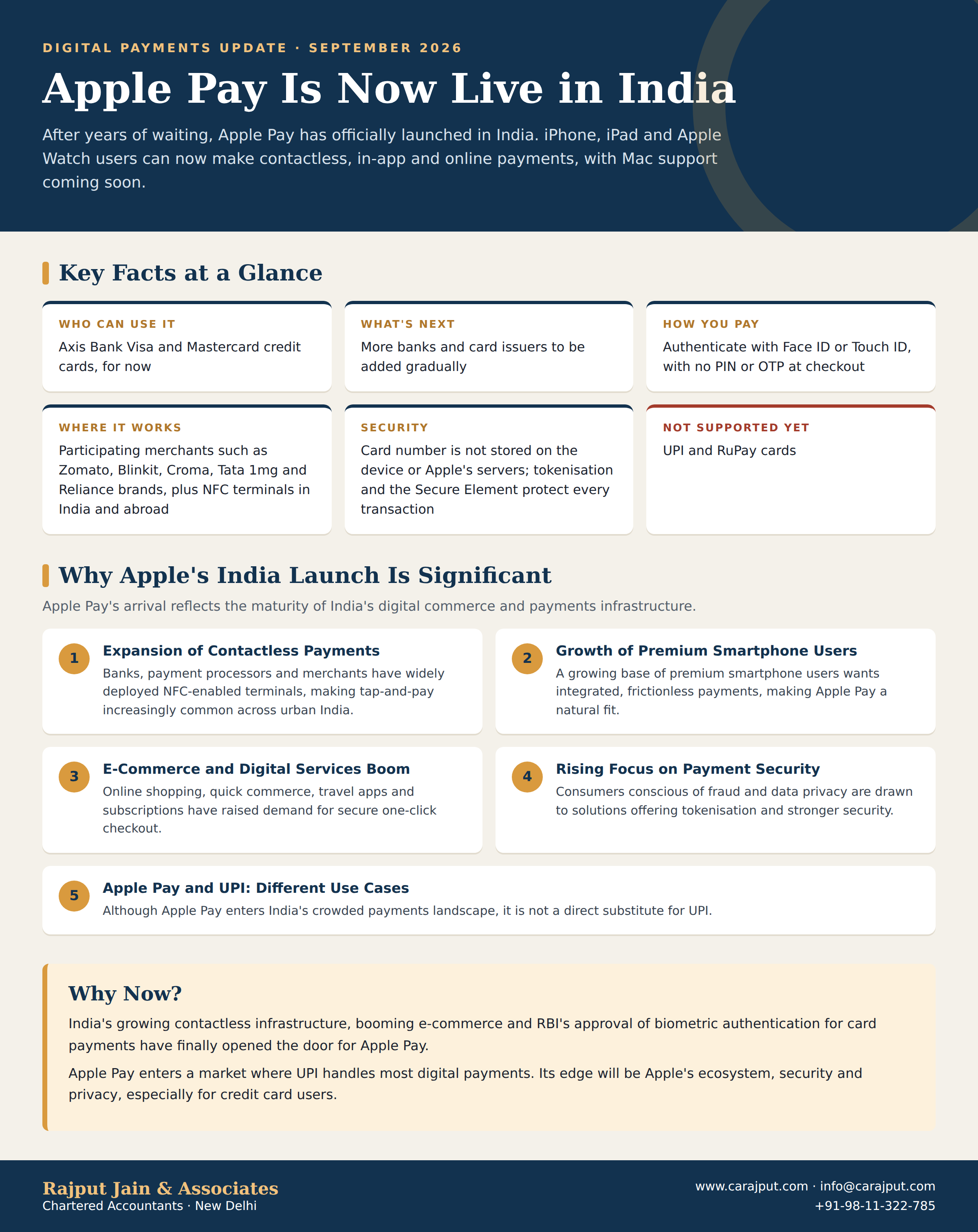
After years of waiting, Apple Pay has officially launched in India. iPhone, iPad and Apple Watch users can now make contactless, in-app and online payments, with Mac support coming soon.
- Who can use it: Axis Bank Visa and Mastercard credit cards, for now
- What’s next: More banks and card issuers to be added gradually
- How you pay: Authenticate with Face ID or Touch ID, with no PIN or OTP at checkout
- Where it works: Participating merchants such as Zomato, Blinkit, Croma, Tata 1mg and Reliance brands, plus NFC terminals in India and abroad
- Security: Your actual card number is not stored on your device or on Apple’s servers. Tokenisation and the Secure Element protect every transaction.
- Not supported yet: UPI and RuPay cards
Why now?
India’s growing contactless infrastructure, booming e-commerce, and RBI’s approval of biometric authentication for card payments have finally opened the door for Apple Pay. Apple Pay enters a market where UPI handles most digital payments. Its edge will be Apple’s ecosystem, security and privacy, especially for credit card users.
**********************************************************
If this article has helped you in any way, i would appreciate if you could share/like it or leave a comment. Thank you for visiting my blog.
Legal Disclaimer:
The information / articles & any relies to the comments on this blog are provided purely for informational and educational purposes only & are purely based on my understanding / knowledge. They do noy constitute legal advice or legal opinions. The information / articles and any replies to the comments are intended but not promised or guaranteed to be current, complete, or up-to-date and should in no way be taken as a legal advice or an indication of future results. Therefore, i can not take any responsibility for the results or consequences of any attempt to use or adopt any of the information presented on this blog. You are advised not to act or rely on any information / articles contained without first seeking the advice of a practicing professional.