When Is GST Registration Mandatory for Your Business?
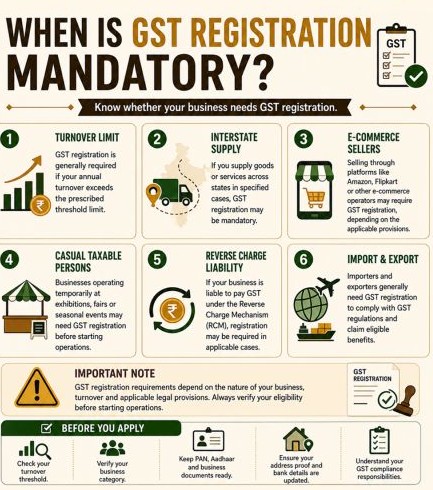
Table of Contents
When Is GST Registration Mandatory for Your Business?
Understanding GST registration requirements is crucial for staying compliant and avoiding penalties. The infographic highlights some of the common situations where GST registration may become mandatory.
Key Situations Requiring GST Registration
✅ Turnover Threshold
- GST registration generally becomes mandatory when your aggregate turnover exceeds the prescribed threshold limit.
✅ Interstate Supply
- Businesses making interstate supplies of goods or services may need GST registration, subject to the applicable provisions.
✅ E-Commerce Sellers
- Sellers operating through e-commerce platforms such as Amazon, Flipkart, and other online marketplaces may require GST registration.
✅ Casual Taxable Persons
- Businesses participating temporarily in exhibitions, fairs, events, or seasonal activities may need GST registration before commencing operations.
✅ Reverse Charge Mechanism (RCM)
- If GST liability arises under the Reverse Charge Mechanism, registration may be required in specified cases.
✅ Importers and Exporters
- Businesses engaged in import or export activities may need GST registration to comply with GST laws and claim available benefits.
GST Registration Documents Requirement
Core Documents Required for All Businesses
- PAN Card of the applicant or business.
- Aadhaar Card for identity verification and e-KYC.
- Photograph of the proprietor, partners, directors, or authorized signatory.
- Business Address Proof, such as an electricity bill, property tax receipt, municipal record, or rent agreement with owner’s NOC (if rented).
- Bank Account Proof, such as a cancelled cheque, bank statement, or first page of the passbook.
Additional Documents Based on Business Structure
Sole Proprietorship
- PAN Card
- Aadhaar Card
- Photograph of the proprietor
Partnership Firm / LLP
- Partnership Deed or LLP Agreement
- PAN and KYC documents of all partners/designated partners
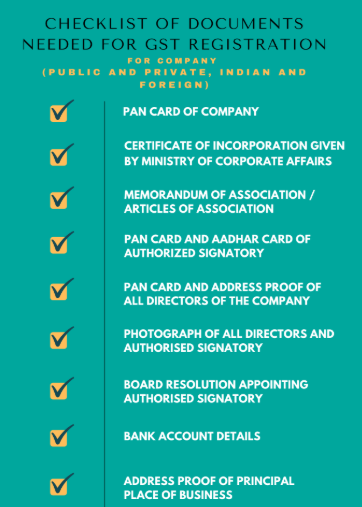
Company (Private Limited/Public Limited)
- Certificate of Incorporation
- MOA and AOA
- Board Resolution authorizing the signatory
Authorized Signatory Documents
- Authorization Letter or Board Resolution where someone is authorized to act on behalf of the business.
Before Applying for GST Registration
- Check your turnover threshold
- Verify your business category
- Keep PAN, Aadhaar, and business documents ready
- Update address and bank account details
- Understand GST compliance requirements
GST registration requirements depend on the nature of your business, turnover, and specific transaction types. Before starting operations, evaluate your GST liability carefully to ensure timely registration and smooth business compliance.
Before applying for GST registration, businesses should keep their PAN, Aadhaar, address proof, bank details, photographs, and entity-specific documents ready. The exact documentation requirement depends on the type of business entity and whether the business premises are owned or rented
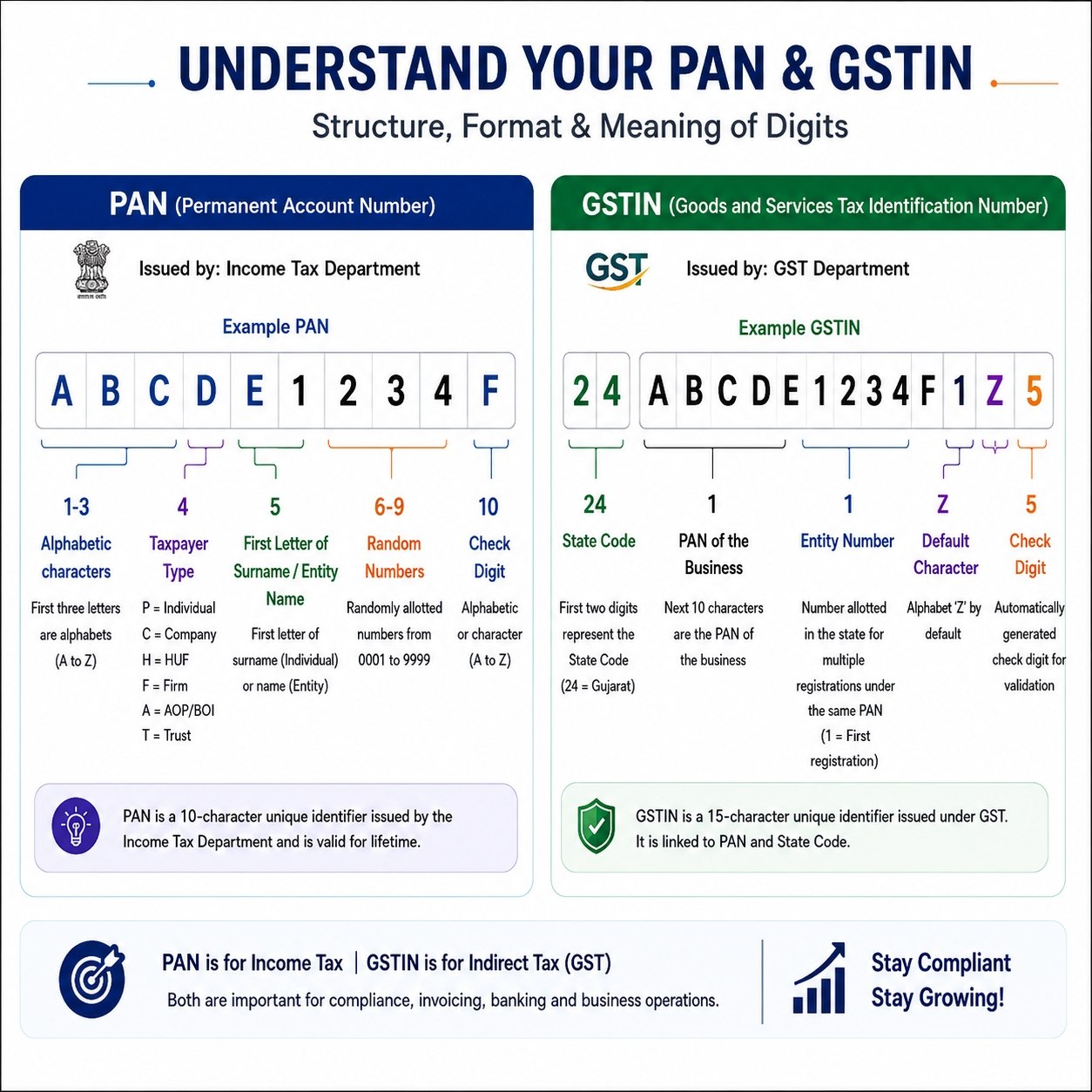
𝐔𝐧𝐝𝐞𝐫𝐬𝐭𝐚𝐧𝐝 𝐘𝐨𝐮𝐫 𝐏𝐀𝐍 & 𝐆𝐒𝐓𝐈𝐍
**********************************************************
If this article has helped you in any way, i would appreciate if you could share/like it or leave a comment. Thank you for visiting my blog.
Legal Disclaimer:
The information / articles & any relies to the comments on this blog are provided purely for informational and educational purposes only & are purely based on my understanding / knowledge. They do noy constitute legal advice or legal opinions. The information / articles and any replies to the comments are intended but not promised or guaranteed to be current, complete, or up-to-date and should in no way be taken as a legal advice or an indication of future results. Therefore, i can not take any responsibility for the results or consequences of any attempt to use or adopt any of the information presented on this blog. You are advised not to act or rely on any information / articles contained without first seeking the advice of a practicing professional.