SC: ITC Credit Depends on Supplier Tax Payment
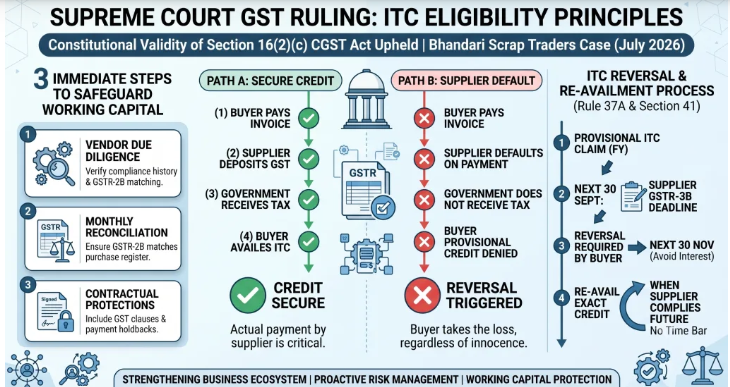
Table of Contents
Supreme Court Settles the ITC Debate: Your Credit Now Depends on Your Supplier’s Tax Payment
Few GST disputes are as frustrating as this one. A genuine business pays its vendor in full, GST included. Months later, it receives a demand notice and its working capital is blocked, because the vendor kept the tax and never filed its returns. For years, taxpayers argued that an honest buyer should not suffer for a supplier’s default.
On 24 July 2026, the Supreme Court of India settled the question. In Bhandari Scrap Traders v. Union of India, the Court upheld the Gujarat High Court’s decision and confirmed that Section 16(2)(c) of the CGST Act is constitutionally valid.
The rule that follows is simple. Your input tax credit depends on whether your supplier actually pays the tax to the Government.
Below, we cover the legal framework, why the defences businesses relied on earlier no longer hold, and how to manage ITC reversals from here on.
The Legal Framework: A Valid Invoice and a Paid Bill Are Not Enough
Under GST, input tax credit is not a vested right. It is a statutory benefit, available only when every condition in the law is met. Many businesses assumed that once they had the paperwork and had paid the vendor, their credit was safe.
The Supreme Court has made clear that the conditions in Section 16(2) are cumulative, so all of them must be met together. A buyer claiming ITC must satisfy each of the following:
- Section 16(2)(a): Hold a valid tax invoice or debit note.
- Under Section 16(2)(aa): The invoice must appear in the buyer’s GSTR-2B, meaning the supplier has reported it.
- Section 16(2)(b): goods or services must actually have been received.
- Under Section 16(2)(c): The supplier must actually have paid the tax on that supply to the Government.
- Section 16(2)(d): buyer must have filed its own return.
U/s 155, the burden of proving eligibility for ITC rests on the person claiming it. Paying the full invoice value, GST included, through proper banking channels does not by itself secure the credit. If the supplier fails to deposit the tax, the credit can still be reversed.
Why the “Bona Fide Purchaser” Defence No Longer Works
During the litigation, taxpayers relied on the principle lex non cogit ad impossibilia: the law does not require a person to do the impossible. Their argument was that a buyer cannot see a supplier’s GSTR-3B and has no way to make the supplier pay its tax.
The Court did not accept that VAT-era rulings could be carried over to GST. It agreed with the Gujarat High Court that the Delhi VAT Act and the CGST Act are built on different statutory schemes. Under the CGST Act, the buyer’s honesty or good faith does not save the credit if the supplier has not actually paid the tax. In practice,
Risk of supplier default now sits with the buyer
First, add the full citation. Bhandari Scrap Traders v. UOI & Ors., SLP(C) also reported as Readers & clients take a blog more seriously when it cites properly.
Second, add the balancing point. The Court did not leave buyers without any remedy. It noted that Sections 41, 73 and 74 of the CGST Act give a purchasing dealer a statutory route to re-avail reversed ITC, subject to the prescribed conditions, once the supplier clears the outstanding tax. Mentioning this fits well with your re-availment section.
An important related point deserves attention. Some commentators have noted that while the judgment upheld Section 16(2)(c) as a valid statutory condition for availing ITC, it did not expressly require recipients to independently obtain proof that the supplier has actually deposited the tax. According to this interpretation, compliance is intended to operate through the GST return-filing framework and mechanisms such as Rule 37A. Keeping this in mind, the original statement that “your credit remains provisional” has been refined to language that remains accurate under either interpretation of the judgment. Additionally, clauses (aa) and (d) have been incorporated so that the discussion covers all conditions prescribed under Section 16(2) in a complete and comprehensive manner.
Claiming, Reversing and Re-availing ITC: A Step-by-Step Compliance Guide
The Court pointed out that buyers do not lose their credit for good when a supplier defaults. Section 41 of the CGST Act, together with Rule 37A, lets the credit be reversed and later restored. The mechanism only protects you if your returns follow its deadlines exactly.
When a supplier fails to pay its tax, your accounts team should follow these four steps.
Claiming the credit
ITC can be taken in your GSTR-3B for the period in which you have both the invoice and the goods or services. The invoice must also appear in your GSTR-2B, which shows the supplier has declared the sale in its GSTR-1. If the invoice is not in GSTR-2B, do not claim the credit yet.
Tracking the supplier’s payment
An invoice showing up in GSTR-2B only means the supplier reported the sale. It does not mean the supplier paid the tax. The key date to track is 30 September after the end of the financial year in which you took the credit. By then, the supplier must have filed the matching GSTR-3B and deposited the tax.
Reversing the credit if the supplier defaults
If the supplier has not filed its GSTR-3B by 30 September, Rule 37A requires you to reverse the credit you claimed against its invoices.
- Reversal deadline: The reversal must be made by 30 November of the same year.
- Where to report it: Show the reversed amount in Table 4(B)(2) of GSTR-3B.
- Cost of missing the deadline: If the credit is not reversed by 30 November, it becomes recoverable from you as tax. Interest under Section 50 of the CGST Act, currently 18% a year, is payable on top.
Re-availing the credit once the supplier pays
The reversal only delays your credit; it does not take it away. Once the supplier files its pending GSTR-3B and pays the tax, Section 41 lets you take the credit back.
- Time limit: Re-availment under Rule 37A is not subject to the Section 16(4) deadline. You can reclaim the credit whenever the supplier complies.
- Where to report it: Claim the credit in Table 4(A)(5) of GSTR-3B. Also show it in Table 4(D)(1), so the return records it as a reclaim of credit reversed earlier. Do this in the return for the month the supplier complies.
Three technical points to tighten before publishing, since readers may rely on the details:
- Interest is not a penalty. Section 50 interest is compensatory, so I called it interest above. Under Section 50(3), the 18% rate applies only where the wrongly availed ITC was also utilised. Credit that was availed but never utilised does not attract this interest.
- The “no time bar” point. This is the widely held view, but it rests on interpretation more than an express statutory exemption. If the judgment states it directly, cite the relevant paragraph. Otherwise, write “is generally understood not to apply” to stay on safe ground.
- QRMP taxpayers. The steps apply to quarterly filers as well. Tables 4(B)(2) and 4(D)(1) are reported in the return for the relevant tax period, whether monthly or quarterly.
Practical Steps to Safeguard Your Business
After the Supreme Court’s ruling in Bhandari Scrap Traders, buyers can no longer treat a supplier’s GST compliance as the supplier’s problem alone. If the vendor fails to pay its tax, the buyer’s input tax credit can be at risk. In practice, every business now has to police its own supply chain. Taking a supplier’s word for it is no longer enough, and the following changes are needed now, not at year-end.
- Check vendors before you deal with them: Before onboarding a supplier or awarding a contract, review its GST track record. Look at its return filing history, registration status and any gaps in compliance. A vendor who defaults can turn into a credit reversal, plus interest, on your books.
- Reconcile GSTR-2B every month: Ad hoc or manual invoice matching will no longer hold up. Your accounts team should match GSTR-2B against the purchase register every month. This shows which suppliers have reported your invoices and paid the tax, and which have not.
- Build protection into vendor contracts: Add clauses in which suppliers warrant their GST compliance and agree to indemnify you if credit is denied because of their default. As a safeguard, consider holding back the GST portion of each invoice. Release it only once you confirm the supplier has filed its return and deposited the tax.
The message from the Supreme Court is clear: a genuine transaction alone does not protect your credit; a compliant supply chain matters just as much. Handling ITC reversals and replying to show cause notices under Sections 73 and 74 requires careful documentation and timely action. Reviewing your vendor base and reconciliation process early is the most reliable way to stay ahead of a demand.
**********************************************************
If this article has helped you in any way, i would appreciate if you could share/like it or leave a comment. Thank you for visiting my blog.
Legal Disclaimer:
The information / articles & any relies to the comments on this blog are provided purely for informational and educational purposes only & are purely based on my understanding / knowledge. They do noy constitute legal advice or legal opinions. The information / articles and any replies to the comments are intended but not promised or guaranteed to be current, complete, or up-to-date and should in no way be taken as a legal advice or an indication of future results. Therefore, i can not take any responsibility for the results or consequences of any attempt to use or adopt any of the information presented on this blog. You are advised not to act or rely on any information / articles contained without first seeking the advice of a practicing professional.