Overview 57th GST Council Meeting Held on 8 October 2026
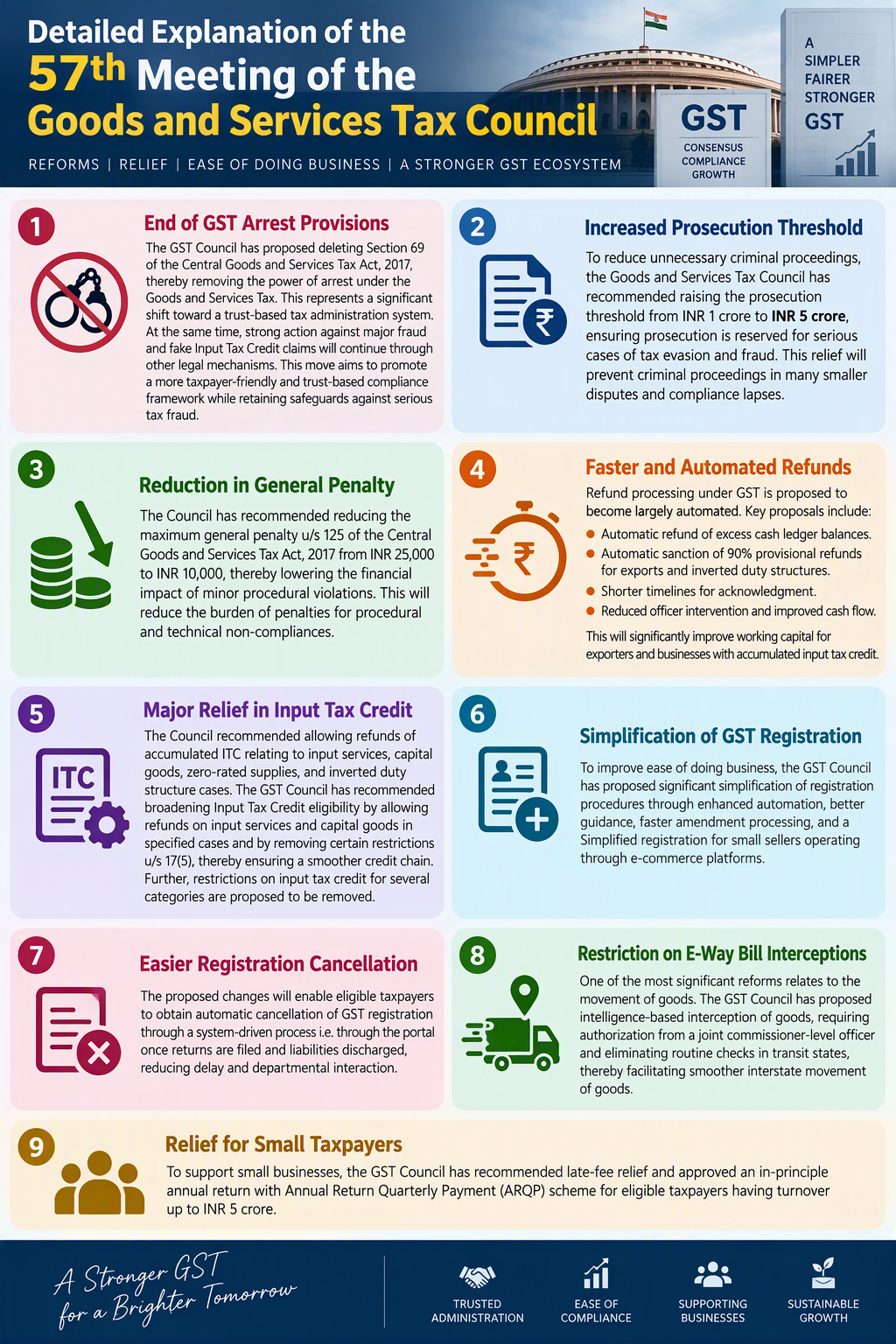
Table of Contents
Key Highlights of the 57th GST Council Meeting Held on 8 October 2026
The 57th GST Council Meeting, chaired by the Union Finance & Corporate Affairs Minister in New Delhi on 8 October 2026, focused primarily on process reforms, digitalisation, ease of compliance, dispute resolution, and trade facilitation. Unlike the 56th GST Council Meeting, which concentrated on rate rationalisation, the 57th Meeting emphasized simplifying GST procedures related to registration, returns, refunds, ITC, litigation, exports, and enforcement.
Importantly, no change in the general GST rate structure has been recommended. These recommendations will become effective only after the issuance of corresponding notifications, circulars, and legislative amendments.
GST Registration Reforms
The GST Council has proposed several measures to simplify GST registration, amendments, and cancellation procedures.
- Simplified Registration Process : A comprehensive circular will prescribe standard documentation and information requirements for GST registration. GST REG-01 will include document-selection drop-downs, FAQs, tooltips, and guided navigation. The GST portal will become more user-friendly, reducing registration-related errors and rejections. This initiative complements the existing automatic registration mechanism under Rule 14A.
- Automatic Amendment of Registration : Most registration amendments will be approved automatically. Only changes relating to the Principal Place of Business (PPoB) may continue to require verification. Taxpayers registered under the automatic registration route may receive automatic approval even for PPoB changes.
- Automated Cancellation of Registration : The proposed reforms introduce phased automation:
- Phase I : GST cancellation applications may be approved automatically if All pending returns are filed and All tax dues are paid.
- Phase II : Further automation by integrating GSTR-10 details directly into GST REG-16.
- Suo Moto Cancellation Reforms : System-based cancellation and revocation mechanisms will be introduced. Certain cancellation triggers under Rule 21 will be removed. Automatic revocation may be permitted after taxpayers rectify defaults.
- Relief for Small E-Commerce Sellers : Small suppliers selling through e-commerce platforms such as Amazon, Flipkart, and Meesho may Use the warehouse of the e-commerce operator as their Principal Place of Business.Obtain automatic GST registration in States where they have no physical presence. This will significantly reduce compliance costs and facilitate interstate expansion.
GST Return Reforms
A major objective of the Council is to eliminate return mismatches that result in notices and litigation.
- Enhanced Reconciliation Framework : The GST portal will introduce mechanisms allowing better alignment among GSTR-1, GSTR-1A, Invoice Furnishing Facility (IFF), GSTR-3B and GSTR-2B
- New Reporting Framework : Two new electronic statements are proposed:
- Electronic Statement of RCM Payments : This statement will track Reverse Charge Tax Paid, Input Tax Credit claimed against RCM
- Electronic Credit Reversal & Reclaim Statement : This statement will record ITC reversals, ITC reclaims and Reasons for adjustments.
- Strengthening the Invoice Management System (IMS) : Recipients will be able to Accept invoices, Reject invoices, Keep invoices pending before they are reflected in GSTR-2B.
- DRC-03 Enhancement : Taxpayers making voluntary payments through DRC-03 will need to disclose the specific invoices related to such payments.
- Effective Date : These reforms are expected to be implemented from the April 2027 GST return cycle.
Refund Reforms
One of the most taxpayer-friendly recommendations is the move towards fully automated refunds.
- Phase 1 : Automatic Cash Ledger Refunds : Excess balance in the Electronic Cash Ledger will be refunded automatically without departmental intervention.
- Faster Processing : Existing timeline: 15 days and Proposed timeline: 10 days. Where no action is taken within 10 days, acknowledgment will be deemed generated automatically.
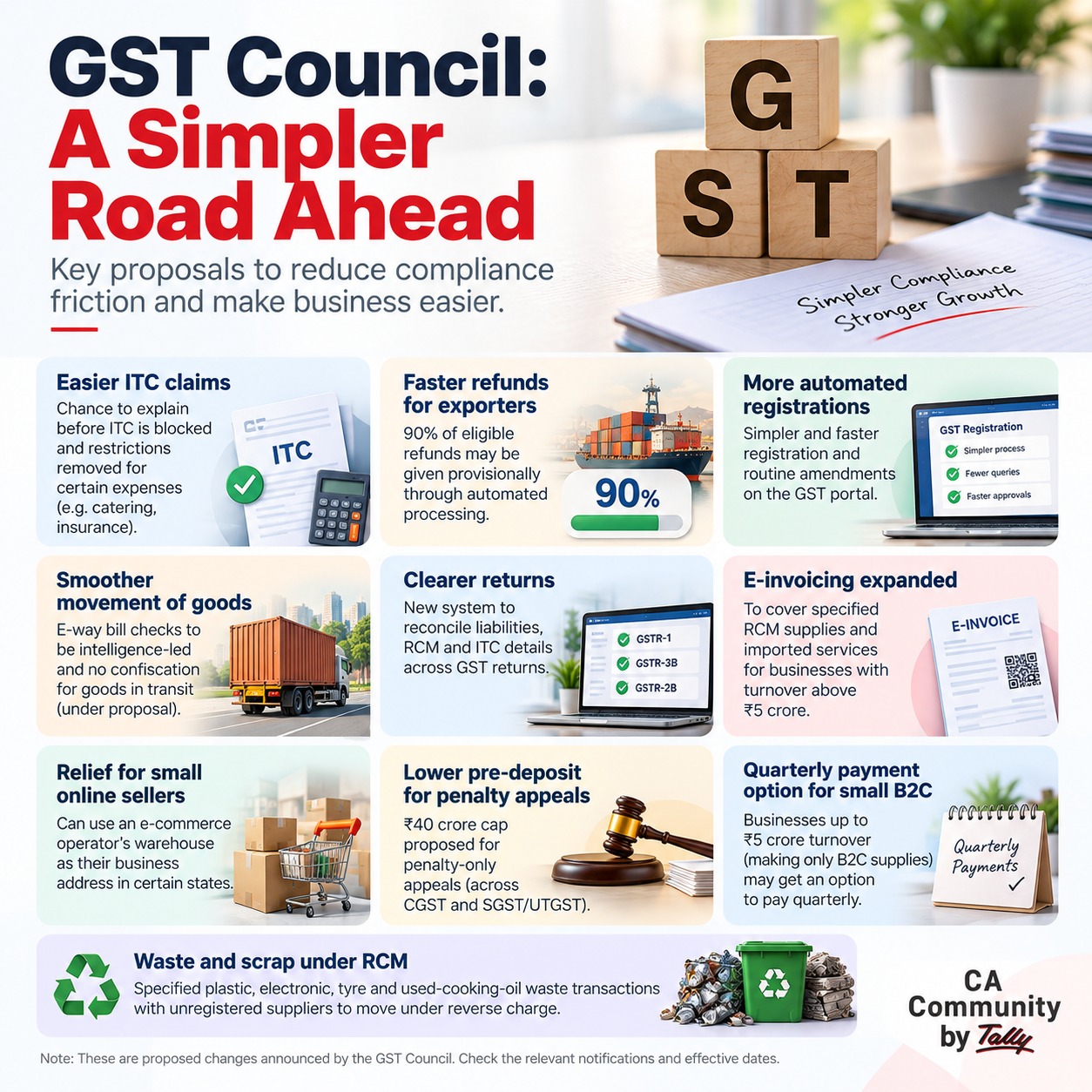
- 90% Automated Refunds : For Zero-rated supplies, Inverted Duty Structure claims and 90% of the eligible refund amount may be sanctioned automatically through a risk-based system.
- Phase 2 : Fully Automated Refund Sanction : After verification Entire refund may be sanctioned automatically., Pending dues, if any, will be adjusted digitally
- Paperless Refund Claims : FORM GST RFD-01 will be redesigned to capture information in a machine-readable format, reducing dependence on scanned documents.
- Removal of Export Turnover Restriction : The current cap of 1.5 times domestic value for calculating export turnover in refund claims is proposed to be removed.
- Clarification on INR 1,000 Refund Threshold : The threshold will apply collectively to CGST, SGST and IGST instead of applying separately.
Dispute Resolution Reforms
The GST Council has proposed several measures to reduce unnecessary litigation.
- Quality Standards for GST Notices : A circular will guide officers regarding Demand notices, Adjudication orders, Appeal orders, Personal hearing requirements and Natural justice principles
- No Notices Below INR 10,000 : No Show Cause Notice may be issued where total tax involved is below INR 10,000. This will significantly reduce small-value litigation.
- Reduced Penalties : For non-fraud cases Penalty may be reduced to 5% of tax. Minimum penalty of INR 10,000 may be removed. And Relief is available where tax and interest are paid within prescribed timelines.
- General Penalty Rationalisation : Maximum penalty under Section 125 proposed to be reduced INR 25,000 → INR 10,000
- Cap on Pre-Deposit : For appeals involving only penalties CGST: INR 20 crore and SGST/UTGST: INR 20 crore Total cap: INR 40 crore
Major Input Tax Credit (ITC) Reforms
- Refund of Input Service ITC : Currently unavailable in inverted duty situations. The Council has recommended refund eligibility for Input Service ITC availed on or after 1 November 2026
- Refund of Capital Goods ITC : For Zero-rated supplies and Inverted duty structure Refund of accumulated ITC on capital goods will be available for ITC availed on or after 1 April 2027 : The refund benefit will be spread over 60 months.
- Expansion of ITC Eligibility : Restrictions under Section 17(5) are proposed to be relaxed for Outdoor Catering, Health Insurance, Life Insurance, Telecom Towers, Pipelines outside factory premises, Free Samples and Expired goods written off under law. This change could eliminate substantial litigation surrounding blocked credits.
- Limited ITC for Specific Services : Limited ITC may be permitted on Restaurant services, Outdoor Catering services, Hotel accommodation up to INR 7,500 per day and Gym and fitness services
Export & Zero-Rating Reforms
- Export Benefits for Overseas Branch Transactions : The current restriction treating overseas branches as distinct persons may be removed. This may allow Services supplied to foreign branches, Shared service centres and Global Capability Centres (GCCs) to qualify as exports and claim refunds.
- Place of Supply Liberalisation : The GST Council proposes removing Section 13(3)(a) of the IGST Act. As a result Place of supply may shift to recipient location. And More transactions could qualify as exports.
- Clarity on Foreign Exchange Receipts : A circular will clarify export eligibility where consideration is received in Foreign Currency and Indian Rupees permitted by RBI
- SEZ & FTWZ Supplies : Goods supplied to overseas buyers but delivered to SEZs or FTWZs may be treated as zero-rated supplies.
Ease of Doing Business Measures
- Removal of GST Arrest Powers : One of the biggest reforms proposed. Section 69 may be omitted completely. GST arrest powers proposed to be withdrawn.
- Higher Threshold for Prosecution : Prosecution threshold proposed to be enhanced INR 1 Crore → INR 5 Crore
- E-Way Bill Reforms : Vehicle interceptions may occur only On specific intelligence inputs. With authorization from a Joint Commissioner. Benefits: Reduced roadside harassment, Better movement of goods.
- No Confiscation During Transit: Goods in transit will not be liable for confiscation under Section 130.
- Late Fee Relief: Taxpayers with turnover up to INR 5 crore may receive waiver of late fees if returns are filed by the end of the month in which they were due.
- ARQP Scheme : The Council approved a concept for Annual Return Quarterly Payment (ARQP) for B2C taxpayers having turnover up to INR 5 crore. This could dramatically reduce compliance requirements for small businesses.
- Hearing Before ITC Blocking : Currently, credit can be blocked under Rule 86A without adequate taxpayer participation.
- Under the proposal Taxpayers may file objections. And Personal hearing may be granted before final blocking of ITC. This strengthens natural justice and reduces arbitrary action.
- E-Invoicing Expansion : For taxpayers with turnover exceeding INR 5 crore: E-invoicing may extend to Reverse Charge transactions, Imported services and Self-invoices issued under RCM
Final Takeaway
The 57th GST Council Meeting marks a transformative shift from enforcement-driven compliance to technology-driven facilitation. Key proposals such as removal of arrest powers, automation of registration and refunds, expansion of ITC eligibility, hearing before ITC blocking, export-related reliefs, and reduced litigation indicate a more taxpayer-centric GST framework. If implemented, these recommendations could represent the most significant compliance and procedural reforms under GST since its introduction in July 2017.
**********************************************************
If this article has helped you in any way, i would appreciate if you could share/like it or leave a comment. Thank you for visiting my blog.
Legal Disclaimer:
The information / articles & any relies to the comments on this blog are provided purely for informational and educational purposes only & are purely based on my understanding / knowledge. They do noy constitute legal advice or legal opinions. The information / articles and any replies to the comments are intended but not promised or guaranteed to be current, complete, or up-to-date and should in no way be taken as a legal advice or an indication of future results. Therefore, i can not take any responsibility for the results or consequences of any attempt to use or adopt any of the information presented on this blog. You are advised not to act or rely on any information / articles contained without first seeking the advice of a practicing professional.