Small Scale Industries : NEW Definition of small companies
Table of Contents
The Ministry of Corporate Affairs reform: NEW Definition of small companies
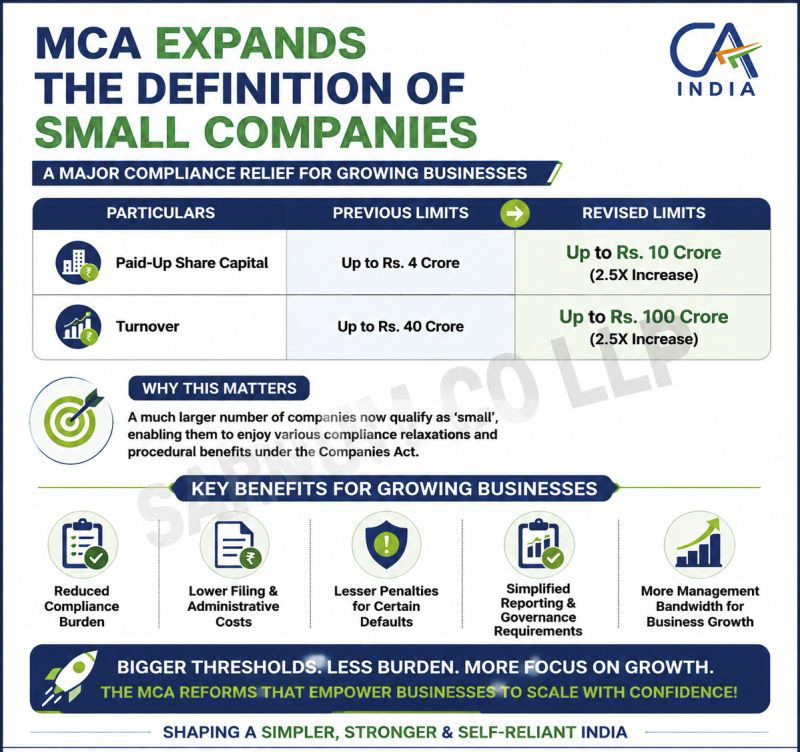
The Ministry of Corporate Affairs reform is aimed at expanding the scope of small companies under the Companies Act, 2013. This change is expected to provide substantial compliance relief to thousands of growing businesses in India.
What has changed in a small company definition?
The MCA has revised the eligibility criteria for classification as a small company by increasing the limits for
| Particulars | Earlier Limit | Revised Limit |
|---|---|---|
| Paid-up Share Capital | Up to INR 4 Crore | Up to INR 10 Crore |
| Turnover | Up to INR 40 Crore | Up to INR 100 Crore |
This represents a 2.5 times increase in both thresholds.
Meaning of small company
A private company can now be classified as a small company if Its paid-up share capital does not exceed INR 10 crore and Its turnover as per the last audited financial statements does not exceed INR 100 crore. As a result, many companies that previously fell outside the Small Company category will now become eligible for various regulatory benefits.
Why Is This Reform Important?
- The objective behind this reform is to promote the government’s vision of ease of doing business. Many growing startups, family-owned businesses, consulting firms, manufacturing companies, and service providers typically cross the earlier threshold of INR 40 crore turnover relatively quickly. Such companies were required to comply with more stringent regulatory requirements despite being operationally small or medium-sized businesses. By increasing the limits, MCA has reduced unnecessary compliance burdens and allowed businesses to focus more on expansion and profitability.
- The Ministry of Corporate Affairs’ decision to increase the small company thresholds from INR 4 crore to INR 10 crore for paid-up capital and from INR 40 crore to INR 100 crore for turnover is a major business-friendly reform. It extends compliance relief to a much larger segment of private companies, lowers regulatory costs, reduces penalties for certain defaults, and improves ease of doing business.
Key Benefits Available to Small Companies
- Simplified Governance Requirements: Small companies are exempt from several governance obligations applicable to larger entities. Examples include relaxed board report requirements. Simplified cash flow disclosures. and an easier secretarial compliance framework. This streamlines internal governance without compromising transparency.
- Reduced Compliance Burden: Small companies enjoy several exemptions under the Companies Act. For example: Lesser board meeting compliance requirements., Simplified annual filing provisions and Reduced procedural formalities. This enables management to devote more time to business operations instead of regulatory paperwork.
- Lower Filing and Administrative Costs: Companies incur substantial costs towards secretarial compliance, ROC filings, professional certifications, and Legal documentation. Small company status helps in reducing these recurring compliance expenses.
- Better Management Bandwidth for Growth: Instead of spending management resources on filing formalities, Procedural approvals, and Extensive governance documentation, businesses can focus on market expansion, product development, customer acquisition, fundraising, and recruitment
- Lesser Penalties for Certain Defaults: Section 446B of the Companies Act provides that small companies are subject to lower monetary penalties in case of specified non-compliances. This is particularly beneficial where defaults are procedural rather than fraudulent in nature. For instance: Delay in filing forms, Minor documentation deficiencies, Technical compliance lapses, may attract reduced penalties compared to larger companies.
Who Cannot Be Treated as a Small Company?
Even after meeting the above financial limits, the following are not considered small companies: public companies, holding companies, and subsidiary companies. Companies registered under Section 8 (Non-profit Companies), Companies governed by any special Act. Therefore, the benefits mainly apply to eligible private limited companies.
Impact on Startups and MSMEs
The amendment is particularly beneficial for
- Startups: Many funded startups quickly exceed the old capital threshold of INR 4 crore. The revised INR 10 crore limit allows them to continue enjoying compliance relaxations for a longer period.
- MSMEs: Growing manufacturing and trading businesses with turnover between INR 40 crore and INR 100 crore now qualify for small company status.
- Professional Firms and Service Companies: Consulting, technology, digital marketing, and outsourcing businesses experiencing high revenue growth can also benefit.
In simple terms: More companies are now eligible to be treated as “Small Companies,” meaning less compliance, lower costs, reduced penalties, and more focus on growth and expansion. This is a welcome step towards building a more business-friendly and self-reliant India
What are small-scale industries?
Small scale industries is a type of industry that engage in services of micro, small scale manufacturing and production, providing services. Small scale industries provide employment and make use of local physical resources too, hence they are necessary for economy. These are the industries that manufacture and provide services using a certain amount of limited investment. These include industries like candles, paper bags, school products, small toys , beauty parlor etc. To avail the services offered by GOI, Small scale industry shall be registered.
Registration process for small-scale industries:
- Apply for provisional registration – In order to provide working capital to small-scale industries, the certificate is given in the pre-operative period. , a provision registration is given without physically inspecting the place of business.
- Start a business: A provisional certificate remains valid for 5 years. It is to be made sure that the operations of firm are being run during this time.
- Application for permanent certificate registration: If after this 5 years, the firm remains operational, the firm can apply for a permanent certificate from ministry of Micro, small and medium enterprise.
ELIGIBILITY CRITERIA FOR SSI
Following are two types small scale Industries
Manufacturing
| Micro | The investment in plant and machinery shall be less than 25 lakh. |
| Small | The investment in plant and machinery can be 25 lakh or above but should not be greater than 5 crore. |
| Medium | The investment in plant and machinery can be Rs.5 crores or above but not exceed Rs.10 crores |
Services
| Micro | The investment in the equipment shall be less than 10lakhs. |
| Small | The investment in the equipment can be more than or equal to 10 lakh but does not exceed 2 crore. |
| Medium | The investment in the equipment can be more than 2 crore but less than 5 crore. |
| Revised MSME Classification | |||
| Conditions/Criteria | Micro | Small | Medium* |
| Investment & Annual Turnover | < Rs.1 Cr & < Rs.5 Cr | < Rs.10 crore & < Rs.50 crore | < Rs.50 crore & < Rs.250 crore |
Merits of registering your SSI
- The raw material is accessed easily.
- The credit is easily accessible
- Loans are offered at low rate of interest
- The incentives are given by state government
- Units of SSI can carry forward MAT for up to 15 years.
- Favor for government license and certificate.
DOCUMENTS REQUIED FOR SSI REGISTRATION
- Partnership deed, AOA and MOA.
- Address proof
- NOC by pollution control committee
- Bill copies of machinery and raw material and other things.
SOME DEMERITS OF SMALL SCALE INDUSTRIES
- Managerial issue
- Shortage of Raw material
- Inadequate finance
- Hassle in import and Export
- Scarce infrastructure
- Shortage of technology upgrade
- Shortfall in market support.
GOALS OF SMALL SCALE INDUSTIRES
- It gives the statistics of the units of SSI working in India.
- Generate various opportunity for employment
- Solves unemployment problems
- Equal distribution of wealth and income
- Improves standard of living of people
- Be self alliant
- Have lower regional imbalance
CHARACTERSTICS OF SMALL SCALE INDUSTRIES
- Short-range: These industries do not function on a significant scale.
- Ownership: these are mainly owned by a sole proprieter or a partnership
- Resources: these industries are mainly located where resources are available without much difficulty, saving the cost of transportation for utilization of resources.
- Flexibility: The dynamic environment doesn’t really affect these small scale Industries.
List of small scale Industries
- Repair services
- Leather products
- Hosiery and garments
- Metal products
- Rubber and plastic products
- Non-metallic mineral products
- Transport equipment and parts
- Repair services
- Miscellaneous manufacturing industries
- Electrical machinery and parts
- Food products
- Paper products and printing
- Cotton textiles
- Basic metal industries
- Jute, hemp, and Mesta Textiles
- Wool, Synthetic Fiber, silk textiles
- Machinery and parts for electrical goods
- Beverages and tobacco products
Various products supplied by Small scale Industries
- Hosiery goods
- Paints and Varnishes
- Preserved vegetables and foods
- Safety matches
- Domestic utensils
- Stationery items – Detergents and Soaps
- Plastic and rubber goods
- Leather and leather goods
- Toothpaste and toothpowder
- Sheet metal goods
- Ready-made garments
**********************************************************
If this article has helped you in any way, i would appreciate if you could share/like it or leave a comment. Thank you for visiting my blog.
Legal Disclaimer:
The information / articles & any relies to the comments on this blog are provided purely for informational and educational purposes only & are purely based on my understanding / knowledge. They do noy constitute legal advice or legal opinions. The information / articles and any replies to the comments are intended but not promised or guaranteed to be current, complete, or up-to-date and should in no way be taken as a legal advice or an indication of future results. Therefore, i can not take any responsibility for the results or consequences of any attempt to use or adopt any of the information presented on this blog. You are advised not to act or rely on any information / articles contained without first seeking the advice of a practicing professional.