Analysis of Carbon Credits & VDA Status in FY 2025-26
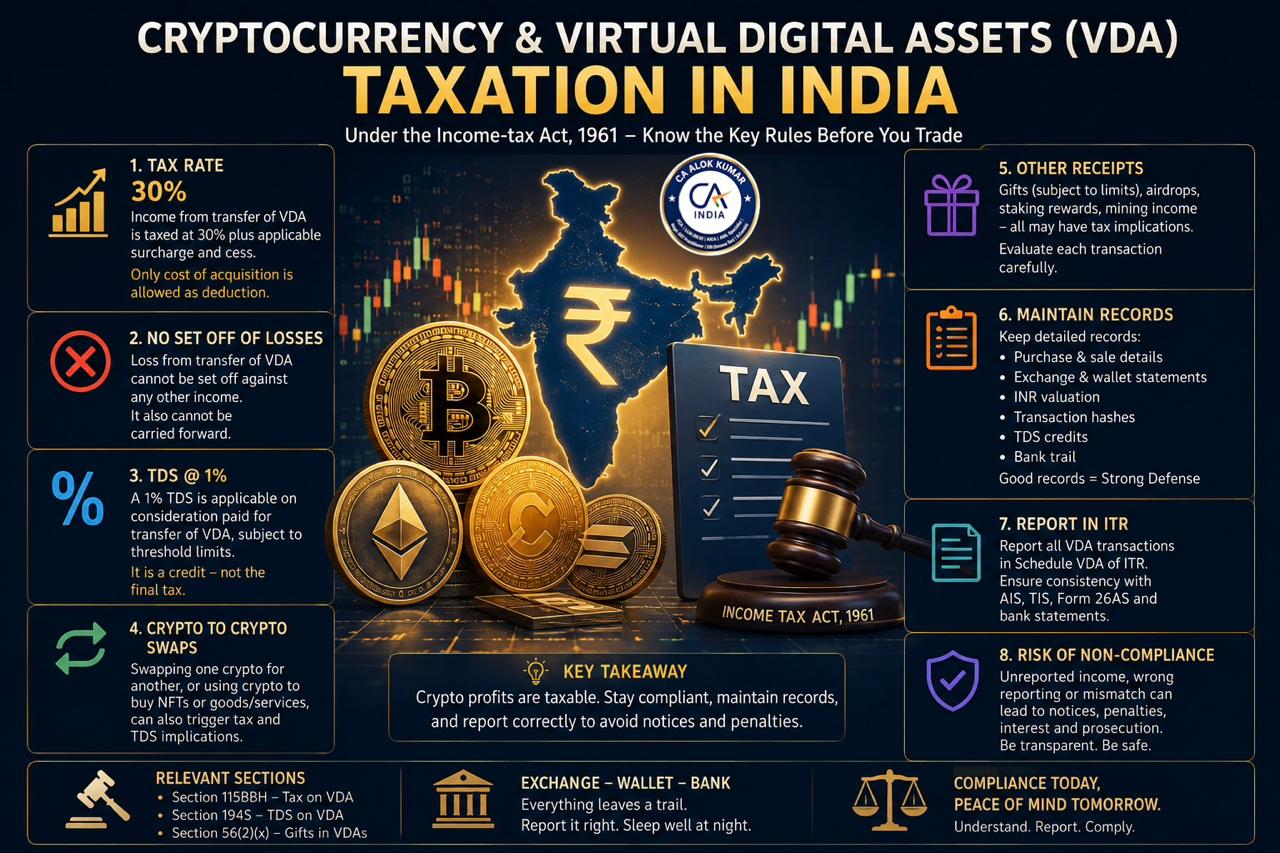
Table of Contents
Detailed Analysis of Carbon Credits & VDA Status in FY 2025-26
Tax audit and compliance framework for virtual digital assets u/s 44AB, with a special focus on cryptocurrency, NFTs, DeFi transactions, and carbon credits.
Legal Framework for VDAs in India
Section 2(47A)—Definition of Virtual Digital Assets: A Virtual Digital Asset generally includes
- Cryptocurrencies (Bitcoin, Ethereum, Solana, etc.)
- NFTs
- Blockchain-based tokens
- Other notified digital assets
- Certain crypto-assets covered through subsequent amendments and notifications
The definition is intentionally broad and covers most blockchain-based digital assets.
Section 115BBH – Taxation of Virtual Digital Assets:
Income from the transfer of virtual digital assets is taxed at 30% flat tax plus applicable surcharge and cess, and only the cost of acquisition is deductible.
-
- No deduction for transaction fees, mining costs, gas fees, or advisory expenses. And other business expenses.
- Losses cannot be Set off against any other income, Set off against another virtual digital asset gain and Carried forward
Section 194S – TDS on Virtual Digital Assets Transfers:
TDS @ 1% of consideration. Applicable on transfer of virtual digital assets: Threshold: INR 50,000 for specified people and INR 10,000 for others
Applies to Exchange trades, P2P trades, OTC transactions and Crypto-to-crypto swaps
Why Section 44AB Audits Have Become Important
The ICAI’s proposed guidance and evolving tax reporting requirements require auditors to verify:
- Virtual Digital Assets Transaction History: Exchange statements, Wallet addresses, Blockchain transaction records and DeFi activity
- TDS Compliance: Verification of Section 194S deduction and Reconciliation with Form 26AS
- Schedule Virtual Digital Assets Reporting: Reconcile ITR disclosures with actual transactions and Verify computation of gains and losses
- Cost of Acquisition: Ensure taxpayers claim only allowable acquisition cost
Documentation Required During Tax Audit:
A virtual digital asset audit file should typically contain the following:
- Identity & Ownership: Wallet addresses, Exchange accounts, KYC records and PAN linkage
- Transaction Records: Binance/CoinDCX/WazirX reports, Wallet exports, Blockchain explorer reports and P2P confirmations
- Valuation Records: FMV at acquisition, FMV at transfer and INR conversion methodology
- Tax Compliance: Form 26AS, AIS, TDS reconciliation and Schedule Virtual Digital Assets reconciliation
Grey area in Indian taxation under Virtual Digital Assets (VDAs)
The statement highlights an important grey area in Indian taxation: whether carbon credits should be treated as Virtual Digital Assets (VDAs) under Section 2(47A) of the Income Tax Act or as traditional goods/intangible assets.
Why the Issue Arises:
The VDA definition under Section 2(47A) is very broad and covers Any information, code, number, or token generated through cryptographic means representing value, NFTs and similar digital tokens. And Other notified digital assets. As a result, when a carbon credit is represented as a token on a blockchain, it may satisfy the characteristics of a VDA even though its underlying purpose is environmental compliance.
Carbon Credits: The Emerging Grey Area
This is currently one of the most complex topics.
- Blockchain-Based Carbon Credits : Examples: Toucan Protocol and KlimaDAO. These may potentially fall within the Virtual Digital Assets framework because they are represented and traded on blockchain networks. Possible consequences 30% tax under Section 115BBH, 1% TDS under Section 194S and Schedule Virtual Digital Assets reporting
- Traditional Carbon Credits: Examples: UNFCCC CERs, Kyoto Protocol credits, and Verra credits did not tokenize. These may continue to be treated under conventional tax principles depending upon facts and circumstances. There is still regulatory uncertainty in several scenarios and practitioners should examine the nature of the underlying instrument before concluding its treatment
Traditional Carbon Credits vs Tokenised Carbon Credits
Traditional Carbon Credits:
Examples Traditional Carbon Credits like UNFCCC Certified Emission Reductions (CERs), Kyoto Protocol credits, Voluntary carbon credits issued by Verra or Gold Standard that remain in conventional registries
Traditional Carbon Credits Characteristics like these exist in centralized registries. Transferred through registry entries, Not represented as blockchain tokens, and generally regarded as environmental commodities or intangible rights. Therefore, many professionals tend to treat such credits under normal taxation principles rather than the special VDA regime.
Blockchain-Based Carbon Credits :
Examples of blockchain-based carbon credits include Toucan Protocol tokens (BCT), KlimaDAO-linked carbon assets and Other tokenized carbon offset projects.
Blockchain-Based Carbon Credits Characteristics like Exist as blockchain tokens., Stored in crypto wallets., Transferred on decentralized networks. And Traded similarly to cryptocurrencies. Because these credits are digital tokens that derive value and are transferred through blockchain systems, they could potentially fall within the VDA framework.
CBDT’s Current Position of Carbon Credits & VDA Status
As of FY 2025-26, there is no CBDT notification specifically excluding carbon credits from the VDA definition. This means Not all carbon credits are automatically VDAs, Not all carbon credits are automatically excluded from VDAs. And Classification depends on the legal and technological structure of the particular instrument. Therefore, practitioners must perform a substance-over-form analysis.
Practical Classification Approach of Carbon Credits & VDA Status
Scenario 1: Tokenized Carbon Credit on Blockchain
Example: A company purchases carbon credits that are converted into blockchain tokens and traded through: Polygon, Ethereum, Toucan Protocol and KlimaDAO
Potential treatment: Likely VDA
- Section 115BBH tax at 30%
- Section 194S TDS implications
- Schedule VDA disclosure in ITR
Scenario 2: Traditional CERs in UNFCCC Registry
Example: A renewable energy company earns CERs through a registered Clean Development Mechanism project.
Characteristics of Traditional CERs in UNFCCC Registry :
- No blockchain token.
- Registry-based transfer.
- Traditional environmental asset.
Traditional CERs in UNFCCC Registry Potential treatment:
- Business income or capital asset treatment.
- Normal tax provisions apply.
- VDA provisions may not apply.
Scenario 3: Voluntary Carbon Market Credits
Examples of voluntary carbon market credits are credits issued by:
- Verra
- Gold Standard
- American Carbon Registry
These may fall into an uncertain category.
Questions to examine:
- Is the credit tokenized?
- Does transfer occur via blockchain?
- Can the credit be held in a crypto wallet?
- Is the asset represented by a token with independent market value?
The answers determine whether the asset resembles a VDA or a conventional carbon instrument.
Tax Consequences if Treated as VDA
If a carbon credit is classified as a VDA, the following implication will arise:
- Income Tax: 30% tax under Section 115BBH, No deduction except cost of acquisition, No set-off of losses. And No carry-forward of losses.
- TDS: 1% TDS under Section 194S on transfer, subject to thresholds.
- Reporting : Schedule VDA disclosure and enhanced audit reporting under Form 3CD.
Tax Auditors and CAs Verify the following transaction and document:
For every carbon-credit transaction:
- The Tax Auditor must obtain a credit issuance certificate, registry details, vintage year, serial numbers, and ownership records.
- Auditor must determine: Is it blockchain-based? Is it tokenized? , Does it trade like a crypto asset? And is there a smart contract involved?
- Tax Auditor must take the document: Tax position adopted, legal rationale, and supporting technical evidence. And Industry guidance relied upon.
A simple rule of thumb is:
-
- Traditional registry-based carbon credits → likely not VDAs.
- Blockchain-tokenized carbon credits → likely VDAs unless specifically clarified otherwise by CBDT.
Since no blanket CBDT exclusion currently exists, every carbon-credit instrument should be examined individually based on its legal nature, transfer mechanism, and technological structure before concluding whether Sections 115BBH and 194S apply. This documentation should form part of the Section 44AB tax audit workpapers to defend the position taken during assessment.
Auditor’s Key Risk Areas:
High-risk issues include:
-
- Missing Wallets: Taxpayers often disclose exchange accounts but omit Self-custody wallets, hardware wallets, and DeFi wallets
- Unreported DeFi Income: Commonly missed Staking rewards, Yield farming income, Airdrops and Liquidity pool rewards
- Crypto-to-Crypto Swaps: Many taxpayers wrongly assume swaps are non-taxable. In reality:
- Swap = Transfer of Virtual Digital Assets
- Tax must be computed at FMV on swap date
- Improper Loss Set-Off: Not allowed under Section 115BBH. Losses cannot reduce Salary, Business income, capital gains, and other virtual digital asset gains
- Suggested Audit Working Papers
For VDA tax audits, maintain:
WP-1 Master transaction register
WP-2 Exchange-to-ITR reconciliation
WP-3 194S TDS reconciliation
WP-4 Carbon credit classification note
WP-5 Wallet balance reconciliation
WP-6 DeFi income computation
WP-7 Form 3CD disclosure support
WP-8 Management representation letter
Practical Takeaway
Crypto, NFTs, DeFi transactions, and blockchain-based carbon credits can no longer be treated as peripheral audit items. A Section 44AB audit now requires complete transaction tracking, wallet-level reconciliations, Schedule Virtual Digital Assets matching, and Section 194S verification. For chartered accountants, the most important controls are comprehensive wallet identification, exchange and blockchain reconciliation, 194S TDS verification, schedule virtual digital asset matching with books and ITR, and proper classification of carbon credits before determining tax treatment. This significantly increases the documentation and audit-evidence requirements for FY 2025-26 onwards.
**********************************************************
If this article has helped you in any way, i would appreciate if you could share/like it or leave a comment. Thank you for visiting my blog.
Legal Disclaimer:
The information / articles & any relies to the comments on this blog are provided purely for informational and educational purposes only & are purely based on my understanding / knowledge. They do noy constitute legal advice or legal opinions. The information / articles and any replies to the comments are intended but not promised or guaranteed to be current, complete, or up-to-date and should in no way be taken as a legal advice or an indication of future results. Therefore, i can not take any responsibility for the results or consequences of any attempt to use or adopt any of the information presented on this blog. You are advised not to act or rely on any information / articles contained without first seeking the advice of a practicing professional.