Skip to content

India Financial Consultancy

  • Home
  • About Us
  • Media
    • Publications
    • Press Releases
    • Newsletters
    • Archives
  • Contact Us
August 21, 2026 / GST advisory

GST Return Mistake can Trigger Scrutiny & Demand Proceeding
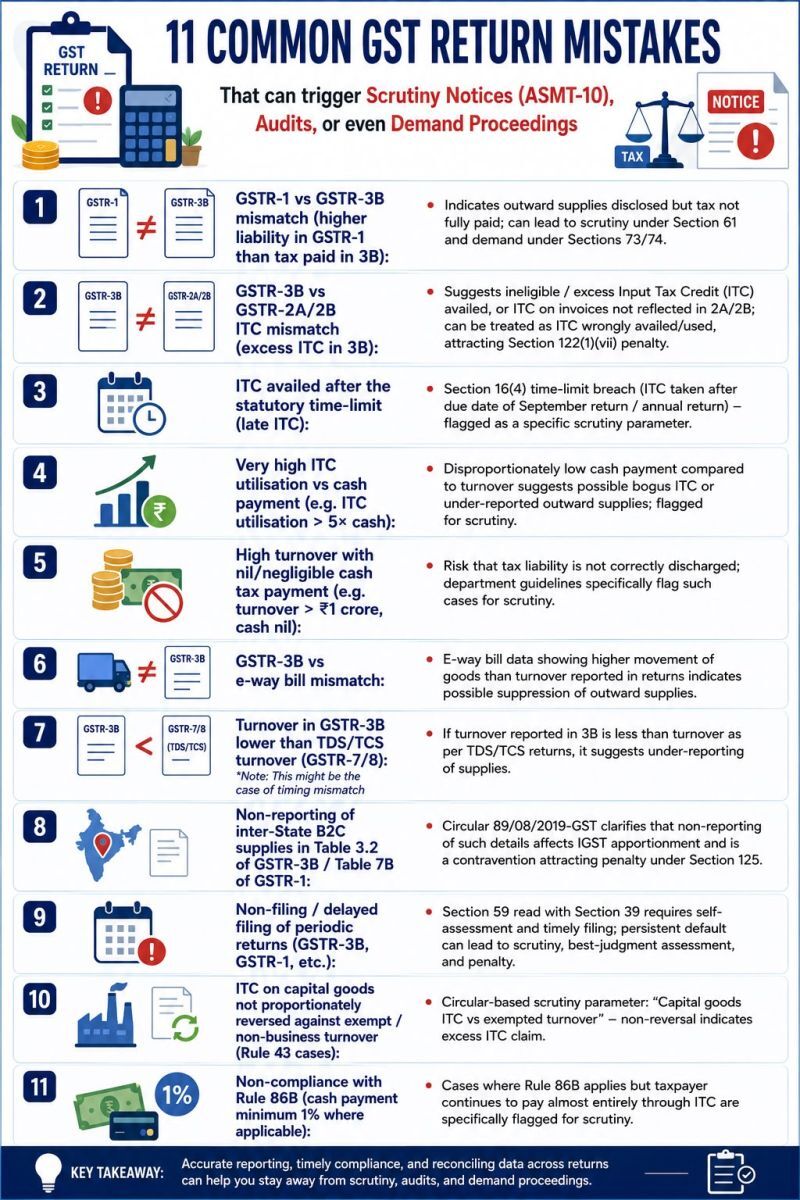
Common GST Return Mistakes That Can Trigger Scrutiny Notices, Audit or Demand Proceedings

Table of Contents

  • Common GST Return Mistakes That Can Trigger Scrutiny Notices, Audit or Demand Proceedings
    • 1. Mismatch Between GSTR-1 and GSTR-3B
    • 2. Excess Input Tax Credit Claimed in GSTR-3B Compared to GSTR-2A/2B
    • 3. Availment of ITC Beyond the Statutory Time Limit
    • 4. Excessive Input Tax Credit Utilisation Compared to Cash Payment
    • 5. High Turnover but Nil or Negligible Cash Tax Payment
    • 6. Mismatch Between GSTR-3B and E-Way Bill Data
    • 7. Turnover Reported in GSTR-3B Lower Than TDS/TCS Returns
    • 8. Non-Reporting of Inter-State B2C Supplies
    • 9. Delayed or Non-Filing of GST Returns
    • 10. Non-Reversal of Input Tax Credit on Capital Goods Used for Exempt Supplies
    • 11. Non-Compliance with Rule 86B
  • Best Practices to Avoid GST Scrutiny

Common GST Return Mistakes That Can Trigger Scrutiny Notices, Audit or Demand Proceedings

Businesses now operate in a highly data-driven GST compliance environment. GST authorities actively use data analytics, AI-based risk assessment, and return cross-verification to identify discrepancies. Consequently, even minor reporting errors can trigger scrutiny notices (ASMT-10), departmental audits, or tax demand proceedings. Share this guide with professionals, accountants, and business owners involved in GST return filing and compliance.

1. Mismatch Between GSTR-1 and GSTR-3B

  • When the outward supplies reported in GSTR-1 are higher than those declared in GSTR-3B, it indicates that tax liability has been disclosed but may not have been fully paid.
  • Risk: Scrutiny under Section 61 and potential demand proceedings under Sections 73 or 74 of the Central Goods and Services Tax Act, 2017

2. Excess Input Tax Credit Claimed in GSTR-3B Compared to GSTR-2A/2B

  • Claiming ITC in excess of the credit reflected in GSTR-2A or GSTR-2B may indicate ineligible input tax credit claims or credits availed on invoices not uploaded by suppliers.
  • Risk: Input tax credit may be treated as wrongly availed or utilized, attracting recovery proceedings and penalties under Goods and Services Tax law.

3. Availment of ITC Beyond the Statutory Time Limit

  • Input tax credit claimed after the time limit prescribed u/s 16(4) of Central Goods and Services Tax Act, 2017 is a common compliance lapse.
  • Risk: Such credits may be disallowed during scrutiny, resulting in tax demand along with applicable interest.

4. Excessive Input Tax Credit Utilisation Compared to Cash Payment

  • Where Input Tax Credit utilization is disproportionately high compared to cash tax payment, especially when ITC utilization is several times higher than cash payment, it may raise concerns.
  • Risk: Authorities may suspect bogus input tax credit claims or under-reporting of outward supplies.

5. High Turnover but Nil or Negligible Cash Tax Payment

  • Businesses reporting substantial turnover while discharging almost the entire tax liability through Input Tax Credit may attract departmental attention.
  • Risk: Such cases are specifically flagged as risk parameters for scrutiny and verification.

6. Mismatch Between GSTR-3B and E-Way Bill Data

  • If the value of goods moved through e-way bills significantly exceeds the turnover reported in Goods and Services Tax returns, it may indicate suppression of taxable supplies.
  • Risk: Detailed departmental examination and possible tax demand proceedings.

7. Turnover Reported in GSTR-3B Lower Than TDS/TCS Returns

  • A mismatch between turnover reported in GSTR-3B and turnover reflected through GSTR-7 (TDS) or GSTR-8 (TCS) may indicate under-reporting of revenue.
  • Note: In some cases, the difference may arise due to timing issues and reconciliation adjustments.
  • Risk: Scrutiny notice seeking explanation and reconciliation.

8. Non-Reporting of Inter-State B2C Supplies

  • Failure to report inter-state B2C transactions in Table 3.2 of GSTR-3B and the corresponding details in GSTR-1 can impact the correct apportionment of IGST between states.
  • Risk: Penalty proceedings u/s 125 of the Central Goods and Services Tax Act, 2017 .

9. Delayed or Non-Filing of GST Returns

  • Regular delays in filing GSTR-1, GSTR-3B, or other prescribed returns are viewed seriously by the Department.
  • Risk: Late fees, interest, scrutiny notices, best-judgment assessment, and penalty proceedings.

10. Non-Reversal of Input Tax Credit on Capital Goods Used for Exempt Supplies

  • Taxpayers are required to reverse eligible portions of input tax credit on capital goods attributable to exempt supplies or non-business activities as per Rule 43.
  • Risk: Excess Input Tax Credit claims may be identified during scrutiny, leading to tax demands and interest.

11. Non-Compliance with Rule 86B

  • Rule 86B requires specified taxpayers to discharge at least 1% of Goods and Services Tax liability in cash, subject to prescribed conditions and exceptions.
  • Risk: Cases where Rule 86B applies but tax continues to be paid almost entirely through Input Tax Credit are frequently selected for scrutiny.

Best Practices to Avoid GST Scrutiny

  • Regularly reconcile GSTR-1, GSTR-3B, GSTR-2B, and books of accounts.
  • Match turnover with e-way bill, tax deducted at source & tax collected at source, and financial records.
  • Verify input tax credit eligibility before claiming credit.
  • Monitor Rule 42, Rule 43 and Rule 86B compliance.
  • Maintain proper documentation and reconciliation statements.
  • File goods and services tax returns accurately and within due dates.
GST authorities now actively use data analytics, AI-driven risk assessment tools, and cross-verification of returns to identify discrepancies. As a result, even minor inconsistencies can trigger scrutiny notices, investigations, or audits. Taxpayers can best protect themselves from GST scrutiny and litigation by conducting regular reconciliations, maintaining accurate records, and ensuring timely compliance with GST provisions.

**********************************************************

If this article has helped you in any way, i would appreciate if you could share/like it or leave a comment. Thank you for visiting my blog.

Legal Disclaimer:
The information / articles & any relies to the comments on this blog are provided purely for informational and educational purposes only & are purely based on my understanding / knowledge. They do noy constitute legal advice or legal opinions. The information / articles and any replies to the comments are intended but not promised or guaranteed to be current, complete, or up-to-date and should in no way be taken as a legal advice or an indication of future results. Therefore, i can not take any responsibility for the results or consequences of any attempt to use or adopt any of the information presented on this blog. You are advised not to act or rely on any information / articles contained without first seeking the advice of a practicing professional.

Post navigation

Previous Post:

CBDT: Verification Drive on Suspicious Foreign Remittances

Leave a Reply Cancel reply

Your email address will not be published. Required fields are marked *

Enquire Now

    About IFCCL

    India Financial Consultancy Corporation Pvt. Ltd. is one of the leading providers of financial and business advisory, internal audit, statutory audit, corporate governance, and tax and regulatory services. With a global approach to service delivery, we are responds to clients' complex business challenges with a broad range of services across industry sectors and national boundaries. The Company has been set up by a group of young, enthusiastic, highly skilled and motivated professionals who have taken experience from top consulting companies and are extensively experienced in their chosen fields has providing a wide array of Accounting, Auditing, Assurance, Risk, Taxation, & Business advisory services to various clients and their stakeholders...
    Read More...

    Contact Info

    P-6/90 Connaught Circus,
    Connaught Place,
    New Delhi - 110001, India

    Landline: 011-43520194
    Email: singh@caindelhiindia.com

    RCS Recent Posts

    • GST Return Mistake can Trigger Scrutiny & Demand Proceeding August 21, 2026
    • CBDT: Verification Drive on Suspicious Foreign Remittances August 21, 2026
    • Foreign Assets of Small Taxpayers Disclosure Scheme, 2026 August 21, 2026
    • Direct Tax Collections FY 2026-27 -Detailed Analysis August 21, 2026
    • Tax Dept verification drive on suspicious foreign remittance August 21, 2026
    • Builder Changes & Buyer Approval Under RERA: Homebuyer Right August 19, 2026
    • Undisclosed Foreign Asset: A One-Time Disclosure Opportunity August 19, 2026
    • ICAI MEF 2026-27: Key Highlights & Summary August 17, 2026

    Archives

    • 2026 (111)
    • 2025 (189)
    • 2024 (154)
    • 2023 (113)
    • 2022 (121)
    • 2021 (92)
    • 2020 (16)
    • 2017 (5)
    • 2016 (181)
    • 2015 (179)
    • 2014 (1)

    Categories

    • Accounting Services (27)
    • Audit (44)
    • Business Consultancy (46)
    • Business Registration Services (15)
    • Business Services (17)
    • Business Set Up in India (30)
    • Business Set Up Outside India (7)
    • Business Strategy (46)
    • CA (7)
    • CBDT (35)
    • Certification (1)
    • CFO Services (12)
    • Chartered Accountant (29)
    • Company Law Compliances (234)
    • Company Registration (6)
    • compliance calendar (12)
    • CORPORATE AND PROFESSIONAL UPDATE (8)
    • Corporate Updates (17)
    • Cryptocurrency (21)
    • DGFT (5)
    • Digital Signature Certificate (1)
    • Direct Tax (109)
      • ITR (35)
    • DTAA (15)
    • FCRA (8)
    • FDI (9)
    • FIU-IND (5)
    • Fixed Asset Register Related Services (4)
    • Foreign Exchange Management Act (56)
    • GST (125)
    • GST advisory (8)
    • GST Compliance (76)
    • GST Registration (16)
    • IBC (40)
    • IEC (4)
    • INCOME TAX (310)
    • income tax return (4)
    • Indirect Tax (214)
    • Insolvency and Bankruptcy Code (4)
    • Intellectual Property Rights (5)
    • Knowledge Management (58)
    • NBFC (5)
    • NGO (17)
    • NRI (29)
    • NRI income tax filing India (1)
    • Others (10)
    • PAN TAN Aadhar (1)
    • Project Finance (28)
    • RBI Consultancy (13)
    • SEBI Compliances (38)
    • SEZ (2)
    • Social Auditor (1)
    • Tax consultant (6)
    • Tax Notice (2)
    • Tax planning (2)
    • Tax Scrutiny & Assessment (3)
    • TDS (42)
    • TDS Return Filing (5)
    • Transfer Pricing (4)
    • Uncategorized (84)
    • Virtual Office Facility (4)
    • XBRL Data Conversion Services (2)

    Follow Us On

    Follow us on Facebook Follow us on Twitter Join us on Linkedin Blogger Google Plus

    © 2026 India Financial Consultancy