Import & Export Compliance Under FEMA: Key Regulatory Change

Table of Contents
Import & Export Compliance Under FEMA: Key Regulatory Changes Every Business Must Know
International trade has become a critical growth driver for Indian businesses. However, with increasing scrutiny from regulatory authorities such as the Enforcement Directorate (ED), Directorate of Revenue Intelligence (DRI), RBI, Customs, and DGFT, businesses engaged in imports and exports must strengthen their compliance frameworks. The presentation on Export & Import Regulations under FEMA provides valuable insights into the evolving regulatory landscape, major changes effective from 1 October 2026, and key compliance requirements for importers and exporters.
- Regulatory Enforcement Has Increased :
- Recent actions by the Enforcement Directorate (ED) and Directorate of Revenue Intelligence (DRI) indicate stricter monitoring of international trade transactions. Cases include:
- Cross-border fund transfers using Virtual Digital Assets (VDAs).
- Missing documentation relating to import and export transactions.
- Customs duty evasion involving luxury furniture imports.
- Export fraud through overvaluation and use of dummy Importer Exporter Code.
- Non-realization of export proceeds and irregular third-party transactions.
- Recent actions by the Enforcement Directorate (ED) and Directorate of Revenue Intelligence (DRI) indicate stricter monitoring of international trade transactions. Cases include:
- Faster Monitoring of Export Proceeds
- RBI has tightened compliance by reducing the timeline for realization of export proceeds, signaling greater emphasis on timely repatriation of foreign exchange earnings.
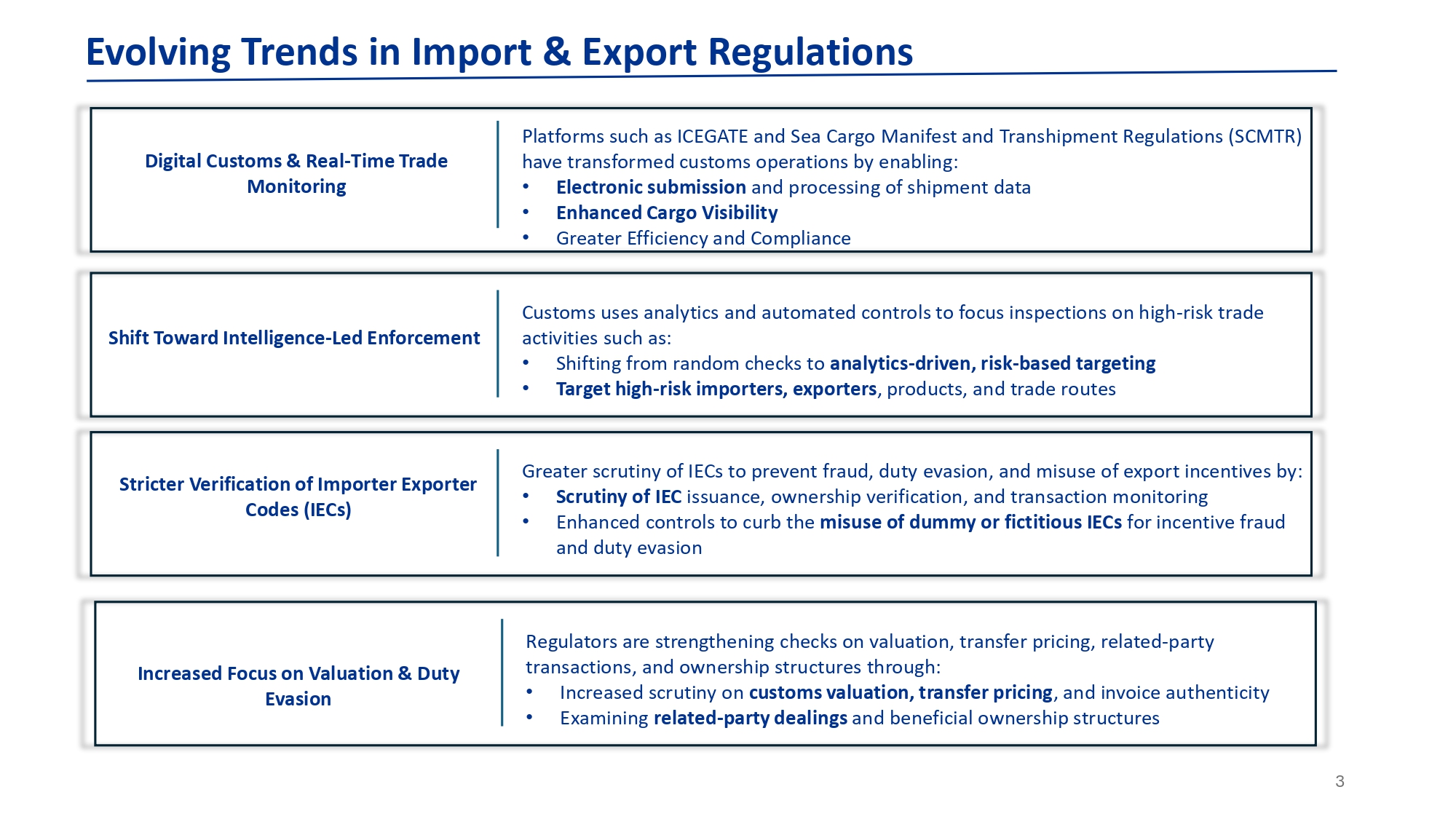
- Digital Customs Ecosystem
- Modern trade compliance is becoming technology-driven through platforms such as ICEGATE and SCMTR, enabling Electronic submission of trade documents, Real-time cargo monitoring and Greater transparency and compliance efficiency.
- Intelligence-Led Enforcement
- Customs authorities are moving away from random inspections and adopting Analytics-driven risk assessment, Automated monitoring systems, Focused scrutiny of high-risk importers, exporters, products, and trade routes.
- Stricter Importer Exporter Code Verification
- Authorities are increasing scrutiny of Importer Exporter Codes to curb Dummy Importer Exporter Code’s, Export incentive fraud, Duty evasion schemes and Fictitious business transactions.
- Greater Focus on Valuation and Related-Party Transactions
- Regulators are paying closer attention to Customs valuation, Transfer pricing arrangements, Invoice authenticity., Related-party transactions and Beneficial ownership structures.
Import payments and reporting must be routed through Authorized Dealer Banks, and businesses must comply with RBI notifications and FEMA requirements. New Foreign Exchange Management (Export and Import of Goods and Services) Regulations, 2026 will apply from 1 October 2026.
Why Import and Export Compliance Is Under the Spotlight
Recent enforcement actions demonstrate the growing focus on foreign trade compliance:
- ED investigations involving cross-border transactions using virtual digital assets.
- Cases involving non-realization of export proceeds.
- Customs duty fraud in luxury goods imports.
- Misdeclaration and overvaluation of exports to claim incentives.
- Enhanced RBI monitoring of export realization timelines.
These developments indicate that businesses can no longer treat FEMA and trade compliance as a routine back-office function.
Digital Transformation of Trade Compliance
Modern trade regulations are increasingly technology-driven. Platforms such as ICEGATE, SCMTR (Sea Cargo Manifest and Transhipment Regulations), IDPMS and EDPMS have transformed customs and Foreign Exchange Management Act compliance through electronic reporting, real-time monitoring, analytics-based scrutiny, and risk-based assessments. Regulators are increasingly using data analytics to identify suspicious transactions, valuation discrepancies, and misuse of Import Export Codes.
Understanding Imports Under FEMA
Imports are governed by Section 5 of Foreign Exchange Management Act. 1999, Current Account Transaction Rules, 2000 and RBI Master Direction on Import of Goods and Services. Import-related foreign exchange payments must be routed through Authorized Dealer (AD) Banks while complying with RBI regulations and reporting requirements.
Under FEMA
- Export means taking goods out of India or providing services from India to a person located outside India. The seller is called an exporter.
- Import means bringing goods or services into India. The buyer is called an importer.
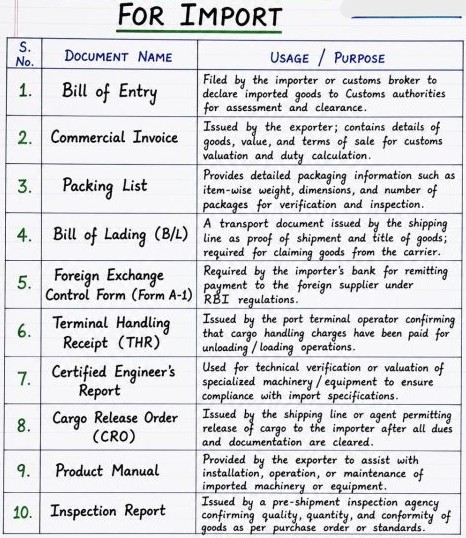
Following are the basic Key Import Documents.
Mandatory Documentation
For Exports
- Bill of Lading/Airway Bill/Lorry Receipt/Railway Receipt
- Commercial Invoice-cum-Packing List
- Shipping Bill/Bill of Export/Postal Bill of Export
For Imports
- Bill of Lading/Airway Bill/Lorry Receipt/Railway Receipt
- Commercial Invoice-cum-Packing List
- Bill of Entry
Every importer should maintain Bill of Entry, Commercial Invoice, Packing List, Bill of Lading, Airway Bill and Railway Receipt or Lorry Receipt (where applicable). Additionally, obtaining an Importer Exporter Code issued by DGFT is mandatory before undertaking import or export activities.
Balance of Trade : The Balance of Trade is calculated as Exports – Imports
- A positive balance indicates higher exports than imports.
- A trade deficit occurs when imports exceed exports.
- Import levels are influenced by a country’s productive capacity, income levels, and self-sufficiency.
Importer Exporter Code (IEC) : IEC is a 10-digit alphanumeric code issued by DGFT, It is mandatory for carrying out import or export activities in India and No person can undertake import-export transactions without obtaining an IEC.
New FEMA Import Regulations Effective from 1 October 2026
The new Foreign Exchange Management (Export and Import of Goods and Services) Regulations, 2026 simplify several import compliance requirements. The new FEMA import regulations effective from 1 October 2026 move from rigid RBI-prescribed limits to a more flexible framework based on commercial contracts and bank-level risk assessment. While the compliance burden is simplified, businesses must maintain strong documentation, proper contracts, and close coordination with their authorized dealer banks to ensure FEMA compliance. The Foreign Exchange Management (Export and Import of Goods and Services) Regulations, 2026 introduce significant changes.
Settlement Period Based on Contract Terms
Under earlier regulations, import payments were subject to specific timelines. Under the new regulations Import settlements can be completed according to the contractual terms agreed between parties. And Authorized Dealer Banks have greater flexibility based on their internal policies.
Import Settlement Timeline
Old Regulation
-
- Goods against advance payment had to be received within 6 months.
- Import payments generally had to be settled within 6 months of shipment.
- Deferred payments were governed by trade credit rules.
New Regulation
-
- Settlement will be governed primarily by the underlying commercial contract.
Extension for Import Payments
Old Regulation
-
- AD Banks could grant extensions up to 6 months at a time.
- Total extension restricted to 3 years.
- RBI approval required beyond 3 years.
New Regulation
-
- Extensions can be granted as per:
- Contractual terms.
- Internal policy of the AD Bank.
- Extensions can be granted as per:
Advance Import Remittances
Previously: USD 200,000 limit for goods and USD 500,000 limit for services. Now Authorized Dealer Banks may approve advance remittances based on genuineness and internal policies.
Old Regulation
-
- Goods: Up to USD 200,000.
- Services: Up to USD 500,000.
- Guarantees required beyond prescribed limits.
New Regulation
-
- Advance remittance is permitted if the AD Bank is satisfied about the genuineness of the transaction.
- Limits may be decided as per the Bank’s internal policy.
Third-Party Payments
Third-party payments continue to be permitted, subject to Bona fide transaction verification, Compliance with bank policies and Appropriate documentation. This flexibility is particularly useful for multinational group structures
Earlier
-
- Required tripartite arrangements and extensive compliance checks.
New Regulation
-
- AD Banks can allow third-party payments based on:
- Internal policy.
- Verification of bona fide nature of transactions.
- AD Banks can allow third-party payments based on:
Set-off of Export Receivables Against Import Payables- Set-Off Arrangements Simplified
Import payables may be set off against export receivables through Authorized Dealer Banks within permitted timelines. This simplifies cash flow management for businesses engaged in both imports and exports.
Earlier Framework
-
- Allowed subject to several conditions such as:
- Same overseas counterparty or group company.
- Outstanding receivables and payables.
- No tax evasion concerns.
- No investigation by authorities.
- Allowed subject to several conditions such as:
New Framework
-
- AD Banks may permit set-off within the prescribed export realization period or extended period.
Non-Physical Imports
The regulations also cover Software imports, Data imported through internet/datacom channels, Drawings and designs received through email or electronic means. A Chartered Accountant’s certificate may be required to confirm receipt of such imports.
Interest on Delayed Import Payments
- Interest on delayed import payments continues to be allowed.
- Importers must ensure that interest remains within the prescribed trade credit all-in-cost ceiling under RBI regulations.
Import Monitoring Through IDPMS
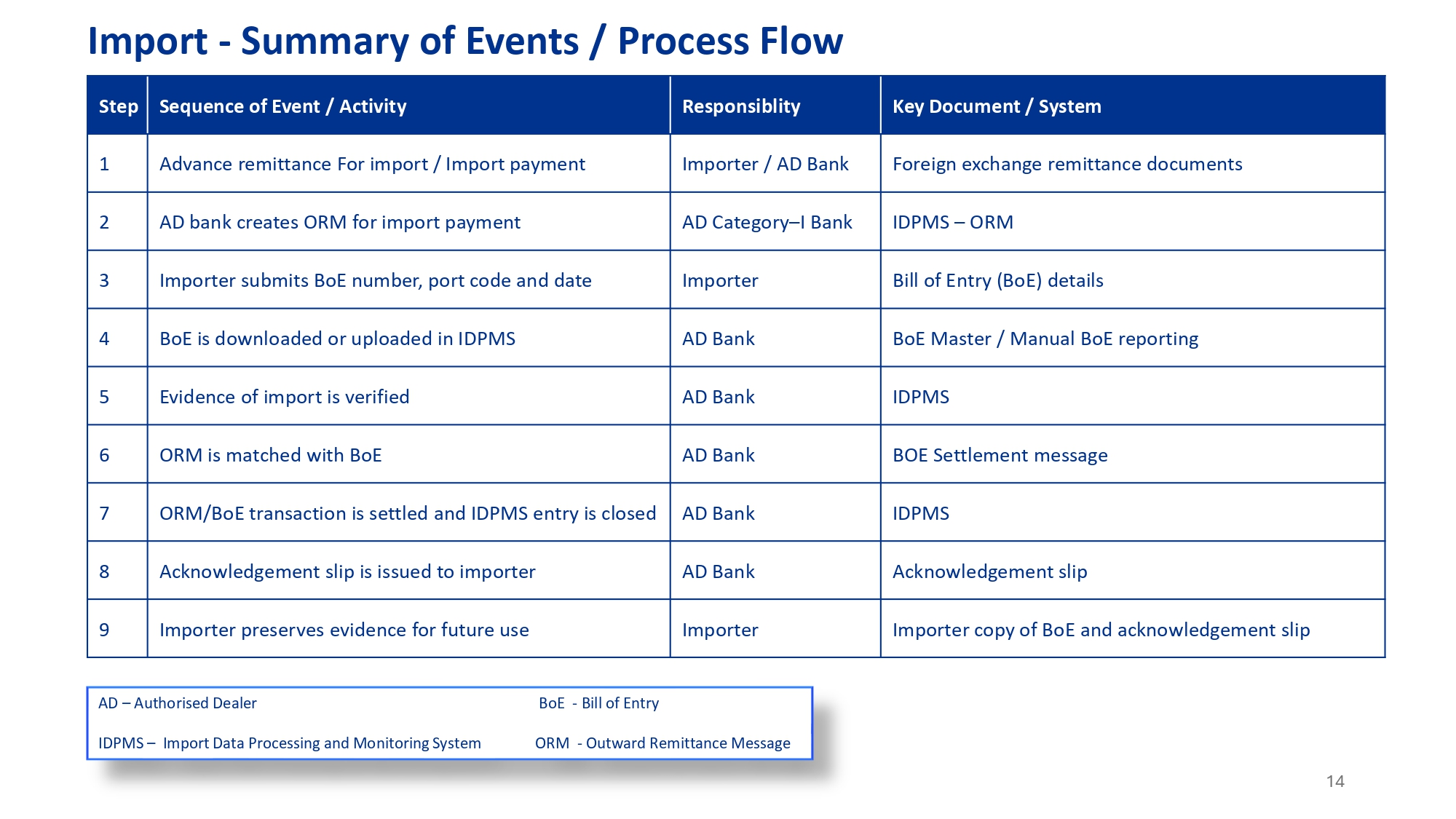
The Import Data Processing and Monitoring System (IDPMS) tracks the lifecycle of import transactions. The process typically involves Import payment, Outward Remittance Message (ORM), Bill of Entry submission, Matching of ORM with Bill of Entry, Compliance verification and Closure of import entries. Businesses should ensure timely submission and reconciliation to avoid regulatory issues.
Export Regulations Under FEMA
Exports are governed by Section 7 of Foreign Exchange Management Act. 1999, Current Account Transaction Rules and RBI Master Direction on Export of Goods and Services. Exporters are responsible for Realization of export proceeds, Submission of declarations, Compliance with reporting requirements and Maintenance of supporting documentation. All export transactions are monitored through the Export Data Processing and Monitoring System (EDPMS).
Key Export Changes Effective from 1 October 2026
The new FEMA export regulations shift from a highly prescriptive RBI approval system to a bank-led compliance model, giving AD Banks greater discretion to approve factoring, project exports, lease exports, SEZ transactions, and overseas warehousing based on their internal policies and risk assessment frameworks. Businesses must therefore maintain strong documentation, genuine commercial arrangements, and close coordination with their AD Banks for smooth export compliance.
- Realisation of Export Proceeds : The new regulations provide 15 months from shipment/invoice for exports of goods and services. 15 months from sale in the case of goods stored in overseas warehouses.
- Third-Party Receipt of Export Proceeds: Authorized dealer banks can permit third-party remittances based on internal policies, transaction genuineness, and Compliance verification. This provides greater operational flexibility for exporters.
- Set-Off of Export Receivables: Export receivables can be set off against import payables through authorized dealer banks within prescribed timelines.
- Merchanting Trade Transactions (MTT) : Merchanting trade refers to transactions where Goods are purchased from one foreign country, Sold to another foreign country and Goods never enter India. Key conditions include Transactions must be routed through the same authorized dealer bank, merchanting activity should generate profit, documentation must establish transaction genuineness, and The transaction should comply with Foreign Exchange Management Act requirements.
- Merchanting trade has become increasingly important for Indian traders operating globally without physically moving goods through India.
- Export Documentation and Compliance : A robust export compliance framework should include Export Declaration Form (EDF), Shipping Bills, Commercial Invoices, Packing Lists, SOFTEX forms for software exports and EDPMS reporting. Failure to comply can result in export realization issues and regulatory actions.
- Other regulation change are as follows
Export Factoring
Old Regulation
-
-
- AD Banks could permit non-recourse export factoring.
- Funding requirements, invoice notations, and due diligence were mandatory.
-
New Regulation
-
-
- AD Banks will frame their own policies and Standard Operating Procedures (SOPs) for export and import factoring.
-
Project Exports
- Project exports include Engineering goods supplied on deferred payment terms, Turnkey projects and Civil construction contracts executed abroad.
- Under the new regulations AD Banks may approve receipts and payments based on the underlying contract and Temporary surplus funds generated abroad may be invested in short-term instruments and bank deposits outside India.
Export of Goods on Lease or Hire
Earlier
-
- RBI approval was required before exporting machinery or equipment on lease/hire basis.
New Framework
-
- AD Banks will formulate policies and procedures for such exports.
Exports by SEZ Units
SEZ units can undertake job work abroad and export from the foreign location, provided:
-
- Manufacturing and processing costs are built into export pricing.
- Arrangements exist for realization of export proceeds.
From October 2026, AD Banks will manage these approvals through internal SOPs.
Overseas Warehouses
Earlier, AD Banks could permit overseas warehouses if:
-
- Export outstanding was below 5% of annual exports.
- Export-turnover exceeded USD 100,000.
- Export proceeds were realized within the prescribed period.
Under the new framework:
-
- AD Banks will establish their own policies and operating procedures for opening or hiring overseas warehouses.
Common Risk Areas for Businesses
Import Risks
- Delayed settlement of import dues
- Improper documentation
- Incorrect valuation
- Third-party payment issues
- Bill of Entry mismatches
Export Risks
- Non-realization of export proceeds
- Incorrect EDF filing
- Undocumented third-party receipts
- Delay in reporting
- Merchanting trade non-compliance
Regulators are increasingly relying on automated monitoring systems, making timely and accurate compliance essential.
Export – Compact Compliance Checklist
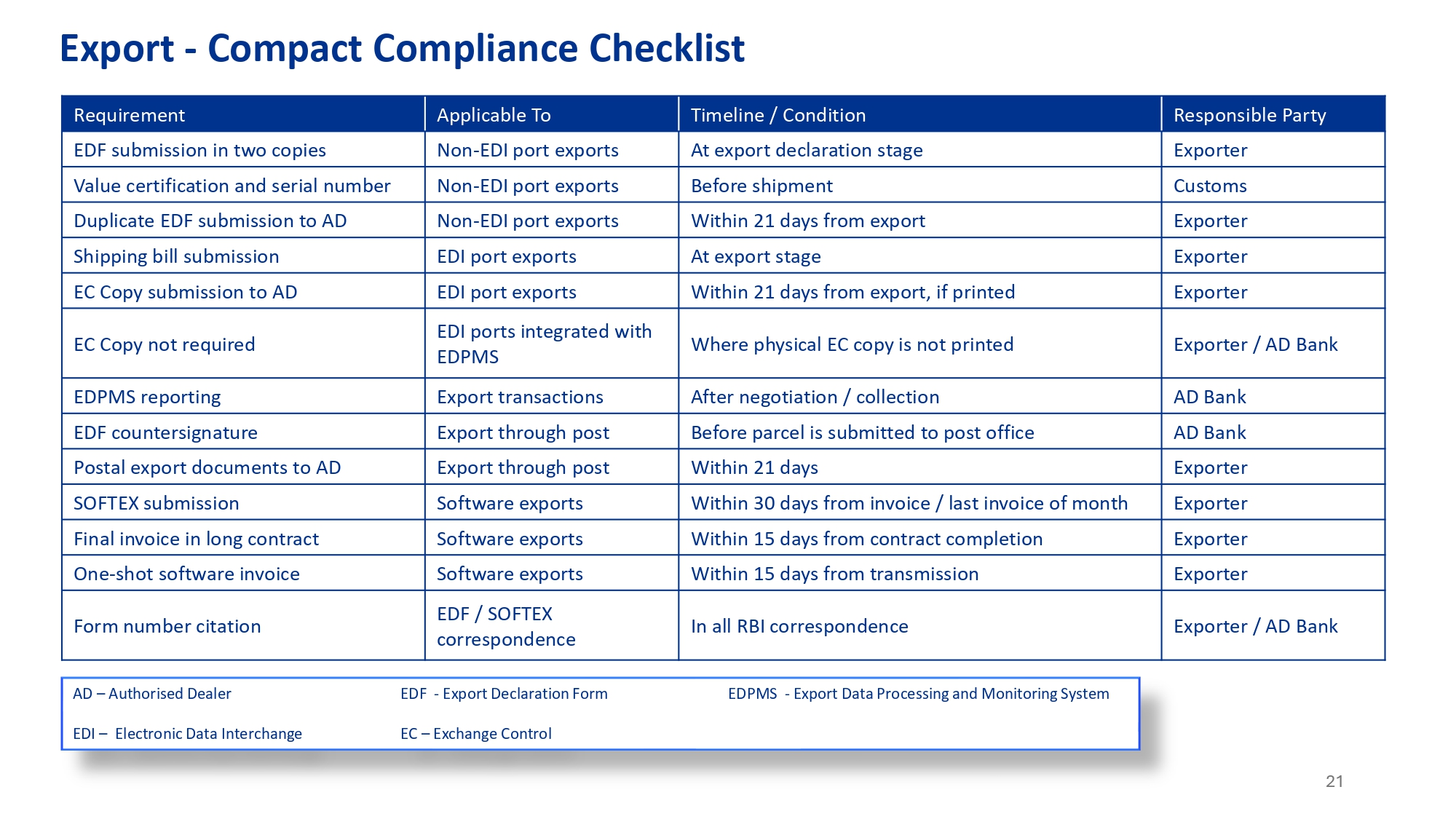
Export – Compact Compliance Checklist” for Indian exporters under FEMA/RBI regulations. It summarizes the key compliance requirements, timelines, and responsible parties for export transactions. The checklist is designed to help exporters avoid reporting lapses and ensure timely realization and monitoring of export proceeds. Following checklist appears in the presentation as a summary of export compliance obligations under FEMA and RBI reporting requirements. Key Compliance Requirements
| Requirement | Applicable To | Timeline / Condition | Responsible Party |
| EDF submission in two copies | Non-EDI port exports | At export declaration stage | Exporter |
| Value certification and serial number | Non-EDI port exports | Before shipment | Customs |
| Duplicate EDF submission to Authorized Dealer | Non-EDI port exports | Within 21 days from export | Exporter |
| Shipping bill submission | EDI port exports | At export stage | Exporter |
| EC Copy submission to AD | EDI port exports | Within 21 days from export, if printed | Exporter |
| EC Copy not required | EDI ports integrated with EDPMS | Where physical EC copy is not printed | Exporter / Authorized Dealer Bank |
| EDPMS reporting | Export transactions | After negotiation/collection | Authorized Dealer Bank |
| EDF countersignature | Export through post | Before parcel is submitted to post office | Authorized Dealer Bank |
| Postal export documents to Authorized Dealer | Export through post | Within 21 days | Exporter |
| SOFTEX submission | Software exports | Within 30 days from invoice or last invoice of the month | Exporter |
| Final invoice in long contract | Software exports | Within 15 days from contract completion | Exporter |
| One-shot software invoice | Software exports | Within 15 days from transmission | Exporter |
| Form number citation | EDF / SOFTEX correspondence | In all RBI correspondence | Exporter / Authorized DealerBank |
Understanding the Key Terms in the Export-Compact Compliance Checklist
- EDF (Export Declaration Form) : Export Declaration Form is a declaration submitted by exporters providing details of goods being exported and the expected realization of export proceeds. It is a fundamental FEMA compliance document.
- EDPMS (Export Data Processing and Monitoring System) : Export Data Processing and Monitoring System is an RBI monitoring system that tracks export transactions, realization of export proceeds, write-offs, and compliance by exporters. AD Banks report export information through this system.
- EDI (Electronic Data Interchange) : Electronic Data Interchange enabled ports electronically exchange export documentation with customs and banking systems, reducing physical documentation requirements.
- SOFTEX : SOFTEX forms are used for software exports and IT services exports to report export value and facilitate monitoring of foreign exchange realization.
Export – A Compact Compliance Checklist Is Important:
Failure to comply with these timelines may result in Delays in closure of export transactions, FEMA compliance issues., Export realization monitoring concerns., Increased scrutiny from RBI and AD Banks and Difficulty in obtaining future export-related approvals or banking facilities.
For Exporters: An exporter should maintain a compliance calendar covering EDF filing deadlines, Shipping bill submission, Export proceeds realization, EDPMS reconciliation, SOFTEX filing (for software exporters) and AD Bank reporting requirements. Proper documentation and timely reporting help ensure smooth FEMA compliance and reduce regulatory risk
Role of Chartered Accountants and Trade Professionals
Professionals can support businesses in Foreign Exchange Management Act compliance reviews, Import-export transaction structuring, IDPMS and EDPMS reconciliations, Export realization tracking, merchanting trade compliance, internal compliance audits, documentation reviews, and Risk assessments.
As regulatory expectations increase, proactive compliance management is becoming a strategic necessity rather than a statutory formality.
Conclusion
India’s import-export regulatory framework is undergoing significant modernization. The new FEMA regulations effective from 1 October 2026 provide greater operational flexibility while simultaneously increasing accountability through digital monitoring and analytics-based enforcement. Businesses involved in international trade must strengthen documentation, reporting, Foreign Exchange Management Act compliance, and internal controls to avoid regulatory scrutiny.
In today’s environment, successful exporters and importers are not just those who grow global revenues. they are those who combine growth with robust compliance and governance practices.
**********************************************************
If this article has helped you in any way, i would appreciate if you could share/like it or leave a comment. Thank you for visiting my blog.
Legal Disclaimer:
The information / articles & any relies to the comments on this blog are provided purely for informational and educational purposes only & are purely based on my understanding / knowledge. They do noy constitute legal advice or legal opinions. The information / articles and any replies to the comments are intended but not promised or guaranteed to be current, complete, or up-to-date and should in no way be taken as a legal advice or an indication of future results. Therefore, i can not take any responsibility for the results or consequences of any attempt to use or adopt any of the information presented on this blog. You are advised not to act or rely on any information / articles contained without first seeking the advice of a practicing professional.