Undisclosed Foreign Asset: A One-Time Disclosure Opportunity
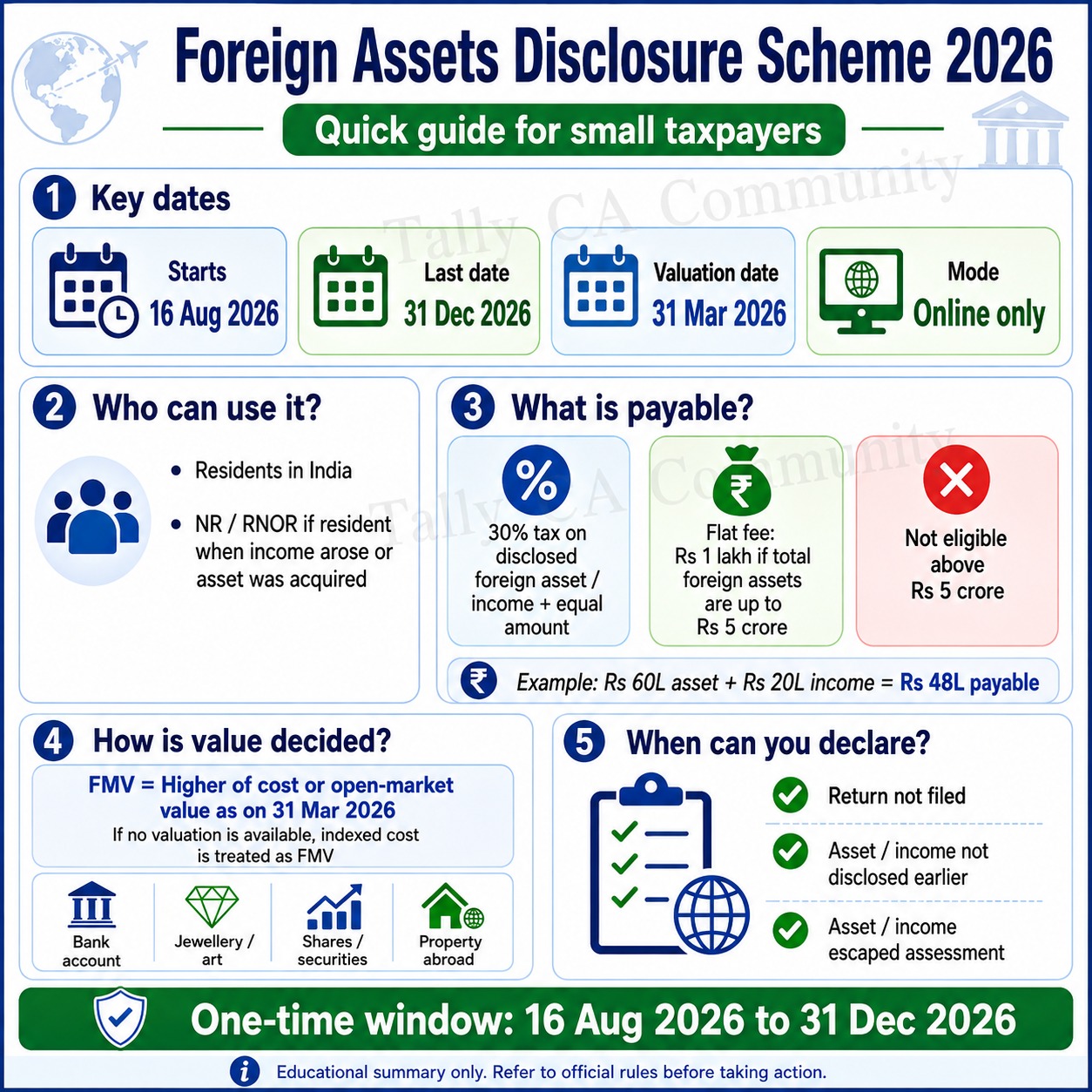
Table of Contents
Undisclosed Foreign Assets? A One-Time Disclosure Opportunity Under the New CBDT Scheme
The Central Board of Direct Taxes has notified the Foreign Assets of Small Taxpayers (Disclosure) Scheme Rules, 2026, effective from 16 August 2026. The scheme provides a limited opportunity for eligible taxpayers to voluntarily disclose certain foreign assets and income that were not reported earlier and regularize their tax position.
With global information exchange mechanisms and enhanced data analytics enabling tax authorities to access overseas financial information more efficiently than ever before, taxpayers holding undisclosed foreign assets should carefully evaluate the benefits of this one-time compliance window.
What is the purpose of the scheme?
The scheme allows eligible taxpayers to voluntarily declare previously undisclosed foreign assets or foreign income and settle their tax obligations by paying the prescribed tax and fees.
It is intended to provide relief to small taxpayers who may have failed to disclose foreign holdings in their income tax returns or whose foreign income and assets have escaped assessment. following are important dates under the disclosure window:
- Opens: 16 August 2026
- Closes: 31 December 2026
Declarations are required to be filed online within the prescribed time. No declaration can be filed after the closure of the scheme.
Who Can Avail the Scheme?
The scheme is available to resident taxpayers in India and certain Non-Residents (NRs) and Resident but Not Ordinarily Residents (RNORs), subject to the prescribed residency conditions. Taxpayers should carefully examine their residential status and eligibility before filing a declaration.
What Amount is Payable?
The scheme provides different treatment depending upon the nature of the foreign asset or income and the manner in which it was acquired.
1. Undisclosed Foreign Assets or Income up to INR 1 Crore
Where foreign assets or income were not disclosed and are eligible under the scheme:
- Tax: 30%
- Additional Amount: 30% of the disclosed value
Effective Levy: 60%—For example, if the disclosed foreign asset/income is valued at ₹50 lakh, the total amount payable under the scheme would be INR 30 lakh.
2. Assets Acquired from Tax-Paid Income but Not Reported in Schedule FA
In cases where:
- The foreign asset was acquired from income already taxed in India, or
- The taxpayer qualified as an NRI when the asset was acquired, but
- The asset was omitted from disclosure in Schedule FA of the income tax return.
A concessional compliance mechanism is available.
Payable Amount: Flat fee of INR 1 lakh
This relief is available where the aggregate value of foreign assets does not exceed INR 5 crore.
3. Assets Exceeding INR 5 Crore
The scheme does not extend this concessional treatment where the aggregate foreign asset value exceeds the prescribed threshold of INR 5 crore.
Valuation of Foreign Assets
For the purpose of disclosure, foreign assets must be valued as of the valuation date: 31 March 2026. The declared value must be determined in accordance with the valuation rules prescribed under the scheme.
How is Fair Market Value Determined?
The method of valuation varies depending upon the nature of the asset, such as:
- Foreign bank accounts
- Shares and securities
- Foreign immovable property
- Jewellery and artwork
- Other overseas investments
In many cases, the higher of the acquisition cost and prescribed Fair Market Value (FMV) is considered for disclosure purposes. Where a prescribed valuation is not readily available, the rules may require an alternative valuation methodology, including indexed cost in specific situations.
When Can a Disclosure Be Made?
A taxpayer may opt for the scheme where
- Foreign income or assets were not disclosed earlier
- Income tax returns were not filed despite disclosure obligations
- Foreign assets were omitted from Schedule FA
- The Foreign income or assets escaped assessment
- Inaccurate or incomplete reporting was made in earlier years
Why This Opportunity Matters
The tax authorities are increasingly relying on:
- International exchange of financial information
- Foreign bank account reporting frameworks
- Data analytics and risk assessment tools
- Cross-verification of tax returns and overseas asset disclosures
As a result, undisclosed foreign assets are becoming significantly easier for authorities to identify.
Key Takeaway—Undisclosed Foreign Assets? A One-Time Disclosure Opportunity
The Foreign Assets of Small Taxpayers (Disclosure) Scheme, 2026, offers a valuable one-time opportunity for eligible taxpayers to regularize undisclosed foreign assets and income before potential detection by the tax authorities. Given the short disclosure window ending on 31 December 2026, taxpayers with overseas investments, bank accounts, securities, or immovable properties that may not have been properly reported should review their compliance position at the earliest and seek professional advice before making a declaration.
Voluntary disclosure today may prove far less costly than enforcement action tomorrow.
**********************************************************
If this article has helped you in any way, i would appreciate if you could share/like it or leave a comment. Thank you for visiting my blog.
Legal Disclaimer:
The information / articles & any relies to the comments on this blog are provided purely for informational and educational purposes only & are purely based on my understanding / knowledge. They do noy constitute legal advice or legal opinions. The information / articles and any replies to the comments are intended but not promised or guaranteed to be current, complete, or up-to-date and should in no way be taken as a legal advice or an indication of future results. Therefore, i can not take any responsibility for the results or consequences of any attempt to use or adopt any of the information presented on this blog. You are advised not to act or rely on any information / articles contained without first seeking the advice of a practicing professional.