ICAI vs. ICMAI: Who will do the statutory audit eligibility?
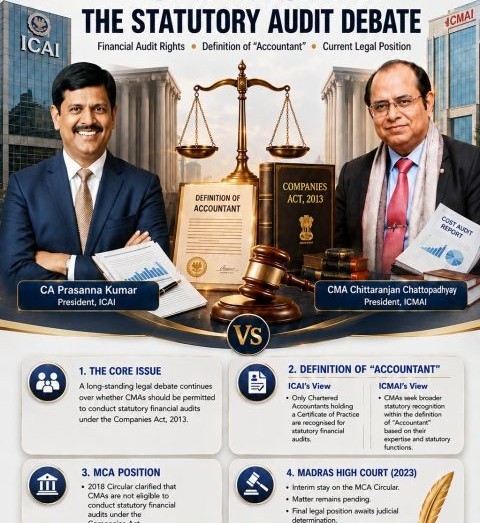
Table of Contents
ICAI vs. ICMAI: Who will do the statutory audit eligibility?
The Ongoing Debate on Statutory Audit Eligibility: ICAI vs ICMAI:
- Professionals, regulators, and industry stakeholders continue to debate who should be eligible to conduct statutory financial audits in India, making it one of the most discussed issues in the accounting profession.
- The debate focuses on how lawmakers and regulators interpret the term “accountant,” apply the provisions of the Companies Act, 2013, and recognize different accounting professionals in India.
ICAI vs. ICMAI: Who will do the statutory audit eligibility?
Core Arguments at a Glance – Key Perspectives in the Debate – ICAI vs ICMAI:
-
ICAI’s Position:
The Institute of Chartered Accountants of India maintains that only Chartered Accountants holding a valid Certificate of Practice are eligible to be appointed as statutory auditors under the Companies Act 2013. The following are ICAI’s key arguments (chartered accountants):
-
- Exclusive Statutory Authority: The Institute of Chartered Accountants of India maintains that the Companies Act, 2013, and the Chartered Accountants Act, 1949, grant the authority to conduct statutory financial audits and issue audit certifications exclusively to Chartered Accountants holding a valid Certificate of Practice.
- Specialized Audit Training: According to the Institute of Chartered Accountants of India, Chartered Accountants undergo extensive articleship training and specialized education in financial reporting, auditing standards, assurance services, corporate law, and regulatory compliance, making them uniquely qualified for statutory audits.
- Regulatory Recognition: The Institute of Chartered Accountants of India emphasizes that regulatory bodies such as the Ministry of Corporate Affairs (MCA) and the National Financial Reporting Authority have historically recognized chartered accountants as the professionals authorized to undertake statutory financial and tax audits.
-
ICMAI’s Position:
The Institute of Cost Accountants of India contends that cost and management accountants possess specialized expertise in accounting, auditing, costing, financial management, and reporting.
Accordingly, it has sought broader statutory recognition for cost and management accountants within the framework of financial and audit-related functions. Following are ICMAI’s Key Arguments (Cost & Management Accountants):
-
- Comparable Professional Expertise: The Institute of Cost Accountants of India argues that Cost and management accountants possess substantial knowledge and training in accounting, auditing, taxation, financial analysis, and reporting, enabling them to competently perform financial certification functions.
- Support from Judicial Developments: Institute of Cost Accountants of India relies on certain legal developments, including the interim stay granted by the Madras High Court on the MCA’s 2018 circular, to support its demand for broader recognition of CMAs in financial audit and certification assignments.
- Need for Wider Professional Recognition: The Institute of Cost Accountants of India advocates expanding the statutory definition of “accountant” under tax and corporate laws to utilize a larger pool of qualified professionals and improve access to compliance and assurance services.
-
MCA’s Clarification:
The Ministry of Corporate Affairs, through a circular issued in 2018, clarified that Cost and management accountants are not eligible to undertake statutory financial audits under the Companies Act.
-
Judicial Developments:
In 2023, the Madras High Court granted an interim stay on the Ministry of Corporate Affairs (MCA) circular. The Court is still hearing the matter, and the final legal position will depend on the judgment it ultimately delivers.
Why does statutory audit eligibility matter?
- The debate extends beyond professional boundaries and raises important questions relating to regulatory recognition, professional competencies, statutory interpretation, and the future structure of audit and assurance services in India.
- Irrespective of differing viewpoints, discussions on such matters should be guided by legal provisions, judicial precedents, and professional respect.
- Constructive dialogue among stakeholders ultimately strengthens the profession and promotes greater public confidence in financial reporting and corporate governance.
The Core Issue in statutory audit eligibility
- The debate centers on whether Chartered Accountants should continue to hold exclusive rights to conduct statutory financial audits or whether Cost and Management Accountants should also receive statutory recognition for certain audit and certification functions.
- ICAI supports its position by relying on the existing legislative framework and established regulatory practices, while ICMAI advocates broader recognition based on the professional competence of CMAs and the evolving compliance landscape.
- Lawmakers and courts will ultimately determine the final legal position through future legislative amendments and judicial pronouncements.
The IFCCL Perspective
- This debate extends beyond audit rights and raises important questions about statutory interpretation, professional recognition, regulatory policy, and the future of India’s accounting profession.
- At IFCCL, we simplify complex legal, tax, and regulatory developments into practical, easy-to-understand insights that help professionals, businesses, students, and aspiring practitioners make informed decisions in a constantly evolving regulatory environment.
- Regardless of differing viewpoints, professionals must engage in informed discussions based on law, facts, and mutual respect to strengthen the profession and promote the public interest.
**********************************************************
If this article has helped you in any way, i would appreciate if you could share/like it or leave a comment. Thank you for visiting my blog.
Legal Disclaimer:
The information / articles & any relies to the comments on this blog are provided purely for informational and educational purposes only & are purely based on my understanding / knowledge. They do noy constitute legal advice or legal opinions. The information / articles and any replies to the comments are intended but not promised or guaranteed to be current, complete, or up-to-date and should in no way be taken as a legal advice or an indication of future results. Therefore, i can not take any responsibility for the results or consequences of any attempt to use or adopt any of the information presented on this blog. You are advised not to act or rely on any information / articles contained without first seeking the advice of a practicing professional.