GSTN Puts E-Way Bill Enhancements on Hold
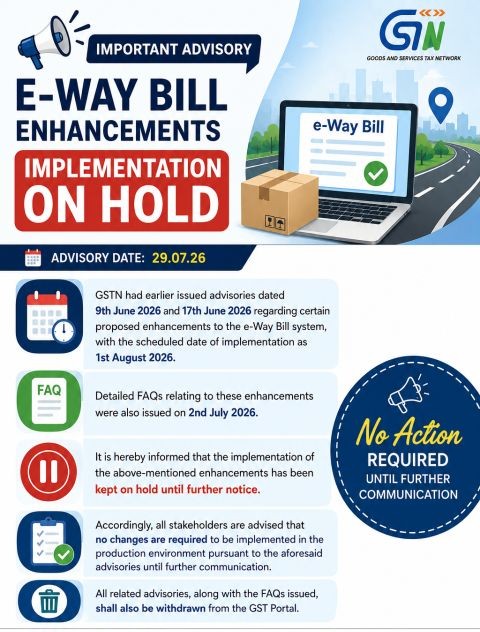
Table of Contents
GSTN Puts E-Way Bill Enhancements on Hold: What This Advisory Means
In the blog, we are going to highlight an important update issued by the Goods and Services Tax Network on 29 July 2026. The proposed e-Way Bill Enhancements, which were scheduled to be implemented from 1 August 2026, have been placed on hold until further notice.
The visual explains the timeline and impact of the GSTN decision:

No Immediate Compliance Action Required
- Withdrawal of Earlier Advisories and FAQs: Goods and Services Tax Network had issued advisories on 9 June 2026 and 17 June 2026 proposing enhancements to the e-Way Bill system. A significant aspect of the latest advisory is the withdrawal of Advisory dated 9 June 2026; Advisory dated 17 June 2026; and Detailed FAQs issued on 2 July 2026. Goods and Services Tax Network has also clarified that these documents will be removed from the GST Portal to avoid confusion regarding their applicability. These changes were scheduled to become effective from 1 August 2026.
- Implementation Deferred : Goods and Services Tax Network has now announced that the implementation of these enhancements is kept on hold until further notice. The proposed changes will not be implemented from 1 August 2026.
- No Action Required : Goods and Services Tax Network specifically states that stakeholders are not required to make any changes in their production environment based on the earlier advisories. And Businesses can continue generating e-Way Bills under the existing framework.
- Advisories and FAQs Withdrawn : Goods and Services Tax Network has also clarified that all related advisories and FAQs pertaining to these proposed enhancements will be withdrawn from the GST Portal.
- Goods and Services Tax Network has expressly stated that taxpayers, transporters, ERP vendors, GSPs, ASPs, and other stakeholders are not required to implement any of the proposed changes that were scheduled for rollout from 1 August 2026. Businesses can therefore continue using the existing e-Way Bill framework without making any modifications to their software systems, APIs, master data, or compliance processes.
Which proposed changes are affected?
The deferred enhancements primarily included:
- Mandatory Ship-To GSTIN: GSTN proposed making the Ship-To GSTIN a mandatory field in certain Bill-to/Ship-to transactions where e-way bill generation was required.
- New Validation Checks: Additional validations were proposed, such as valid Ship-To GSTIN verification, State code and PIN code validation, and restriction on using the same GSTIN as both Bill-To and Ship-To in specified cases.
- Voluntary e-Way Bill Closure: A new feature was proposed to allow suppliers, recipients, transporters, and authorized persons to voluntarily close an e-Way Bill once delivery was completed.
All these proposals are now on hold.
Relief for Businesses and Software Providers
The decision provides immediate relief to businesses and technology partners that were preparing for changes such as
- Mandatory capture of Ship-To GSTIN
- New validation checks for Bill-To and Ship-To transactions;
- Changes in e-Way Bill generation through IRN; and
- Voluntary e-way bill closure functionality.
ERP providers, accounting software vendors, transporters, and GST compliance solution providers can pause implementation and testing activities until GSTN releases a revised roadmap.
Practical impact on taxpayers
For the time being:
- No mandatory Ship-To GSTIN requirement.
- Existing e-way bill processes will continue unchanged.
- No new validation rules for Bill-To/Ship-To transactions.
- There is no need to implement voluntary e-Way Bill closure functionality.
- No ERP or API changes are required solely because of the withdrawn advisories.
What Should Taxpayers Do Now?
For the time being:
- Continue following the existing e-Way Bill procedures.
- Do not implement the withdrawn enhancements in production systems.
- Monitor future GSTN advisories for any revised implementation schedule.
- Use the additional time to review master data and system readiness for any future rollout.
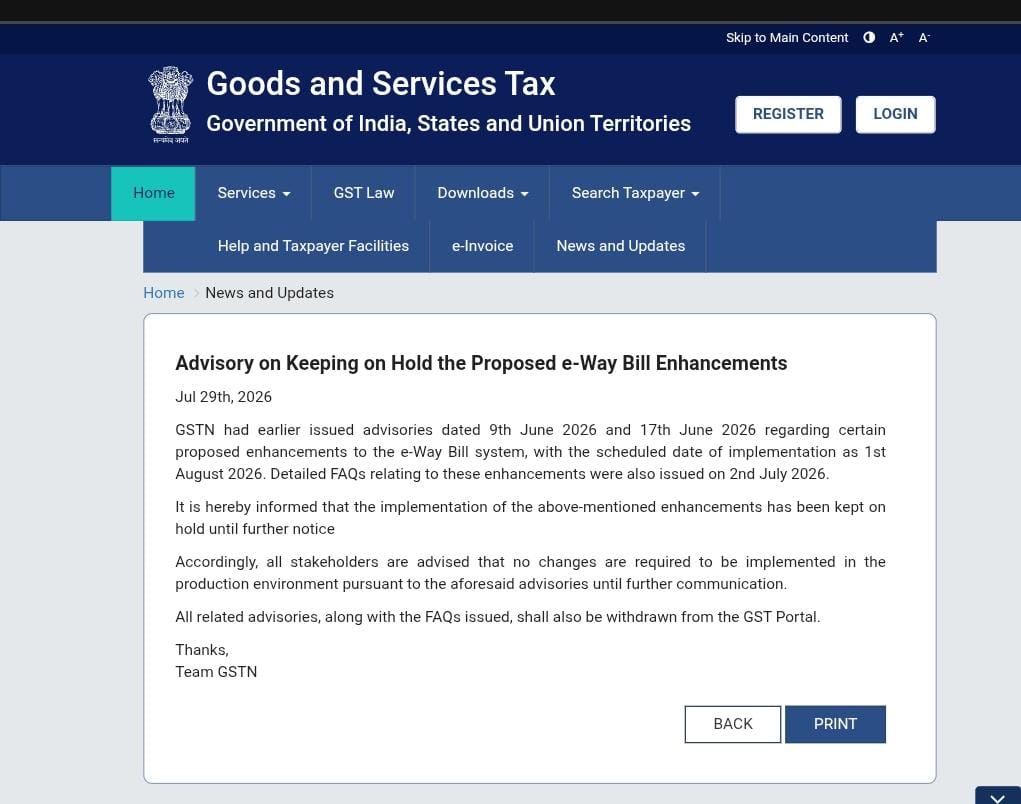
Key Takeaway of GST Advisory
- The real takeaway from the 29 July 2026 advisory is that the entire package of proposed e-Way Bill enhancements has been placed in abeyance, and all related guidance issued so far has been withdrawn.
- Until the Goods and Services Tax Network issues a fresh notification, taxpayers can continue operating under the current e-Way Bill system without any additional compliance requirements.
“Implementation On Hold = No Immediate Compliance Changes.”
- While Goods and Services Tax Network may reintroduce these enhancements in the future after further stakeholder consultations, businesses currently have no additional compliance obligations arising from the June and July 2026 advisories. Until a fresh notification is issued, taxpayers can continue operating under the existing e-Way Bill framework.
- Always remember: Goods and Services Tax Network has not cancelled the proposals; it has only postponed them. Therefore, taxpayers should continue monitoring future Goods and Services Tax Network advisories for any revised implementation date.
**********************************************************
If this article has helped you in any way, i would appreciate if you could share/like it or leave a comment. Thank you for visiting my blog.
Legal Disclaimer:
The information / articles & any relies to the comments on this blog are provided purely for informational and educational purposes only & are purely based on my understanding / knowledge. They do noy constitute legal advice or legal opinions. The information / articles and any replies to the comments are intended but not promised or guaranteed to be current, complete, or up-to-date and should in no way be taken as a legal advice or an indication of future results. Therefore, i can not take any responsibility for the results or consequences of any attempt to use or adopt any of the information presented on this blog. You are advised not to act or rely on any information / articles contained without first seeking the advice of a practicing professional.