Do You Need to File ESIC Returns When There Are No Employees?
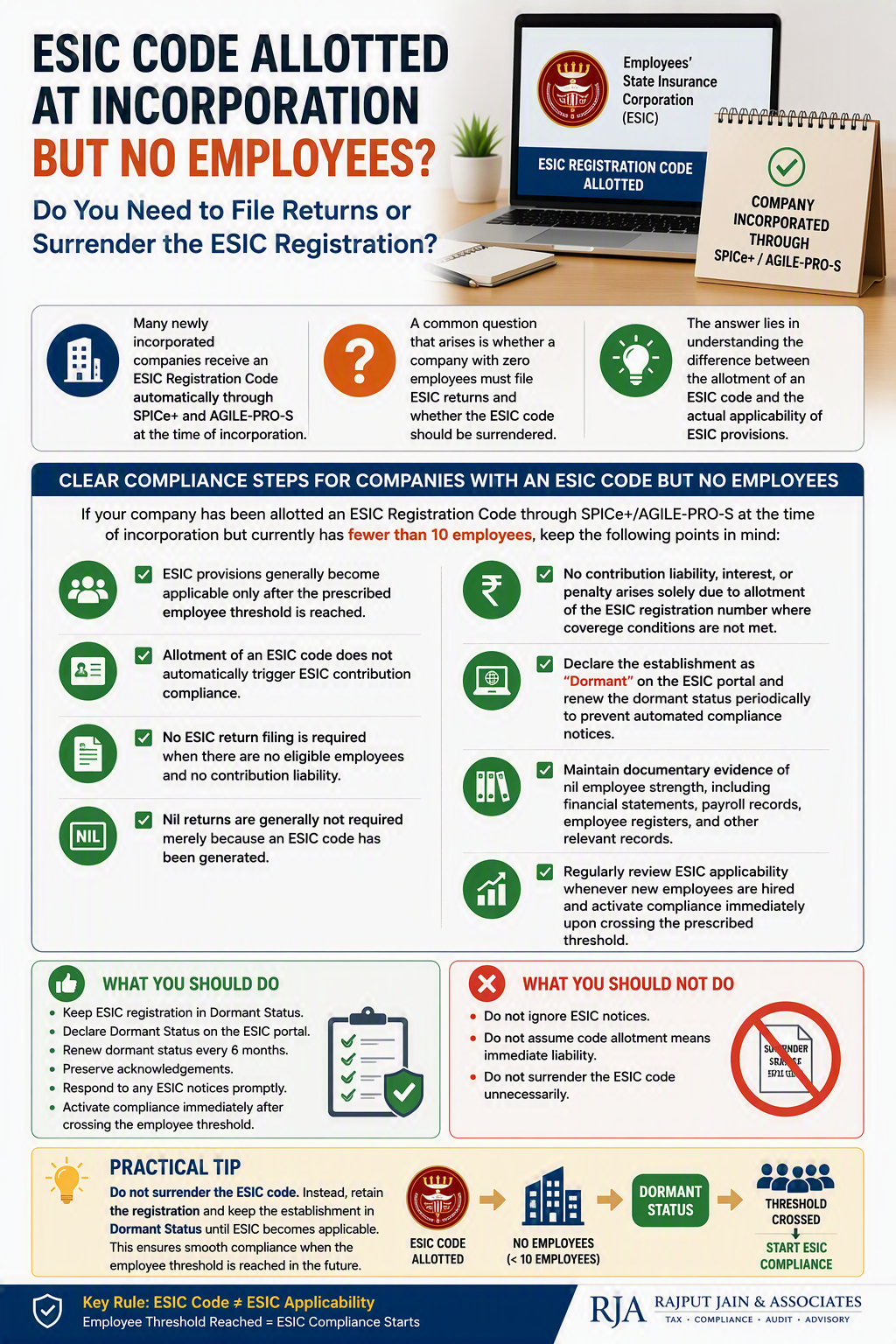
Table of Contents
ESIC Code Allotted at Incorporation but No Employees? Do You Need to File Returns or Surrender the ESIC Registration?
- Many newly incorporated companies receive an ESIC Registration Code automatically through SPICe+ and AGILE-PRO-S at the time of incorporation.
- A common question that arises is whether a company with zero employees must file ESIC returns and whether the ESIC code should be surrendered.
- The answer lies in understanding the difference between the allotment of an ESIC code and the actual applicability of ESIC provisions.
ESIC Code Allotment Does Not Mean ESIC Coverage
- The ESIC code generated through the MCA incorporation process is merely an administrative registration and does not automatically imply that the establishment is covered under ESIC laws. Coverage depends on the statutory employee threshold prescribed under the social security framework.
- A company with no employees has no insured persons, no wage payments, no ESIC contributions payable and No contribution records to report. Therefore, mere allotment of an ESIC code does not create an immediate compliance obligation where the company has not employed any person.
Current Legal Position
- With effect from 21 November 2025, the Employees’ State Insurance Act, 1948 has been repealed and replaced under the Code on Social Security, 2020. However, existing ESIC procedures, regulations, and portal mechanisms continue during the transition period up to 20 November 2026.
- Importantly, the employee threshold for ESIC coverage remains unchanged. Accordingly, companies that have not reached the prescribed employee limit continue to remain outside the contribution framework.
Why ESIC Notices Are Issued to Companies with No Employees
Once an ESIC code is generated, the system treats the establishment as an active employer unless informed otherwise. As a result, automated notices, compliance reminders, and inspection triggers may be generated even where employee strength is nil. These notices are often system-driven and do not necessarily indicate actual liability. However, they should not be ignored.
ESIC Dormant Status: The Practical Solution
Recognizing this issue, ESIC introduced a dormancy mechanism through Circular dated 21 November 2022 for establishments registered through the MCA portal. Under this mechanism:
- Establishments not meeting the coverage criteria can mark themselves as Dormant.
- Dormancy can be selected for up to six months at a time.
- Before expiry, the status must be renewed.
- If not renewed, the system may automatically reactivate the registration.
- Once the employee threshold is reached, the employer must activate the code and commence compliance immediately.
Key Takeaway
The appropriate response is not filing Nil Returns but declaring the establishment as non-coverable and maintaining dormant status on the ESIC portal.
Is Filing Nil Returns Mandatory?
- In practice, where no employees exist and no contributions are payable, there is generally no contribution data available for generating monthly challans or contribution filings.
- Instead, employers should declare dormant status on the ESIC portal, Maintain documentary evidence showing nil employee strength, Reply to any notice received from ESIC and Keep dormancy status renewed periodically.
Why Ignoring the Notice Is Risky
Even if the company legally has no ESIC liability, ignoring notices can lead to automated compliance defaults, best-judgment assessments, Interest and damages proceedings and Unnecessary litigation and appeals. A simple declaration of non-applicability and dormancy status can avoid future disputes at virtually no cost.
Can the ESIC Code Be Surrendered?
In most cases, No. There is generally no specific mechanism under the law for voluntary surrender or cancellation of an ESIC code merely because an establishment currently has no employees. Further:
- Registration and coverage are separate concepts.
- A live company with no employees is not considered a closed establishment.
- Closure requests may trigger inspections and verification.
- The code will eventually be required when employees are engaged.
Therefore, surrendering the code is usually neither necessary nor advisable.
Recommended Course of Action
If your company has an ESIC code but no employees:
- Login to the ESIC Employer Portal.
- Declare the establishment as Not Applicable / Dormant.
- Save the acknowledgement for records.
- Reply to any ESIC notice mentioning nil employee strength.
- Renew dormant status every six months.
- Maintain supporting records such as financial statements, payroll records (showing no employee payments), No PF/ESI challans and Books of account reflecting nil employee cost
- Review coverage immediately when employees are hired.
Clear Compliance Steps for Companies with an ESIC Code but No Employees
If your company has been allotted an ESIC Registration Code through SPICe+/AGILE-PRO-S at the time of incorporation but currently has fewer than 10 employees, keep the following points in mind:
- ESIC provisions generally become applicable only after the prescribed employee threshold is reached.
- Allotment of an ESIC code does not automatically trigger ESIC contribution compliance.
- No ESIC return filing is required when the company has no eligible employees and no contribution liability.
- Nil returns are generally not required merely because an ESIC code has been generated.
- No contribution liability, interest, or penalty arises solely due to the allotment of the ESIC registration number where coverage conditions are not met.
- Declare the establishment as “Dormant” on the ESIC portal and renew the dormant status periodically to prevent automated compliance notices.
- Maintain documentary evidence of nil employee strength, including financial statements, payroll records, employee registers, and other relevant records.
- Regularly review ESIC applicability whenever new employees are hired and activate compliance immediately upon crossing the prescribed threshold.
Conclusion
- An ESIC code allotted through SPICe+ at incorporation does not automatically mean ESIC compliance is applicable.
- Where a company has no employees, filing contribution returns is generally not required. Instead of surrendering the ESIC code, companies should use the Dormant Status facility, respond to any notices received, and maintain proper records until they become coverable under the employee threshold.
- This approach ensures compliance while avoiding unnecessary administrative complications and future disputes.
- Do not surrender the ESIC code. Instead, retain the registration and keep the establishment in Dormant Status until ESIC becomes applicable. This ensures smooth compliance when the employee threshold is reached in the future
**********************************************************
If this article has helped you in any way, i would appreciate if you could share/like it or leave a comment. Thank you for visiting my blog.
Legal Disclaimer:
The information / articles & any relies to the comments on this blog are provided purely for informational and educational purposes only & are purely based on my understanding / knowledge. They do noy constitute legal advice or legal opinions. The information / articles and any replies to the comments are intended but not promised or guaranteed to be current, complete, or up-to-date and should in no way be taken as a legal advice or an indication of future results. Therefore, i can not take any responsibility for the results or consequences of any attempt to use or adopt any of the information presented on this blog. You are advised not to act or rely on any information / articles contained without first seeking the advice of a practicing professional.