Key Highlights of Income Tax Act 2025 for FY 2025-26
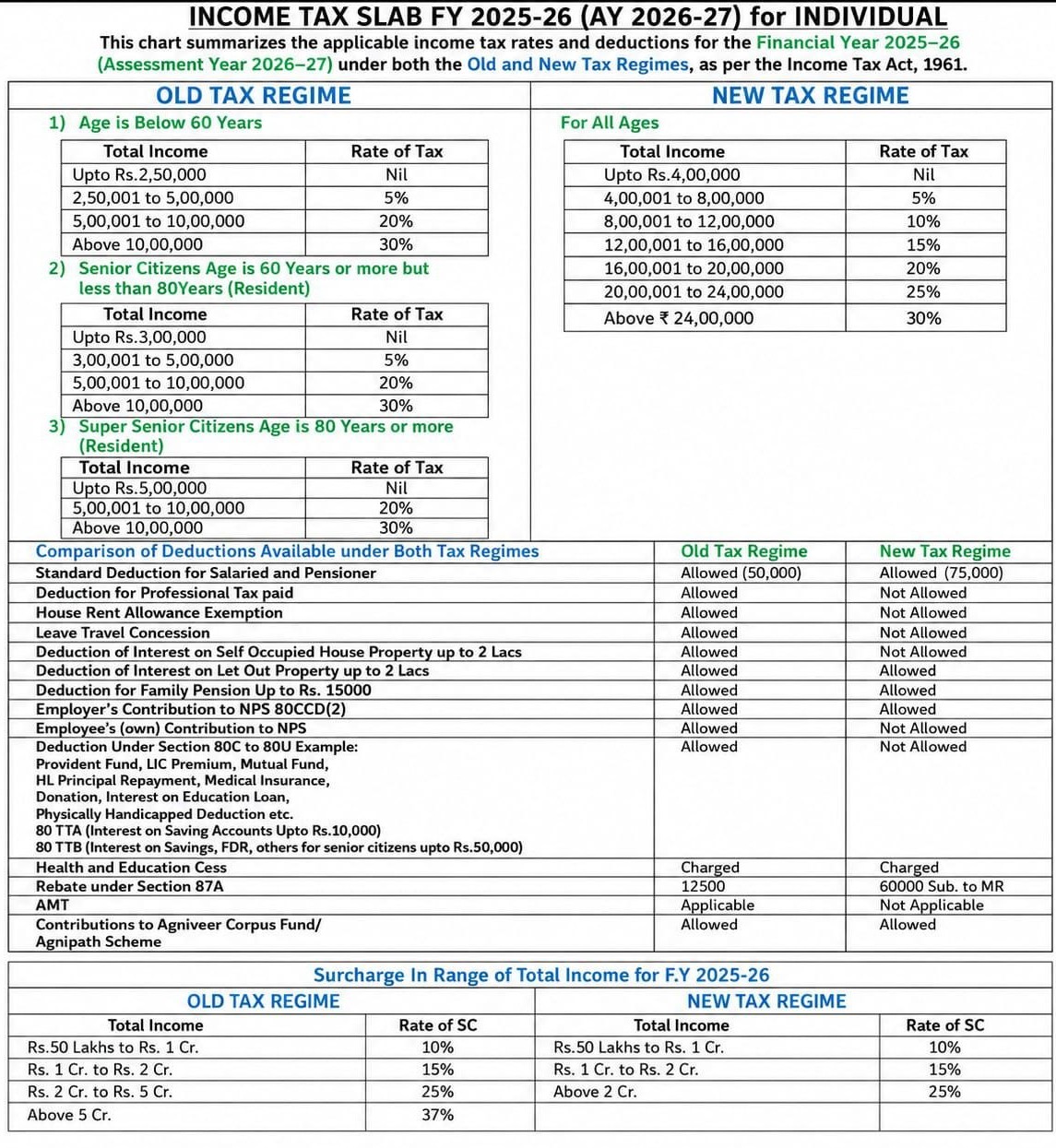
Table of Contents
What Taxpayers & Professionals Should Know about Income Tax Act, 2025
India’s Income-tax framework in 2025 continues to evolve towards simplification, digitization, and transparency, with a strong emphasis on voluntary compliance and technology-driven administration. Here are the key takeaways for FY 2025-26 & beyond.
- Faceless & Technology-Based Regime : Assessments, appeals, rectifications, refunds, and even penalty proceedings are increasingly faceless, reducing human interface while enhancing objectivity and accountability.
- Greater Data Matching & Reporting : Income and transactions are closely monitored through AIS & TIS, including salary & interest income, capital gains (equity, property, securities), crypto/virtual digital assets (VDA), foreign income & assets, and high-value financial transactions. Mismatch = Automated notice
- The Income Tax Dept. has made stricter disclosure norms for mandatory and accurate disclosure of foreign income & foreign assets, VDAs (crypto transactions), & high-value investments & transfers. Nondisclosure may lead to heavy penalties, interest, and prosecution in case of serious cases.
- New vs Old Tax Regime : New Tax Regime continues as the default option, & Taxpayers may still opt for the Old Regime after proper evaluation, Wrong regime selection can result in higher tax outgo
- Faster Corrections & Rectifications: The tax dept has enhanced powers of CPC to correct refund issues, rectify tax credit mismatches, fix interest computation errors & lessen litigation, and speed up resolution .
- Strong Focus on Ease of Compliance: The tax dept is trying to make simplified ITR forms, Pre-filled return data, online notice responses & Time-bound grievance redressal
Deductions & Exemptions Available Under New Tax Regime
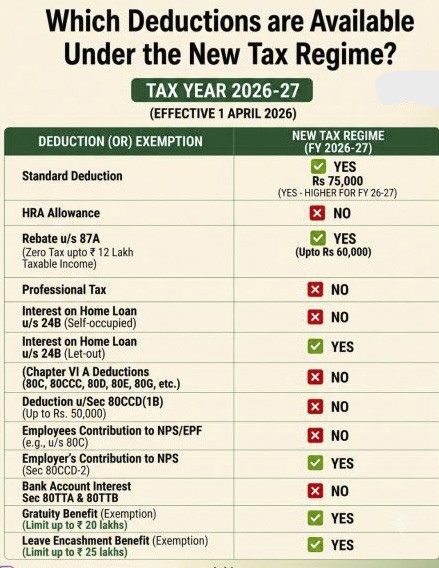
major deductions and exemptions available (or not available) under the New Tax Regime [Section 115BAC] for FY 2026-27 (AY 2027-28). Here’s a practical explanation:
Available Under the New Tax Regime
- Standard Deduction – INR 75,000, Available: Yes, Salaried employees and pensioners can claim a standard deduction of INR 75,000. No bills or proof are required, Deducted automatically from salary income.
- Rebate under Section 87A: Available: Yes. If taxable income is within the prescribed limit under the new regime, a rebate is available. rebate up to INR 60,000. Practical impact: Many taxpayers can achieve nil tax liability up to the eligible income threshold after rebate.
- Interest on Home Loan (Let-Out Property): Available: Yes If a house property is let out (rented): Interest on a housing loan can be considered while computing income from house property. Subject to house property provisions. Available for a let-out property.
- Employer’s Contribution to NPS [Section 80CCD(2)]: Available: Yes This is one of the most valuable deductions under the new regime. A deduction is available for the employer’s contribution to the NPS account. Many salaried employees structure CTC to maximize this benefit.
- Gratuity Exemption: Available: Yes, gratuity received on retirement/resignation remains exempt, subject to prescribed limits under the Income Tax Act.
- Leave Encashment Exemption: Available: Yes. Leave encashment received on retirement is eligible for exemption as per the income tax provisions.
Not Available Under the New Tax Regime
- HRA Exemption: Not Available House rent allowance exemption cannot be claimed under the new regime.
- Professional Tax: Not Available: A deduction for professional tax paid is generally not available.
- Interest on Self-Occupied House Property [Section 24(b)]: Not Available, Old Regime: Deduction up to ₹2 lakh available. and New Regime: No deduction for self-occupied house property loan interest.
- Chapter VI-A Deductions : Not Available These popular deductions are generally not allowed: Section 80C, Section 80CCC, Section 80CCD(1), Section 80D, Section 80E, Section 80G, Section 80TTA, Most other Chapter VI-A deductions.
- Section 80CCD(1B) – Additional NPS ₹50,000: Not Available. The additional ₹50,000 deduction available in the old regime cannot be claimed in the new regime.
- Employee Contribution to EPF/NPS: Not Available, employee’s own contribution does not qualify for deduction under sections like 80C or 80CCD(1). Only the employer’s contribution u/s 80CCD(2) remains available.
- Savings Bank Interest Deduction: Not Available: No deduction under Section 80TTA and Section 80TTB in the new regime.
Quick Summary—Professional Takeaway
- When advising clients under the new tax regime, the biggest tax-saving opportunities now are the standard deduction of INR 75,000, employer NPS contribution u/s 80CCD(2), Section 87A rebate, and proper salary structuring through employer contributions. Since traditional deductions like 80C, 80D, housing loan interest (self-occupied), and HRA are unavailable, a regime comparison should be done before filing the return to determine the more beneficial option.
- Allowed: Standard Deduction INR 75,000, Rebate u/s 87A, Employer NPS Contribution u/s 80CCD(2), Interest on Let-Out Property, Gratuity Exemption, Leave Encashment Exemption
- Not Allowed: HRA, 80C, 80D, 80G, 80CCD(1B), Self-Occupied Home Loan Interest, Professional Tax, 80TTA/80TTB, and Employee’s own EPF/NPS deductions
- Before filing your ITR, the taxpayer must reconcile AIS & TIS, review Form 26AS & disclose all foreign income/assets, and choose the correct tax regime. Smart planning > risky tax-saving tricks. The taxpayer may call us. For assistance with ITR filing, revision, notice replies, or tax planning, you may contact us.
**********************************************************
If this article has helped you in any way, i would appreciate if you could share/like it or leave a comment. Thank you for visiting my blog.
Legal Disclaimer:
The information / articles & any relies to the comments on this blog are provided purely for informational and educational purposes only & are purely based on my understanding / knowledge. They do noy constitute legal advice or legal opinions. The information / articles and any replies to the comments are intended but not promised or guaranteed to be current, complete, or up-to-date and should in no way be taken as a legal advice or an indication of future results. Therefore, i can not take any responsibility for the results or consequences of any attempt to use or adopt any of the information presented on this blog. You are advised not to act or rely on any information / articles contained without first seeking the advice of a practicing professional.