ITR Forms -Types & Applicability
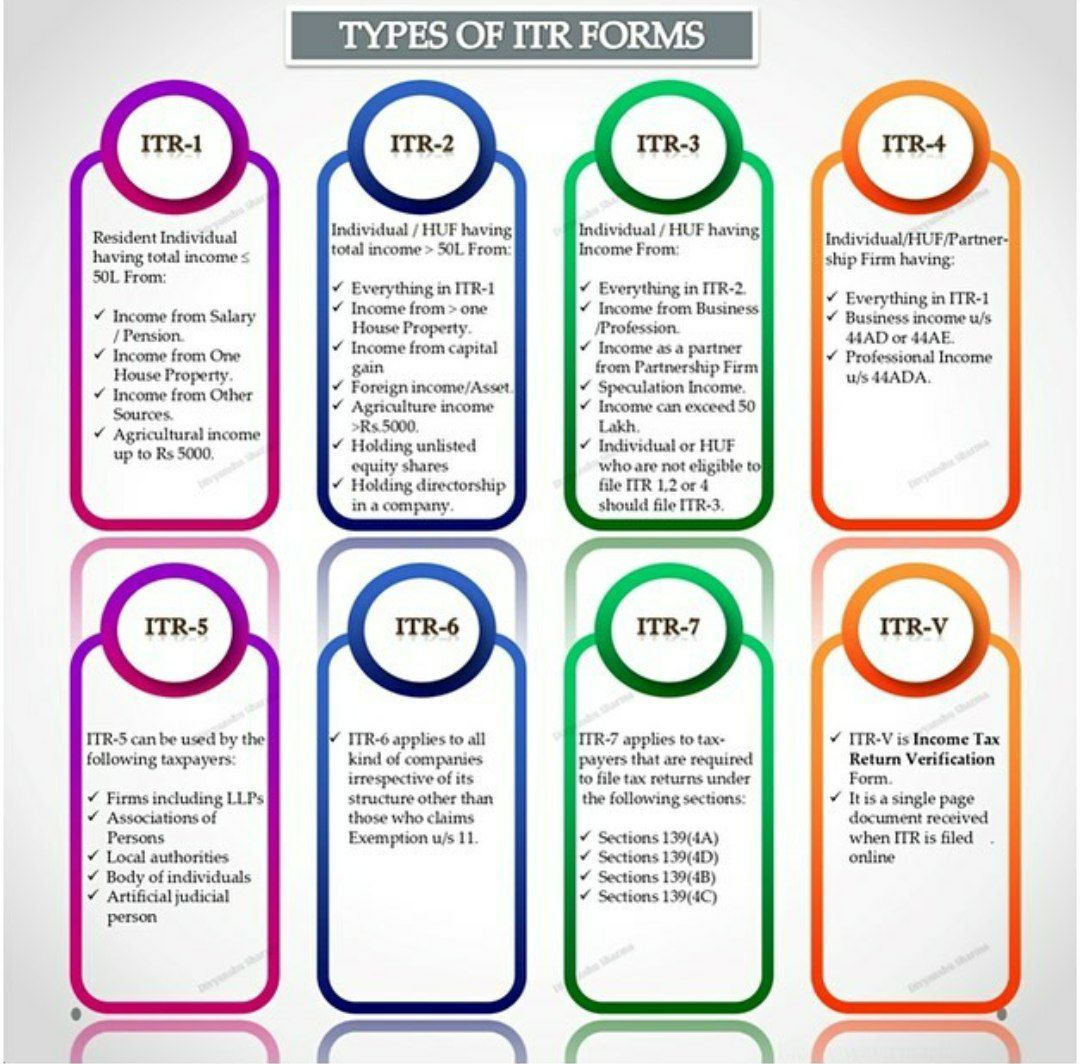
Table of Contents
NEW ITR FORMS FOR FY 2026-27 – TYPES & APPLICABILITY
- Where offline ITRs were filed, greater importance shall be given to the type of ITR form applicable based on the source and quantum of the income of the taxpayer. However, with the advancement of technology, all this manual work is now done with the help of software’s and thus would not require the application of knowledge.
- Even though everything is online, the taxpayer is required to have a basic knowledge of all the ITR forms in order to proceed with their ITR filing.
- An income tax return is a statement forming the structure of a taxpayer’s income. It basically describes the quantum of income and their sources, and the said information is furnished to the government so that they can easily gather the details of income of all the taxpayers and can collect taxes accordingly.
Which ITR Form Should You File for AY 2026-27 (FY 2025-26)?
- Selecting the correct Income Tax Return (ITR) form is the first step towards hassle-free tax compliance. The applicability of an ITR form depends on the taxpayer’s residential status, type of income, and legal status of the assessee. Filing an incorrect form may result in the return being treated as defective by the Income Tax Department.
- Where a taxpayer is required to file their ITR, the same can be done by filing the ITR forms, made available on the IT portal. Specific forms have been prescribed, based on the source and quantum of income. The taxpayer is required to identify the applicable form and furnish the information in the said identified form.
TYPES OF ITR AND THEIR APPLICABILITY
-
ITR 1
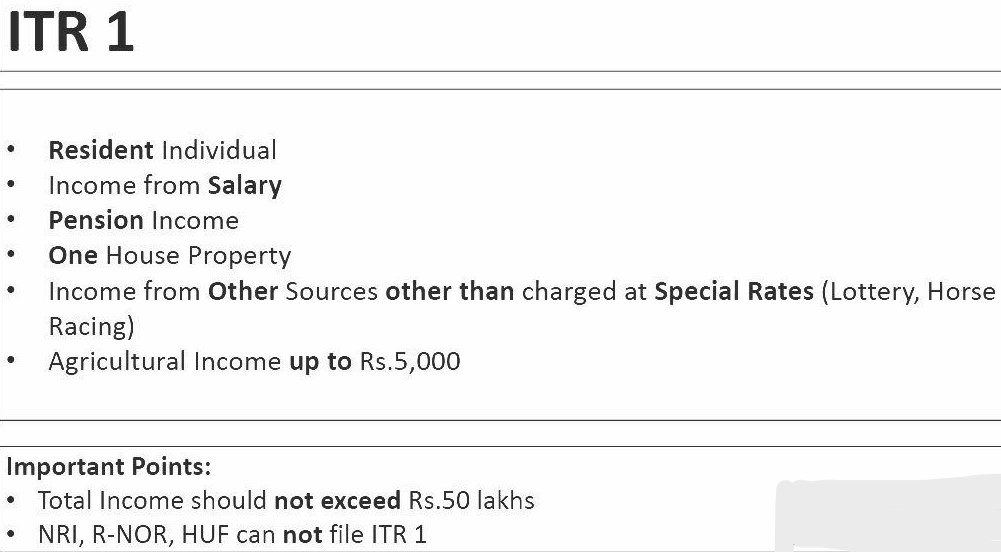
This form is applicable to individuals who are residents and have total income of up to Rs 50 lakh constituting of Income from Salary, one house property, income from other sources (including family pension and interest income), and income from agricultural activities maximum up to Rs 5000. This ITR form does not apply to a Director in a company or made investment in unlisted equity shares or even in cases where TDS got subtracted as per section 194N where the ESOP taxation aspect has been deferred under new relaxation.
-
ITR 2
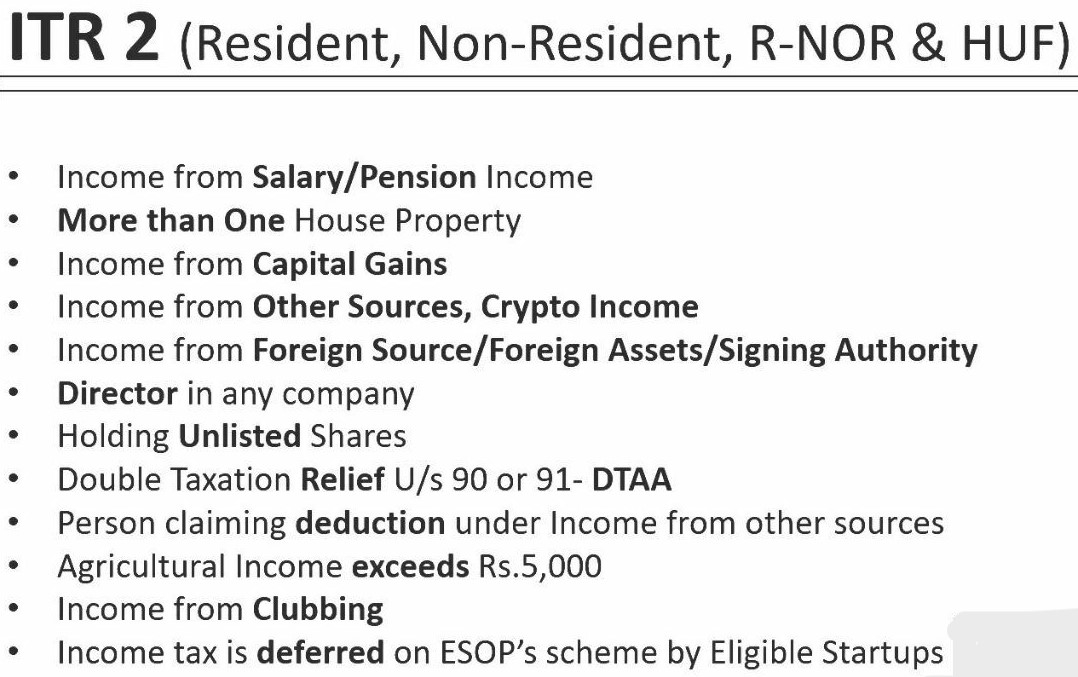
It is applicable to Individuals and HUFs having income from different sources except from business or professional income. Thus, an individual or HUF, not eligible to file Sahaj ITR 1, can file ITR-2. Therefore, any director of a company, as well as anyone who owns unlisted equity shares of a company, will be required to file ITR-2 returns. Also, individuals having more than one house property should also file an ITR-2 income tax return.
-
ITR 3
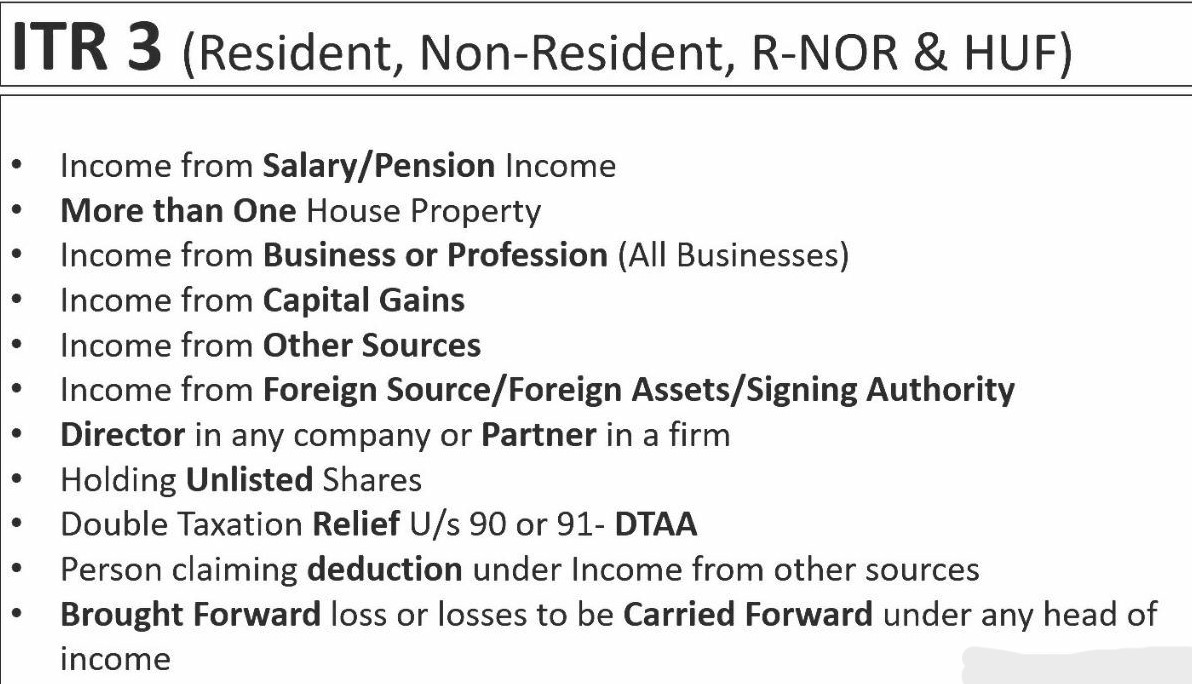
It is to be filed by persons having income from a business or profession. Thus, the eligible source of income for ITR 3 are –
-
- Running a business or profession whether subject to audit or not.
- Income from all other sources like salary, house property, capital gain and other sources, be also included.
-
ITR 4
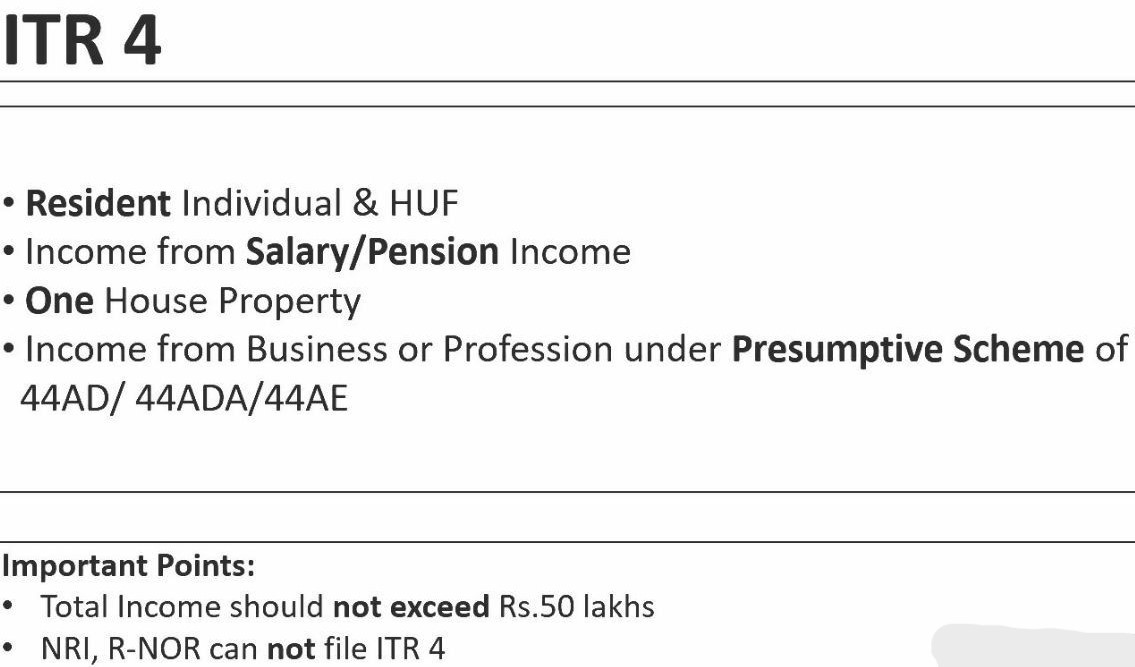
It is applied to Individuals, HUFs, and Firms, excluding LLPs, who are residents and have total income up to Rs.50 lakh. Such income constitutes income from business and profession, subject to computation under sections 44AD, 44ADA, or 44AE. Apart from business or profession, it includes income from one house property with single ownership, interest Income, Family Pension, and agricultural income up to Rs.5,000.
-
ITR 5
This form is to be filed by Firms, LLPs, Association of Persons, Body of Individuals, Artificial Juridical Person, legal heirs of deceased and insolvent person, trust and investment-based funds.
-
ITR 6
Such form is required to be filed by companies not eligible for an exemption under Section 11. It is to be noted that exemption under section 11 is provided to companies that receive income from property held for charitable or religious purposes. Such a return be filed electronically and authorized with the assigned digital signature.
-
ITR 7
It is to be filed by trusts, political parties, charitable institutions, etc. receiving exempt income under the Act. Also, where the individuals and companies fall under section 139(4A), section 139(4B), section 139(4C), or section 139(4D), they can also file the ITR-7 form. One of the required aspects of this form is that the taxes deducted, collected, or paid by or on their behalf must match with their Tax Credit Statement Form 26AS. This form is divided into two parts with a total of 23 schedules.
ITR Form Applicability for AY 2026-27 (FY 2025-26)
| ITR Form | Who Should File? |
|---|---|
| ITR-1 (Sahaj) | Resident individuals (other than not ordinarily resident) having total income up to ₹50 lakh from salary, pension, up to two house properties, other sources, and agricultural income up to ₹5,000. Also applicable where LTCG under Section 112A does not exceed ₹1.25 lakh. Not available to directors in companies or persons holding unlisted equity shares. ITR-1 (Sahaj) is designed for resident individuals with relatively simple income sources such as salary, house property, and other income. |
| ITR-2 | Individuals and HUFs having income from salary, multiple house properties, capital gains, foreign assets, foreign income, or agricultural income exceeding ₹5,000, but not having income from business or profession. ITR-2 is suitable for individuals and HUFs earning capital gains, foreign income, or holding foreign assets, provided they do not have business or professional income. |
| ITR-3 | Individuals and HUFs earning income from business or profession, including proprietors, freelancers, consultants, and partners in partnership firms receiving remuneration or interest from the firm. ITR-3 is applicable to individuals and HUFs having income from business or profession, including partners receiving remuneration, interest, bonus, or commission from a partnership firm. |
ITR-4 (Sugam) |
Resident individuals, HUFs, and firms (other than LLPs) with total income up to ₹50 lakh opting for presumptive taxation under Sections 44AD, 44ADA, or 44AE. Also permitted for LTCG under Section 112A up to ₹1.25 lakh, subject to prescribed conditions. ITR-4 (Sugam) is meant for taxpayers opting for the presumptive taxation schemes under Sections 44AD, 44ADA, or 44AE. |
| ITR-5 | Partnership firms, LLPs, Association of Persons (AOPs), Body of Individuals (BOIs), Artificial Juridical Persons (AJPs), and other entities not required to file ITR-7. ITR-5 is generally used by partnership firms, LLPs, AOPs, BOIs, and other entities not required to file ITR-7. |
| ITR-6 | Companies other than those claiming exemption under Section 11 relating to income from property held for charitable or religious purposes. ITR-6 is applicable to companies other than those claiming exemption under Section 11. |
| ITR-7 | Persons and entities required to furnish returns under Sections 139(4A), 139(4B), 139(4C), or 139(4D), including charitable trusts, religious trusts, political parties, research associations, educational institutions, and certain other exempt organizations. ITR-7 is prescribed for charitable trusts, religious institutions, political parties, educational institutions, and other entities covered under specific provisions of Section 139. |
Quick Guide on ITR form
| If You Are… | ITR Form |
|---|---|
| Salaried employee with income up to ₹50 lakh | ITR-1 |
| Salaried employee with capital gains or foreign assets | ITR-2 |
| Freelancer, consultant, professional, or proprietor | ITR-3 |
| Presumptive taxation taxpayer under Sections 44AD/44ADA/44AE | ITR-4 |
| Partnership Firm or LLP | ITR-5 |
| Company | ITR-6 |
| Trust, NGO, Educational Institution, Political Party | ITR-7 |
**********************************************************
If this article has helped you in any way, i would appreciate if you could share/like it or leave a comment. Thank you for visiting my blog.
Legal Disclaimer:
The information / articles & any relies to the comments on this blog are provided purely for informational and educational purposes only & are purely based on my understanding / knowledge. They do noy constitute legal advice or legal opinions. The information / articles and any replies to the comments are intended but not promised or guaranteed to be current, complete, or up-to-date and should in no way be taken as a legal advice or an indication of future results. Therefore, i can not take any responsibility for the results or consequences of any attempt to use or adopt any of the information presented on this blog. You are advised not to act or rely on any information / articles contained without first seeking the advice of a practicing professional.