All about VPF (Voluntary Provident Fund)

Table of Contents
Lesser-Known Facts About VPF (Voluntary Provident Fund)
Key Features of VPF:
- Extension of EPF, Not a Separate Scheme : A voluntary provident fund is not a separate fund — it is an extension of the Employee Provident Fund. Only salaried employees contributing to EPF can opt for Voluntary Provident Fund. Contributing to a VPF account is not mandatory; it’s entirely at the discretion of the employee. Unlike Employee Provident Fund, employees can contribute up to 100% of their Basic Salary + Dearness Allowance to the voluntary provident fund account.
-
Government-Declared Interest Rate: The Government of India revises the voluntary provident fund interest rate at the beginning of each financial year. It may increase or decrease based on macroeconomic factors.
-
Transferable Between Employers: voluntary provident fund balances can be transferred from a previous employer to the current employer, ensuring continuity of the account.
- Full Withdrawal at Maturity: The total accumulated amount (contributions + interest) can be withdrawn at the time of resignation or retirement.
- No Automatic Enrollment : You must request in writing to your employer to start VPF. It can typically only be modified at the start of a financial year, depending on company policy.
-
Nominee Benefits: In the unfortunate event of the account holder’s demise, the nominee/legal heir receives the entire accumulated corpus.
- Visible in EPFO Passbook: Voluntary provident fund contributions and interest appear in your regular EPF passbook, making tracking easy.
- 🇮🇳 Safe & Government-Backed: Since Employee Provident Fund/voluntary provident fund is managed by the EPFO under the Ministry of Labour, it is considered one of the safest investment options.
- Can Be Stopped or Changed (But Limited Window): Once opted in, you may not be able to alter the voluntary provident fund contribution mid-year, unless the employer’s policy allows it. Some companies lock the contribution amount for the year.
Voluntary Provident Fund – Rules & Regulations
- Tax Benefits (EEE Regime): voluntary provident fund enjoys Exempt-Exempt-Exempt tax treatment: Contribution: Deductible under Section 80C (within INR 1.5 lakh limit). Interest: Tax-free (up to a limit, see below). Maturity: Fully tax-free if criteria are met.
- Tax on Interest for High-Income Earners: From FY 2021–22 onwards, if your annual employee contribution to EPF + voluntary provident fund exceeds INR 2.5 lakh, interest earned on the excess is taxable. If there is no employer contribution (e.g., government employees with GPF), the threshold is INR 5 lakh.
- Account Opening Window: voluntary provident fund accounts can be opened anytime during the financial year.
- Lock-in Period and Withdrawal Rules : Partial withdrawals are allowed in the form of loans. Premature withdrawal may attract tax liability on the interest earne, voluntary provident fund has a 5-year lock-in for tax-free withdrawal. Premature withdrawals are allowed for Marriage Medical emergencies House purchase/construction Higher education, however, tax benefits may be reversed if withdrawn before 5 years. Once opted in, contributions to the voluntary provident fund account cannot be discontinued for 5 years (to retain tax-free status).
- Interest Rate Same as Employee Provident Fund : voluntary provident fund earns the same interest rate as Employee Provident Fund, which is decided by the EPFO every year (8.15% for FY 2023–24). Returns are compounded annually, making it more attractive for long-term, risk-averse investors.
-
You can contribute up to 100% of Basic + DA : Only salaried employees covered under the Employees’ Provident Fund Organisation (EPFO) are eligible. Individuals in the unorganised sector are not allowed to open a VPF account. You can contribute up to 100% of your basic salary and Dearness Allowance voluntarily (beyond the mandatory 12%). However, your employer is not obligated to match the extra contribution.
What is the difference between voluntary provident fund & EPF?
| Feature | Employee Provident Fund | voluntary provident fund |
|---|---|---|
| Contribution | Mandatory 12% of Basic + DA | Voluntary, up to 100% of Basic + DA |
| Employer Contribution | Mandatory | Not applicable |
| Flexibility | Fixed statutory contribution | Completely flexible (voluntary) |
| Tax Benefits | Under Section 80C (EEE status) | Under Section 80C (EEE status) |
EPFO Applicability under the Code on Social Security, 2020—Explained Clearly
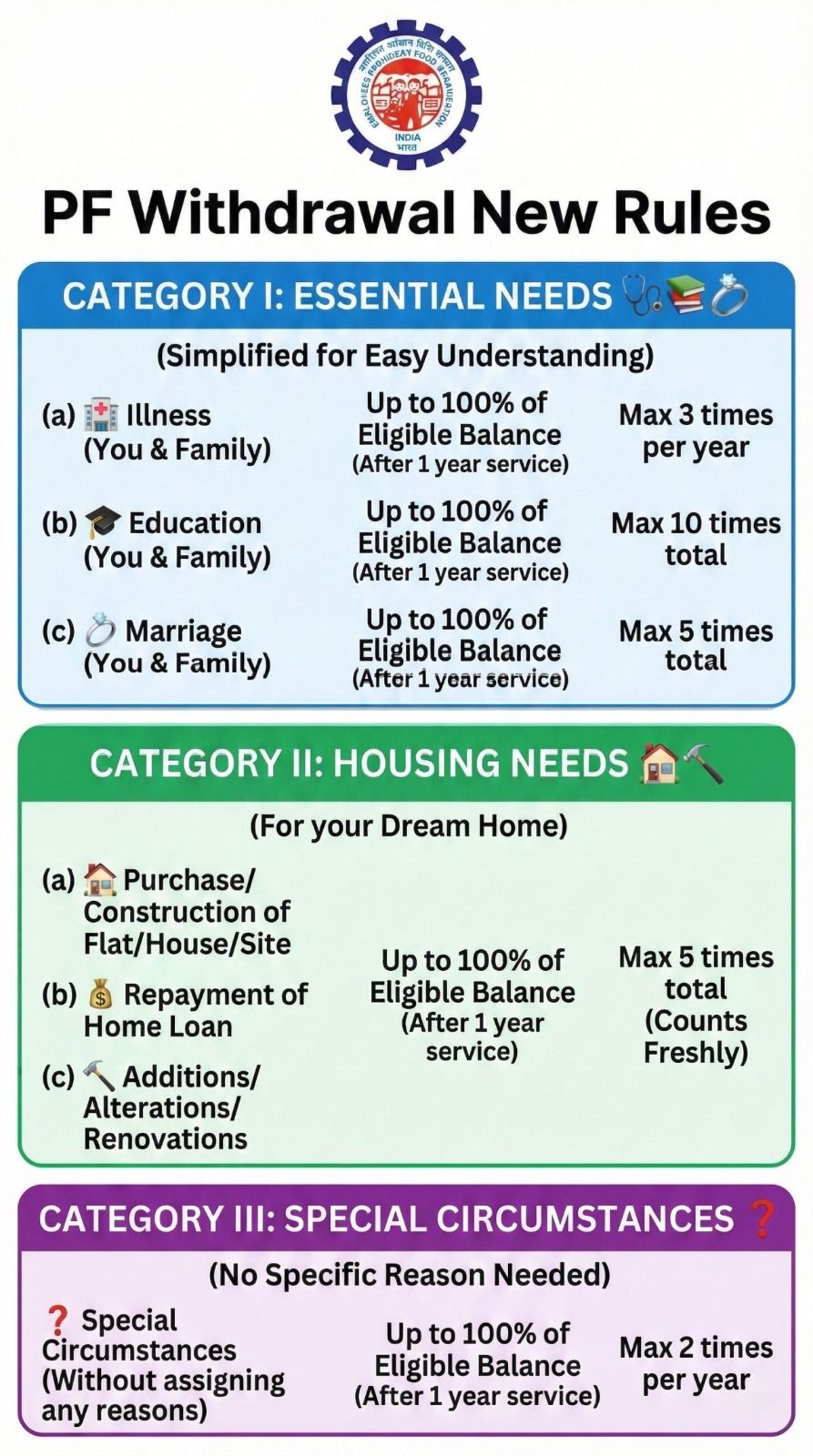
Provident Fund compliance is not optional—it’s foundational. For HR and Payroll professionals, a correct understanding of wages, ceilings, and attendance-based calculations is critical to avoid errors, disputes, and penalties. Below is a simple breakdown based on the new wage definition under the Code on Social Security, 2020
Provident Fund—Key Concept Under the New Code
Rule: At least 50% of total remuneration must be treated as “wages.” Any allowance exceeding this limit is added back for Provident Fundcalculation. Allowance-heavy salary structures will increase Provident Fund liability. Provident Fund contribution depends on earned wages, not just salary structure. Attendance directly impacts PF when wages fall below the ceiling. Accurate structuring today avoids future EPFO litigation. EPFO compliances require timely filing, accurate employee records, and adherence to due dates to avoid penalties.
𝐏𝐅 𝐖𝐢𝐭𝐡𝐝𝐫𝐚𝐰𝐚𝐥 𝐒𝐭𝐞𝐩 – 𝐛𝐲 – 𝐒𝐭𝐞𝐩 𝐆𝐮𝐢𝐝𝐞
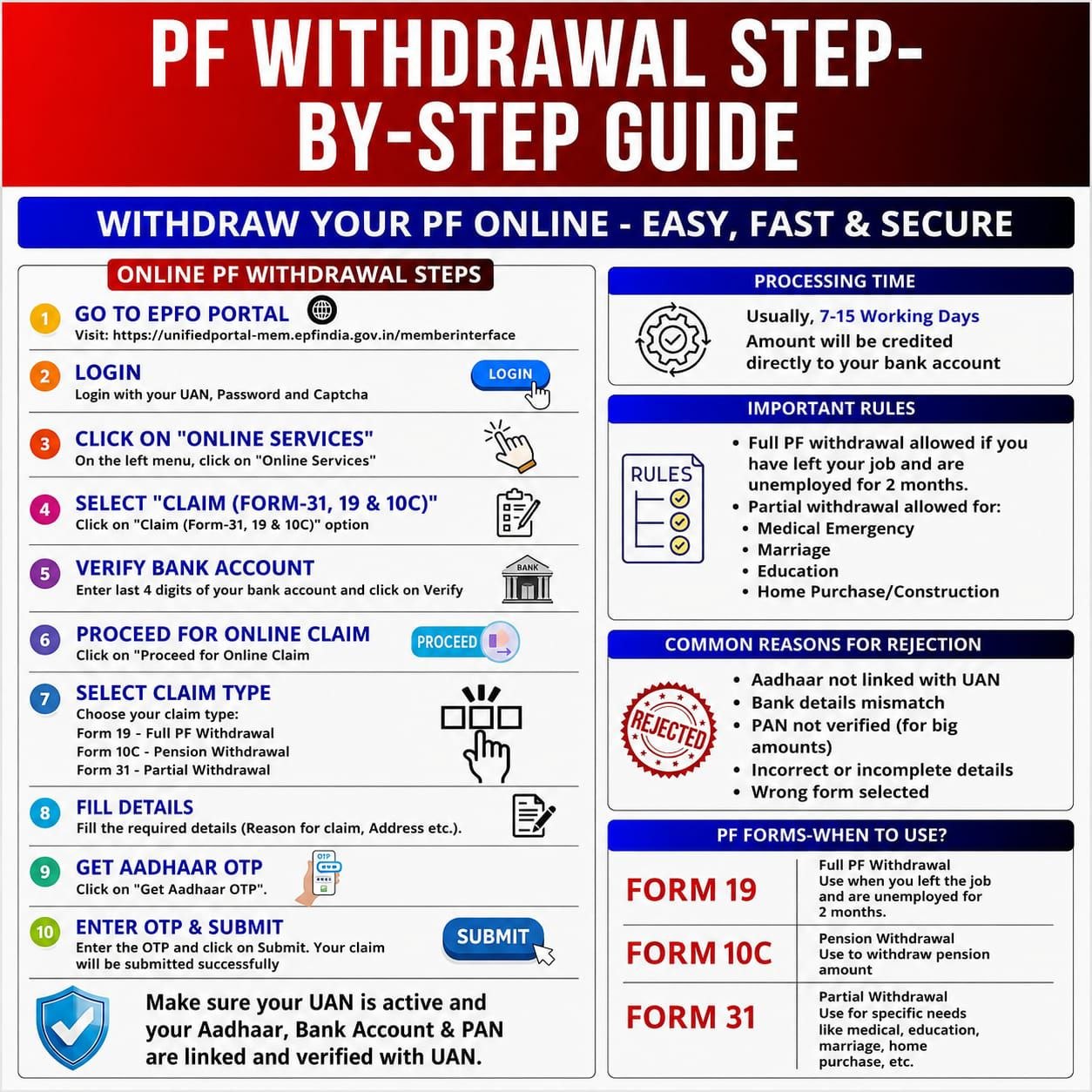
Provident Fund Withdrawal Step-by-Step Guide (EPFO Online Claim Process)
Employees can easily withdraw their Provident Fund online through the EPFO Unified Member Portal if their UAN, Aadhaar, PAN, and bank details are verified.
Step-by-Step Process for Provident Fund Withdrawal
Step-1: Visit the EPFO Portal: Go to the EPFO Unified Member Portal: https://unifiedportal-mem.epfindia.gov.in/memberinterface
Step-2: Login : Log in using your UAN (Universal Account Number), password, and CAPTCHA code.
Step-3: Click on “Online Services”: From the top menu, select Online Services → Claim (Form 31, 19 & 10C)
Step-4: Verify Bank Account : Enter the last 4 digits of your bank account number. and click Verify.
Step-5: Proceed for Online Claim: After successful verification, click: Proceed for Online Claim
Step-6: Select Claim Type: Choose the appropriate withdrawal form: Form 19 : Used for Full Provident Fund withdrawal & After leaving employment and remaining unemployed for at least 2 months
- Form 10C : Used for pension withdrawal benefit under EPS
- PF Form 31 : Used for: Partial Provident Fund withdrawal (advance)
Step-7: Fill Required Details: Provide the purpose of withdrawal, Address (if required), Amount (for partial withdrawals) and Other requested information
Step-8: Aadhaar Authentication: Click “Get Aadhaar OTP,” & an OTP will be sent to the mobile number linked with Aadhaar.
Step-9: Submit Claim: Enter OTP and Click Submit
The claim will be successfully lodged with EPFO. Processing Time: Usually 7 to 15 working days, and the amount is generally credited directly to the linked bank account
Important Provident Fund Withdrawal Rules
- Full Withdrawal: Full Provident Fund withdrawal is generally permitted when Employment has ceased and The member remains unemployed for at least 2 months
- Partial Withdrawal (Form 31): Provident Fund advance can be claimed for approved purposes such as Medical treatment, Marriage, Higher education, House purchase, house construction, and Home loan repayment (subject to conditions)
- Common Reasons for PF Claim Rejection: Avoid the following mistakes: Aadhaar not linked with UAN, Bank account details mismatch, PAN not verified (especially for larger withdrawals), Incorrect or incomplete information, Wrong form selected and KYC not approved by employer or EPFO
- PF Forms and Their Purpose
| Form | Purpose |
|---|---|
| Form 19 | Full Provident Fund Withdrawal |
| Form 10C | Pension Withdrawal Benefit |
| Form 31 | Partial Provident Fund Withdrawal / Provident Fund Advance |
Before Applying for Provident Fund Withdrawal
- Ensure that UAN is activated, Aadhaar is linked and verified, PAN is linked and verified, the bank account is seeded with UAN, the mobile number linked with Aadhaar is active and KYC status shows “Verified”. PF withdrawal has become largely paperless through the EPFO portal. Before submitting an online claim, ensure that your Aadhaar, PAN, bank account, and UAN details are correctly linked and verified to avoid delays or rejection of the claim.
**********************************************************
If this article has helped you in any way, i would appreciate if you could share/like it or leave a comment. Thank you for visiting my blog.
Legal Disclaimer:
The information / articles & any relies to the comments on this blog are provided purely for informational and educational purposes only & are purely based on my understanding / knowledge. They do noy constitute legal advice or legal opinions. The information / articles and any replies to the comments are intended but not promised or guaranteed to be current, complete, or up-to-date and should in no way be taken as a legal advice or an indication of future results. Therefore, i can not take any responsibility for the results or consequences of any attempt to use or adopt any of the information presented on this blog. You are advised not to act or rely on any information / articles contained without first seeking the advice of a practicing professional.