Depreciation U/s 32: Latest WDV Rates & Rules Explained
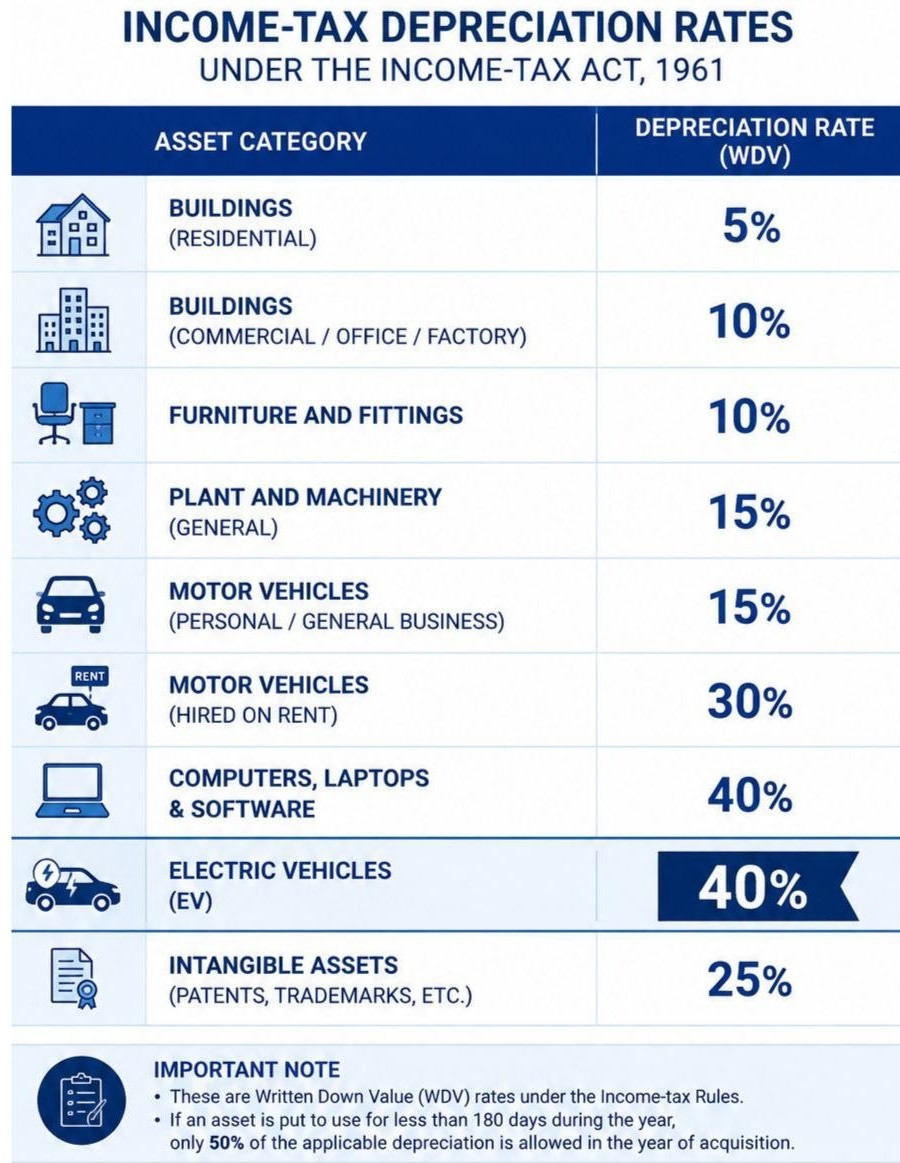
Table of Contents
All about Depreciation Rates Under the Income-tax Act, 1961
Depreciation Under Section 32 of the Income Tax Act, 1961
Section 32 of the Income Tax Act allows businesses and professionals to claim depreciation as a tax deduction on assets used for business or professional purposes. Depreciation is generally calculated using the written-down value method, where assets are grouped into blocks and depreciation is allowed on the block’s WDV. The following are the commonly used written-down value depreciation rates applicable under the income tax rules:
| Asset Category | Depreciation Rate (WDV) |
|---|---|
| Buildings (Residential) | 5% |
| Buildings (Commercial / Office / Factory) | 10% |
| Furniture and Fittings | 10% |
| Plant and Machinery (General) | 15% |
| Motor Vehicles (Personal / General Business Use) | 15% |
| Motor Vehicles Used on Hire (Rent, Taxi, etc.) | 30% |
| Computers, Laptops & Software | 40% |
| Electric Vehicles (EVs) | 40% |
| Intangible Assets (Patents, Trademarks, Licenses, Franchises, etc.) | 25% |
Key Rules and Conditions related to depreciation
- 180-Day Rule: If an asset is acquired and put to use for less than 180 days during the financial year, only 50% of the normal depreciation can be claimed in that year.
- Additional Depreciation: Manufacturing and power-generation businesses can claim an additional 20% depreciation on eligible new plant and machinery, and If the asset is used for less than 180 days, additional depreciation is restricted to 10% in the year of acquisition.
- Block of Assets Concept: Depreciation is not calculated asset-wise. Similar assets carrying the same depreciation rate are grouped into a block of assets, and depreciation is calculated on the aggregate WDV of that block.
- Straight-Line Method (SLM) : While WDV is the standard method, businesses engaged in the generation or distribution of power may opt for the Straight-Line Method (SLM).
- Personal Use Assets: Depreciation is allowed only on assets used for business or professional purposes. Assets used exclusively for personal purposes are not eligible for depreciation.
- Written Down Value Method: Depreciation under the Income Tax Act is generally allowed on the WDV method, where depreciation is calculated on the opening WDV of the block of assets.
- Assets Used for Less Than 180 Days: If an asset is acquired during the financial year and is put to use for less than 180 days, only 50% of the applicable depreciation can be claimed in that year. Examples: A computer purchased and used for less than 180 days:
- Normal rate = 40%
- Eligible depreciation = 20%
- Plant & machinery used for less than 180 days:
- Normal rate = 15%
- Eligible depreciation = 7.5%
Quick WDV depreciation rates applicable under the Income Tax Rules:
Depreciation u/s 32 helps businesses reduce taxable income by recognizing the wear and tear of business assets. The written-down value method, block of assets concept, 180-day rule, and additional depreciation provisions are important factors that taxpayers should consider while computing depreciation and preparing their income tax returns. details about depreciation rate here under :
- Residential Building – 5%
- Commercial Building – 10%
- Furniture & Fixtures – 10%
- Plant & Machinery – 15%
- Motor Car (Business Use) – 15%
- Motor Vehicle Used on Hire – 30%
- Computers & Software – 40%
- Electric Vehicles – 40%
- Patents, Trademarks & Other Intangible Assets – 25%
- These rates are widely used for income-tax computation, tax audits, and business income tax return filings under the block-of-assets concept.
**********************************************************
If this article has helped you in any way, i would appreciate if you could share/like it or leave a comment. Thank you for visiting my blog.
Legal Disclaimer:
The information / articles & any relies to the comments on this blog are provided purely for informational and educational purposes only & are purely based on my understanding / knowledge. They do noy constitute legal advice or legal opinions. The information / articles and any replies to the comments are intended but not promised or guaranteed to be current, complete, or up-to-date and should in no way be taken as a legal advice or an indication of future results. Therefore, i can not take any responsibility for the results or consequences of any attempt to use or adopt any of the information presented on this blog. You are advised not to act or rely on any information / articles contained without first seeking the advice of a practicing professional.