CBDT: AIS Foreign Asset Reporting + FAST-DS 2026
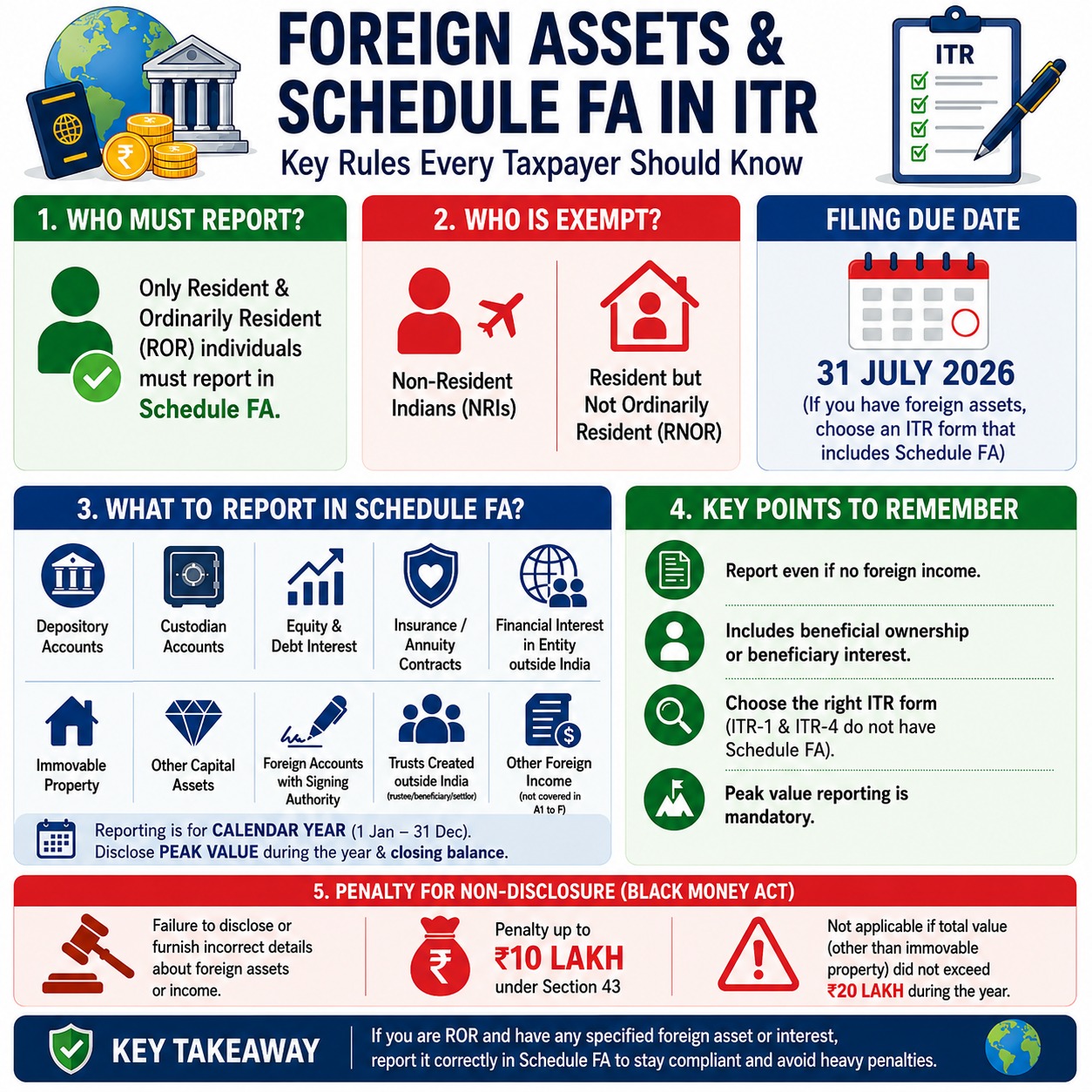
Table of Contents
FAST-DS 2026: Income Tax Relief Available, But Foreign Exchange Management Act Risks Still Remain
A Golden Opportunity for Foreign Asset Compliance
- Foreign Assets Disclosure Scheme 2026 was introduced in the Union Budget 2026, providing a one-time compliance window for people who had neglected to include abroad assets or income in their Indian tax returns.
- The scheme enabling qualified individuals to disclose undisclosed foreign assets and income, pay the required tax and penalty, and receive immunity from prosecution and penal repercussions under the Income-tax Act and the Black Money (Undisclosed Foreign Income and Assets) and Imposition of Tax Act, 2015, the program seeks to promote voluntary compliance. However, taxpayers must understand one critical point:
- Tax regularization under Foreign Assets Disclosure Scheme 2026 does not automatically regularise violations under the Foreign Exchange Management Act 1999. Therefore, while the scheme may provide relief from income-tax liabilities, it does not grant immunity from exchange control violations.
What Can Be Disclosed Under Foreign Assets Disclosure Scheme 2026?
The Foreign Assets Disclosure Scheme 2026 allows the following:
- Undisclosed Foreign Income and Assets: Disclosure of foreign income and assets up to INR 5 crore.
- Reporting Lapses: Cases where income was already taxed in India, but The corresponding foreign asset was not reported in tax returns. Such reporting omissions can be regularised up to INR 1 crore.
Who Can Avail of the Foreign Assets Disclosure Scheme 2026 Scheme?
Foreign Assets Disclosure Scheme 2026 is available only to Individual taxpayers. It is not available for Companies, LLPs, Partnership firms, Trusts, and Other non-individual entities
Why Foreign Exchange Management Act Compliance Matters
Many people believe that all legal concerns are settled once a foreign asset is revealed under the tax plan. This is incorrect.
- The Foreign Exchange Management Act and income tax law function independently. Even if a foreign asset is regularized for tax purposes, it may nevertheless violate the Foreign Exchange Management Act.
- As a result, taxpayers should thoroughly review how the asset was obtained, how money was transferred overseas, whether reporting requirements were met, and if foreign investments adhered to Foreign Exchange Management Act laws before filing a disclosure.
Key Foreign Exchange Management Act Risks Associated with Foreign Asset Disclosures
-
Foreign Bank Accounts and Deposits
-
- Individuals often maintain Savings accounts abroad, Fixed deposits and Foreign currency balances
- Under Foreign Exchange Management Act regulations, a resident Indian is generally required to repatriate or surrender foreign exchange within prescribed timelines unless specifically permitted.
Potential Violation
-
- If funds remain parked in foreign bank accounts beyond the permissible period without a valid Foreign Exchange Management Act exception, the continued retention may amount to a contravention.
- This issue may also arise for Interest income, Investment earnings and Foreign deposits accumulated over time
- Therefore, disclosure under Foreign Assets Disclosure Scheme 2026 may simultaneously expose Foreign Exchange Management Act non-compliance relating to retention of foreign exchange overseas.
Overseas Direct Investment Risks
Investment in Foreign Entities Having Step-Down Subsidiaries
-
-
- Under the Overseas Investment Rules, resident individuals are generally prohibited from making overseas direct investments in foreign entities that have step-down subsidiaries.
- Many global startups and holding companies operate through layered corporate structures.
- As a result, an individual investing in Offshore holding companies, International startup groups and Multi-tier corporate structures may unknowingly breach Foreign Exchange Management Act provisions.
-
Exceptions of Overseas Direct Investment Risks
-
-
- Certain acquisitions remain permissible if received through Inheritance, Employee stock options, Employee benefit schemes, Qualification shares and Sweat equity
-
Investment in Foreign Financial Services Businesses
- Resident individuals are generally restricted from investing in overseas entities engaged in financial services activities.
- Common examples include Fintech platforms, lending businesses, trading applications, investment advisory firms, and crypto exchanges.
- Many investors fail to recognise that these businesses may be classified as “financial services” under the Foreign Exchange Management Act.
- Consequently, what appears to be a legitimate investment overseas may become a Foreign Exchange Management Act violation in India.
Improper Funding Routes
FEMA permits overseas investments only through approved channels.
- Common violations include Cash funding through friends or relatives abroad, Third-party funding arrangements, Hawala transactions, Informal settlement mechanisms, Transfers through unapproved channels and Personal overseas account funding outside permitted banking routes
- Even where the investment itself is allowed, an improper funding structure can trigger Foreign Exchange Management Act contraventions.
Reporting and Filing Failures
- Many otherwise compliant overseas investments become non-compliant due to missed reporting obligations.
Typical lapses include
- Delayed Form FC Filing : Investors are required to Obtain a Unique Identification Number and File Form FC through the authorized dealer bank.
- In practice, delays often occur when a foreign company is incorporated before its bank account is opened.
Delay in Submission of Share Certificates
- Foreign Exchange Management Act requires investors to furnish share certificates or other evidence of investment within prescribed timelines.
- Failure to do so may result in procedural non-compliance.
FEMA Risks in Overseas Property Ownership
- Acquisition of Foreign Immovable Property, Many resident Indians own Apartments abroad, Holiday homes and Commercial properties
- Although Foreign Exchange Management Act permits overseas property acquisition in certain cases, the source of funding is extremely important.
Permitted Routes
- Property may generally be acquired through Inheritance, Gift, Purchase through a liberalized remittance scheme, resident foreign currency accounts, and Permissible foreign income and asset proceeds
Potential Violations
- Foreign Exchange Management Act concerns may arise when funding comes from Overseas borrowings, Foreign entities, Friends or relatives, Third-party arrangements and Informal channels
Deferred Payment and Instalment Purchases
- A frequently overlooked issue involves overseas property purchased on installment plans and Deferred payment terms
- Such arrangements can sometimes be interpreted as creating a financing obligation outside India.
- Since this may amount to a capital account transaction, prior RBI approval could be required in certain situations.
- Accordingly, taxpayers should carefully evaluate the structure of overseas property purchases before relying solely on tax regularization.
Foreign Exchange Management Act Relief Mechanisms Still Exist
The good news is that a Foreign Exchange Management Act violation does not prevent an individual from participating in Foreign Assets Disclosure Scheme 2026. Moreover, Foreign Exchange Management Act provides separate mechanisms for regularization, including
- Late Submission Fees : Late submission fees may be used to regularise delayed reporting and filing requirements.
- Compounding of Contraventions: Individuals may apply for compounding, allowing Foreign Exchange Management Act breaches to be resolved upon payment of prescribed amounts and compliance with regulatory requirements.
Important Protection Under Foreign Exchange Management Act Section 6(4)
- Residents are generally permitted to continue holding foreign assets if they were Acquired when they were non-residents or Inherited from a person resident outside India.
- This provision offers relief in many genuine cases involving migration, overseas employment, or inheritance-based ownership.
Foreign Assets Disclosure Scheme 2026 can resolve tax non-compliance, but it does not automatically cure Foreign Exchange Management Act violations.
- Individuals considering disclosure should undertake a comprehensive review of both tax and Foreign Exchange Management Act obligations, and where gaps exist, explore available Foreign Exchange Management Act regularisation mechanisms such as late submission fees and compounding.
- A proactive and coordinated compliance approach will ensure that disclosure under Foreign Assets Disclosure Scheme 2026 becomes a complete solution rather than the beginning of a new compliance challenge
- Foreign Assets Disclosure Scheme 2026 has been announced but is not yet operational. As of 16 July 2026, the Central Government has not issued the required Gazette notification, so the six-month disclosure window has not started.
- Choose the correct Income tax return form: Taxpayers holding foreign assets cannot file ITR-1. Salaried individuals should file ITR-2, while those with business or professional income must file ITR-3.
- Monitor RNOR to ROR status carefully: Returning NRIs often overlook the transition from RNOR (Resident but Not Ordinarily Resident) to ROR (Resident and Ordinarily Resident), after which foreign asset reporting requirements expand significantly.
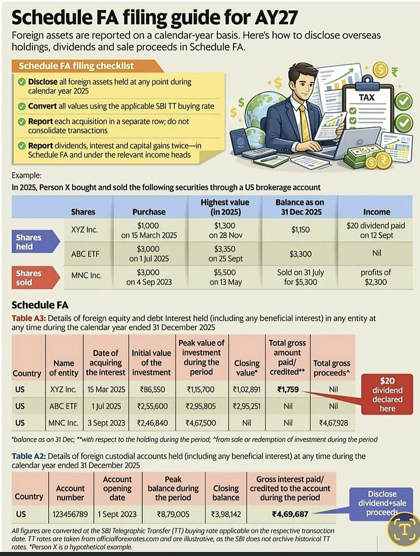
- Schedule FA follows the calendar year: Unlike most tax schedules that follow the financial year (April–March), Schedule foreign asset covers January–December, making accurate reporting crucial.
Disclosure of Foreign Assets in Income tax Return
- Global data sharing has increased transparency: Through FATCA and the Common Reporting Standard (CRS), tax authorities across more than 100 countries automatically exchange financial information, making undisclosed foreign assets easier to detect.
- The scheme is meant for resident individuals with undisclosed foreign assets or income and does not apply to companies, LLPs, partnerships, or deliberate large-scale tax evasion cases.
- Category-A covers foreign assets/income that were never taxed or disclosed and requires payment of 60% of the asset/income value.
- Category-B applies where assets were acquired from legitimate, already-taxed funds (or during NRI status) but were not reported in Schedule FA, with a flat fee of INR 1 lakh per asset.
- Union Budget 2026 also provides automatic prosecution relief for certain non-immovable foreign assets up to INR 20 lakh, subject to prescribed conditions.
- Importantly, the Foreign Assets Disclosure Scheme 2026 provides immunity only under the Income-Tax Act and Black Money Act—not FEMA. Any FEMA violations must be regularised separately through mechanisms such as compounding or late submission fees.
- Foreign assets must be reported in both foreign currency and INR using the Telegraphic Transfer Buying Rate. Foreign currency held within India (e.g., Resident Foreign Currency/Foreign Currency Non-Resident accounts is not reportable under Schedule Foreign Assets.
- Scheduling foreign assets is mandatory for resident and ordinarily resident individuals holding foreign assets, even if their income is below the taxable limit.
- Schedule Foreign Assets reports foreign assets, while Schedule FSI reports foreign-source income such as dividends, interest, rent, or capital gains.
- Disclose ESOPs, RSUs, and ESPPs annually: Foreign employee stock holdings must be reported in Schedule FA every year, even if the shares are unsold and tax was already paid at vesting. This is one of the most commonly missed disclosures.
- Foreign Restricted Stock Units, Employee Stock Options, US stocks, overseas brokerage accounts, pension accounts, and retirement funds may require disclosure in Schedule Foreign Assets, depending on the taxpayer’s residential status.
- Foreign Assets Disclosure Scheme 2026 provides a one-time opportunity for eligible taxpayers to voluntarily disclose previously unreported foreign assets and foreign income
Relief is available for past omissions:
- Union Budget 2026 relief for small foreign assets grants specified benefits for certain non-immovable foreign assets up to INR 20 lakh, subject to conditions.
- Taxpayers should start gathering supporting documents such as foreign bank statements, brokerage records, tax payment proofs, ESOP/RSU records, and property documents before the scheme becomes operational.
- ITR-U may help correct missed disclosures, subject to eligibility u/s 139(8A).
- Taxpayers should maintain proper documentation, including foreign bank statements, investment records, dividend statements, and property documents, to support disclosures and address future scrutiny.
- Use SBI TT Buying Rate for currency conversion: Foreign assets and income must be converted into INR using the State Bank of India Telegraphic Transfer (TT) Buying Rate, not online exchange rates.
- The foreign brokerage accounts must be reported even if no transactions occurred during the year.
- Taxpayers who missed foreign asset disclosures may consider the following:
- Foreign Assets Disclosure Scheme 2026, the proposed one-time disclosure scheme for past non-reporting of foreign assets.
- Revised return filing, where eligible corrections can be made within the permitted timeline without penalty.
- Failure to disclose foreign assets could result in exposure under the Black Money Act, including tax and penalties up to 120% of asset value and possible prosecution. Non-disclosure of foreign assets can attract severe penalties, including a penalty of up to INR 10 lakh and imprisonment in certain cases under the Black Money Act.
- There is no direct penalty for not updating NRI status, but continuing to operate resident savings accounts after becoming a non-resident may lead to Foreign Exchange Management Act compliance issues and banking penalties.
What has CBDT done?
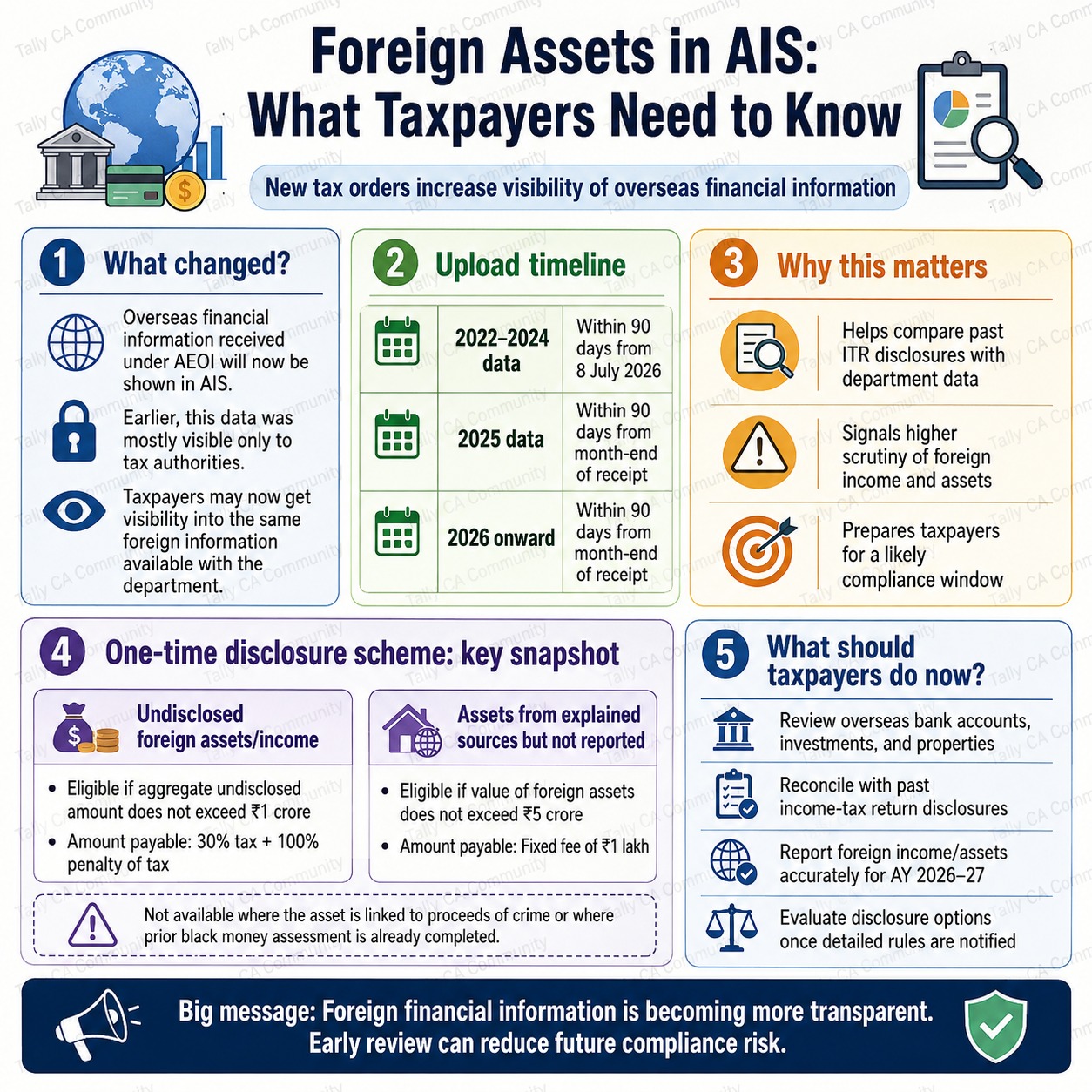
CBDT issued an order on 8 July 2026 authorising the Director General of Income-tax (Systems) to upload financial information received from foreign countries under the Automatic Exchange of Information (AEOI) framework into taxpayers’ Annual Information Statement (AIS) (Form 168) and related tax information systems. This means that information already being received by the Income Tax Department from foreign jurisdictions will now become visible to taxpayers through AIS, improving transparency and enabling self-verification
What is AEOI?
Automatic Exchange of Information (AEOI) is a global information-sharing mechanism under which countries exchange financial account information of tax residents annually. Through agreements such as Common Reporting Standard (CRS), FATCA-related arrangements, Tax treaties under sections 90 and 90A foreign tax authorities share information with India regarding Indian residents’ overseas financial accounts and investments.
What kind of information may appear in AIS?
Depending upon the data received from foreign jurisdictions, AIS may reflect the following:
- Foreign bank accounts
- Overseas financial accounts
- Foreign shareholdings and securities
- The Foreign mutual fund investments
- Interest income earned abroad
- Dividend income from foreign companies
- Certain foreign financial assets
- Information reported under CRS/FATCA frameworks
- Other overseas investments and holdings
Upload Timeline Prescribed by CBDT : Historical Data For information relating to Calendar Year 2022, Calendar Year 2023 Calendar Year 2024. the data already available with the department must be uploaded within 90 days from 8 July 2026.
Future Data: For Calendar Year 2025 onwards, information must be uploaded within 90 days from the end of the month in which India receives the information from the foreign jurisdiction.
Why is this important?
1. Increased Transparency : Earlier, the Department could see foreign information but taxpayers generally could not. Now, both the taxpayer and the department will have visibility over the same data.
2. Easier Reconciliation : Taxpayers can compare AIS disclosures, Schedule FA (Foreign Assets), Schedule FSI (Foreign Source Income) and past Income Tax Returns and identify omissions or mismatches.
3. Higher Scrutiny Risk : Once foreign information is reflected in AIS, undisclosed foreign assets or income become easier for the Department to detect during assessments and risk analysis.
The development is especially relevant for:
- Resident taxpayers having foreign bank accounts
- Individuals holding foreign shares or securities
- Employees receiving RSUs/ESOPs from overseas employers
- Persons earning foreign interest or dividend income
- Returning NRIs who became residents
- Students or professionals who maintained accounts abroad
- Taxpayers who made investments through overseas platforms
Review Existing Foreign Holdings
Check Bank accounts abroad, Foreign brokerage accounts, Overseas shares and mutual funds, RSUs/ESOPs and Foreign pension or retirement accounts
Reconcile with Earlier Returns
Compare AIS information with Schedule FA, Schedule FSI, Schedule TR and Previously filed ITRs. If any foreign asset or foreign income was not properly reported, evaluate available compliance options under the Income-tax Act and other applicable laws after professional review.
This is not a new tax or a new disclosure obligation. The real change is that foreign financial information received under international exchange agreements will now be visible in AIS, allowing the Department to match overseas data more effectively with return disclosures. Taxpayers with foreign assets or foreign income should proactively review past filings and ensure complete reporting going forward
Conclusion
- Foreign Assets Disclosure Scheme 2026 offers a valuable opportunity for individuals to clean up historical non-disclosures of foreign income and assets and obtain immunity from prosecution under tax laws. However, taxpayers must not view the scheme solely through an income-tax lens.
- The acquisition, funding, holding, transfer, and reporting of foreign assets also need to be examined from a Foreign Exchange Management Act perspective. Foreign bank balances, overseas investments, offshore startups, Employee Stock Ownership or Option Plan holdings, and foreign immovable properties may all carry separate exchange-control implications.
- Foreign asset reporting is no longer an area that can be ignored. Correct income tax return selection, annual schedule of foreign asset disclosures, proper residential status evaluation, and accurate currency conversion are critical to avoid penalties and ensure full compliance with Indian tax laws.
- ITR Filing Changes Checklist – AY 2026-27
**********************************************************
If this article has helped you in any way, i would appreciate if you could share/like it or leave a comment. Thank you for visiting my blog.
Legal Disclaimer:
The information / articles & any relies to the comments on this blog are provided purely for informational and educational purposes only & are purely based on my understanding / knowledge. They do noy constitute legal advice or legal opinions. The information / articles and any replies to the comments are intended but not promised or guaranteed to be current, complete, or up-to-date and should in no way be taken as a legal advice or an indication of future results. Therefore, i can not take any responsibility for the results or consequences of any attempt to use or adopt any of the information presented on this blog. You are advised not to act or rely on any information / articles contained without first seeking the advice of a practicing professional.