Old Tax Regime vs New Tax Regime: which one Choose?
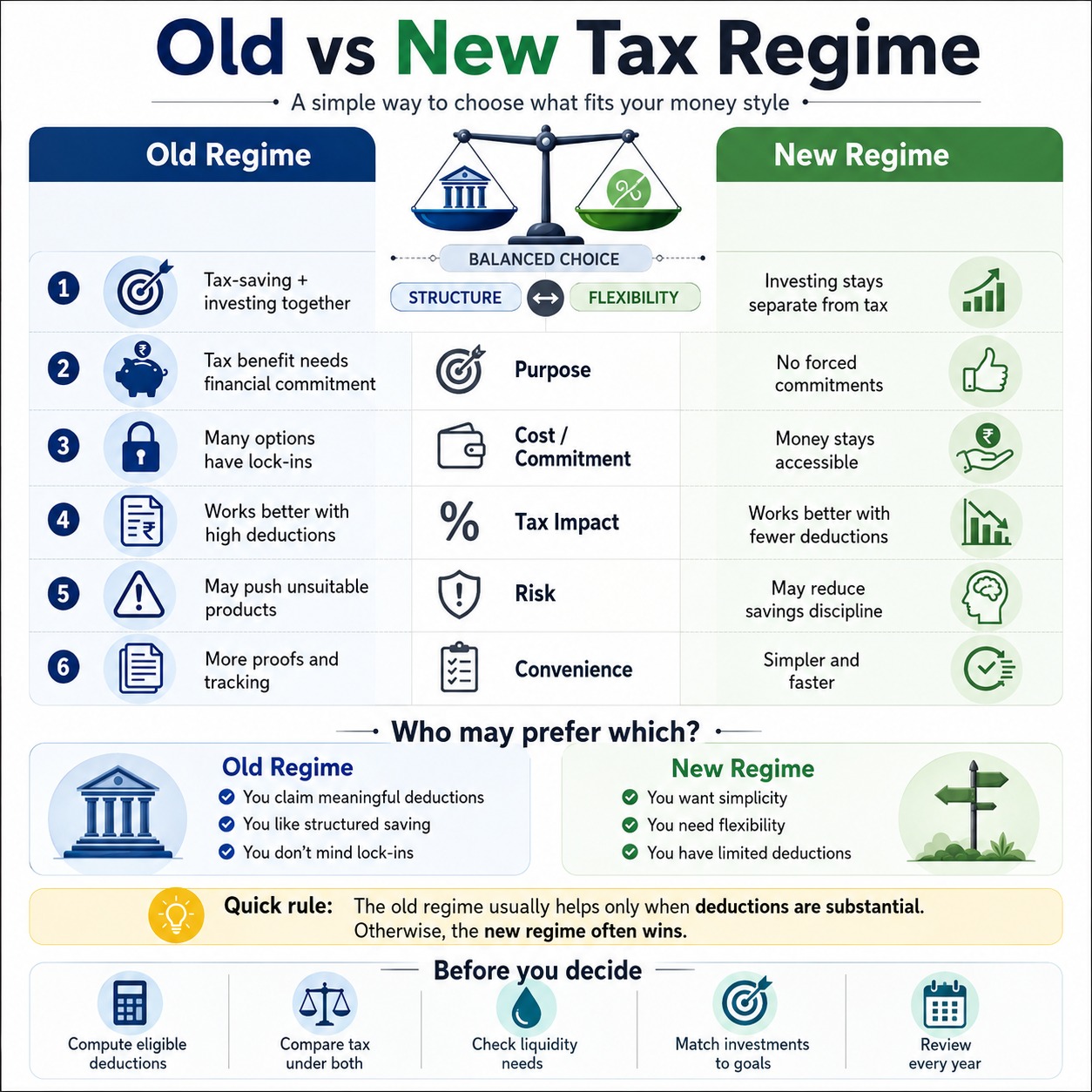
Table of Contents
Old Tax Regime vs New Tax Regime: Which One Should You Choose?
Every tax season, taxpayers face an important question: Should I choose the Old Tax Regime or the New Tax Regime?
The answer is not just about paying lower taxes. It also depends on your financial goals, investment habits, lifestyle, and the amount of deductions and exemptions you are eligible to claim. Understanding the Key Difference
Old Tax Regime : The Old Tax Regime allows taxpayers to reduce their taxable income through various deductions and exemptions. Some popular tax benefits available include:
- Deduction under Section 80C (PPF, ELSS, Life Insurance Premium, EPF, NSC, etc.)
- Health insurance deduction under Section 80D
- Home loan interest benefits
- HRA exemption
- Leave Travel Allowance (LTA)
- Education loan interest deduction
- Other eligible deductions and exemptions
This regime is generally suitable for individuals who have significant investments, insurance premiums, housing loans, and other tax-saving expenditures.
New Tax Regime : The New Tax Regime offers lower tax rates but removes most deductions and exemptions available under the Old Regime. Key advantages include:
- Simplified tax structure
- Lower tax rates
- Reduced documentation requirements
- Greater flexibility in investment decisions
- No compulsion to invest solely for tax-saving purposes
This regime is often preferred by taxpayers who have limited deductions or prefer maintaining liquidity and flexibility in their finances.
What Are You Giving Up?
Under the Old Tax Regime
Benefits Old Tax Regime
- Tax deductions and exemptions significantly reduce taxable income.
- Suitable for taxpayers making regular tax-saving investments.
- Additional tax relief through housing loan, health insurance, and retirement investments.
Limitations of Old Tax Regime
- Many tax-saving investments have lock-in periods.
- Investment decisions may become tax-driven rather than goal-driven.
- More paperwork and record-keeping requirements.
Under the New Tax Regime
Benefits of New Tax Regime
- Lower tax rates.
- Simpler return filing process.
- Greater flexibility and liquidity.
- No need to artificially invest to save taxes.
Limitations of New Tax Regime
Most deductions and exemptions are not available.
Taxpayers with substantial deductions may end up paying higher taxes.
Which Regime May Be Better for You?
Old tax regime may be suitable if the taxpayer:
- Claim full deduction under Section 80C.
- Pay health insurance premiums eligible under Section 80D
- Have a home loan and claim interest benefits.
- Receive HRA and other salary exemptions.
- Have substantial tax-saving investments and deductions.
New Tax Regime May Be Suitable If taxpayer
- Have limited deductions.
- Do not claim major exemptions.
- Prefer flexibility in financial planning.
- Want to maintain liquidity rather than lock money in tax-saving products.
- Are young professionals with limited investments and commitments.
Common Mistakes Taxpayers Make
- Investing Only for Tax Saving: Many taxpayers invest in unsuitable products merely to save tax without considering financial goals, liquidity needs, or risk appetite.
- Following Last Year’s Choice: The right tax regime can change every year depending on salary structure, investments, housing loans, and family circumstances.
- Ignoring a Comparison Calculation: Choosing a regime without calculating tax liability under both options can lead to higher taxes.
- Not Reviewing Financial Changes: A new home loan, additional insurance premium, increased salary, or retirement planning can significantly impact the suitability of a regime.
Before filing your income tax return, calculate taxable income under the old tax regime, include all available deductions and exemptions, Calculate tax liability under the new tax regime, compare the final tax payable under both regimes, Select the option that best aligns with your financial objectives.
Final Thought
There is no universally better tax regime. The Old Tax Regime rewards disciplined investors who actively use deductions and exemptions, while the New Tax Regime offers simplicity, flexibility, and lower tax rates with fewer conditions. The ideal choice is not necessarily the one that saves the most tax today—it is the one that supports your overall financial planning, cash flow requirements, and long-term wealth creation strategy.
ITR Filing Changes Checklist – AY 2026-27
**********************************************************
If this article has helped you in any way, i would appreciate if you could share/like it or leave a comment. Thank you for visiting my blog.
Legal Disclaimer:
The information / articles & any relies to the comments on this blog are provided purely for informational and educational purposes only & are purely based on my understanding / knowledge. They do noy constitute legal advice or legal opinions. The information / articles and any replies to the comments are intended but not promised or guaranteed to be current, complete, or up-to-date and should in no way be taken as a legal advice or an indication of future results. Therefore, i can not take any responsibility for the results or consequences of any attempt to use or adopt any of the information presented on this blog. You are advised not to act or rely on any information / articles contained without first seeking the advice of a practicing professional.