NCLT Approve INR 6.5 Cr Repayment Plan Against 22k Cr Claims
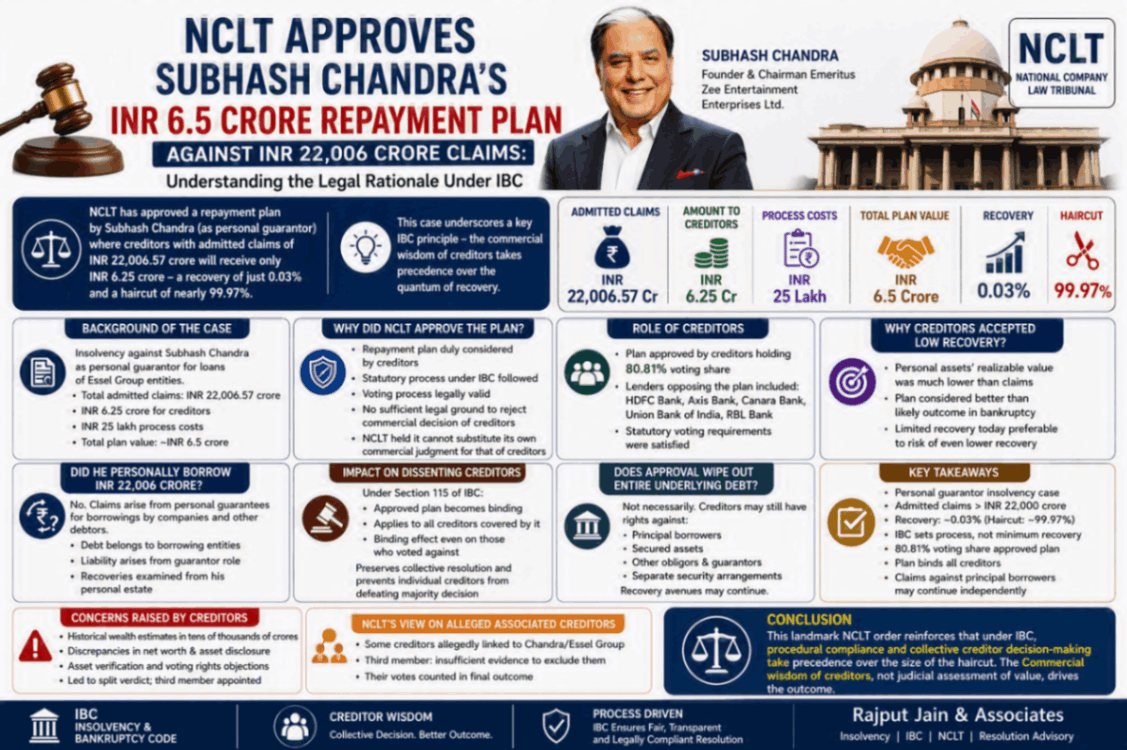
Table of Contents
NCLT Approves Subhash Chandra’s INR 6.5 Crore Repayment Plan Against INR 22,006 Crore Claims: Understanding the Legal Rationale Under IBC
- The recent approval by the National Company Law Tribunal (NCLT) of a repayment plan proposed by Essel Group Chairman and Zee founder Subhash Chandra has sparked widespread debate across the insolvency and banking sectors. The controversy arises from the fact that creditors holding admitted claims of approximately INR 22,006.57 crore will receive only INR 6.25 crore, resulting in a recovery of merely 0.03% and a haircut of nearly 99.97%.
- While the figures appear startling, the case highlights an important principle under India’s Insolvency and Bankruptcy Code (IBC): the commercial wisdom of creditors often takes precedence over the quantum of recovery.
Background of the Case
The insolvency proceedings relate to Subhash Chandra in his capacity as a personal guarantor for loans availed by various Essel Group entities. under the personal insolvency process:
- Total admitted claims against the personal guarantor amounted to INR 22,006.57 crore. The approved repayment plan provides INR 6.25 crore towards creditor payments. INR 25 lakh towards insolvency process costs.
- Total plan value stands at approximately INR 6.5 crore.
The matter gained significance because of the exceptionally low recovery proposed for lenders.
Did Subhash Chandra Personally Borrow INR 22,006 Crore?
A common misconception is that the admitted claim amount represents personal borrowings of INR 22,006 crore. This is not the case. The claims arise from personal guarantees provided by Subhash Chandra for borrowings made by companies and other principal debtors. When borrowers default, the guarantor becomes liable under the guarantee agreement. Therefore:
- The debt belongs primarily to the borrowing entities.
- Chandra’s liability arises from his role as a guarantor.
- The insolvency proceedings examine recoveries from his personal estate rather than from the principal borrowers.
How Significant Is the Haircut?
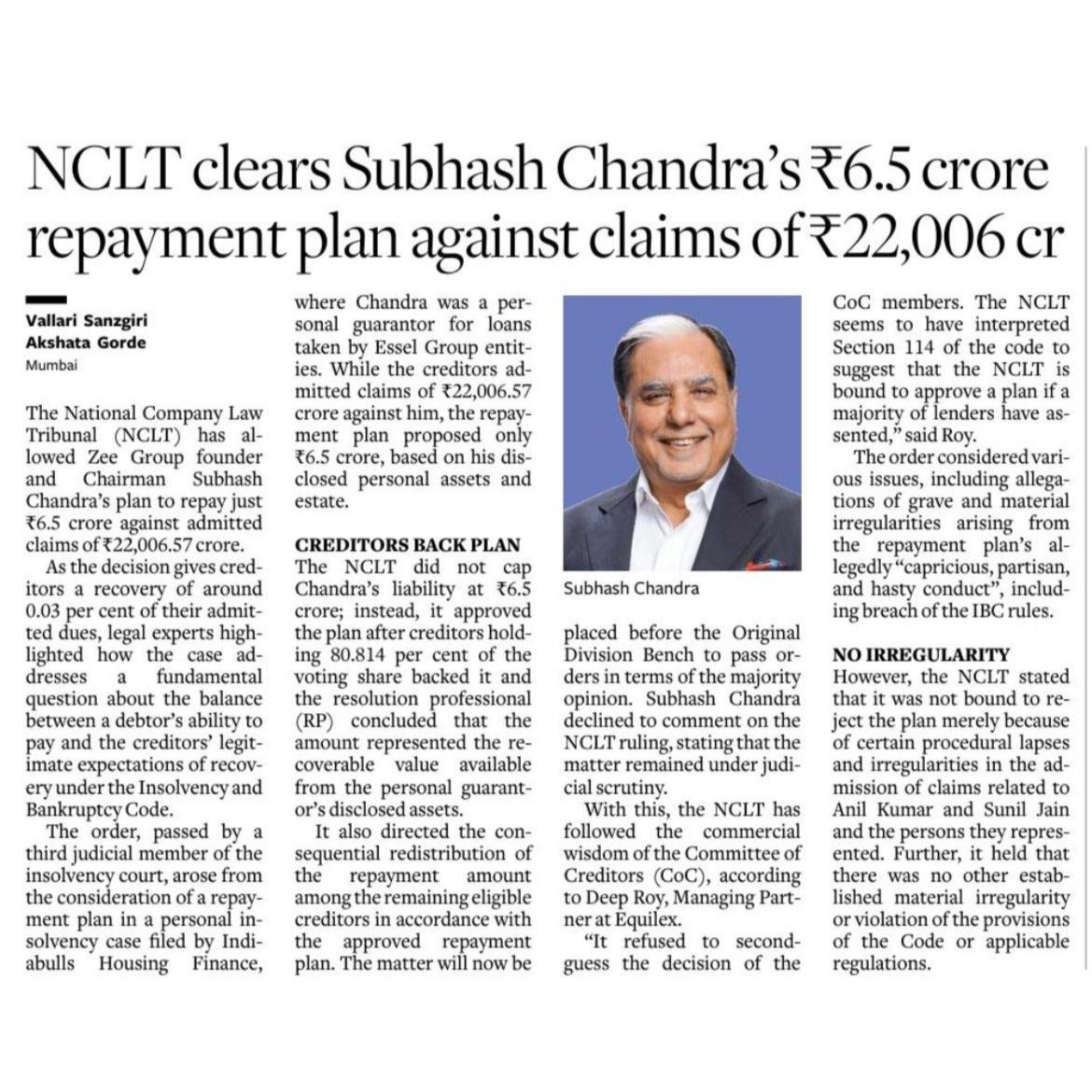
The mathematics of the approved plan is straightforward:
| Particulars | Amount |
| Admitted Claims | INR 22,006.57 Crore |
| Amount Offered to Creditors | INR 6.25 Crore |
| Recovery Percentage | Approx. 0.03% |
| Haircut | Approx. 99.97% |
For example, a creditor having an admitted claim of INR 1,322.39 crore would receive only a few lakh rupees under the approved plan. Such a haircut is among the highest seen in any insolvency-related proceeding and naturally raised questions among stakeholders.
Does the IBC Prescribe a Minimum Recovery Threshold?
One of the key legal issues in this case is whether the Insolvency and Bankruptcy Code prescribes any minimum payout to creditors. The answer is No. The IBC does not specify:
- A minimum recovery percentage.
- A maximum haircut limit.
- A mandatory payout threshold for personal guarantor insolvency plans.
Instead, the Code focuses on a structured process involving preparation of a repayment plan, evaluation by creditors, voting by creditors, and judicial review by the adjudicating authority. Accordingly, the law emphasizes procedural compliance rather than prescribing what constitutes an acceptable commercial settlement.
Why Did the National Company Law Tribunal Approve the Plan?
It is important to understand that the National Company Law Tribunal did not independently determine that INR 6.25 crore was an appropriate value for INR 22,006 crore of claims. Rather, the tribunal found that:
- The repayment plan was duly considered by creditors.
- Statutory procedure under the IBC was followed.
- Voting process was legally valid.
- There was no sufficient legal ground to reject the commercial decision of creditors.
The National Company Law Tribunal effectively held that it cannot replace the commercial wisdom of creditors with its own assessment of value.
Role of Creditors in Approval
- A significant factor behind the approval was creditor voting. The repayment plan received support from creditors holding approximately 80.81% of the voting share. Several lenders opposed the proposal, including HDFC Bank, Axis Bank, Canara Bank, Union Bank of India and RBL Bank. However, since creditors representing a substantial majority approved the plan, the statutory voting requirements were satisfied.
Why Would Creditors Approve Such a Low Recovery?
The answer lies in the valuation of the personal guarantor’s estate. According to the valuation and findings presented during the insolvency process:
- The realizable value of Subhash Chandra’s personal assets was significantly lower than the admitted claims.
- Creditors supporting the plan considered the proposed recovery better than the likely outcome in bankruptcy proceedings.
In commercial terms, accepting a limited recovery today may be preferable to pursuing bankruptcy proceedings that could generate even lower recoveries.
Impact on Dissenting Creditors
An important consequence of the approval is that dissenting creditors cannot continue to pursue recovery from the personal guarantor for the full amount of their original claims. Under Section 115 of the IBC:
- An approved repayment plan becomes binding.
- The plan applies to all creditors covered by it.
- The binding effect extends even to creditors who voted against the proposal.
This principle preserves the collective nature of insolvency resolution and prevents individual creditors from defeating a majority-approved plan.
Does the Approval Wipe Out the Entire Underlying Debt?
Not necessarily. The approved repayment plan relates only to the personal guarantor. Creditors may still have:
- Rights against principal borrowers.
- The Rights against secured assets.
- Rights against other obligors and guarantors.
- The Rights under separate security arrangements.
Therefore, the approved plan does not automatically extinguish all avenues of recovery relating to the underlying loans.
Concerns Raised by Creditors
- The matter became more complex because creditors pointed to Historical estimates of Subhash Chandra’s wealth running into tens of thousands of crores. Alleged discrepancies between historic net worth and currently disclosed assets. Questions regarding asset verification and objections regarding voting rights of certain creditors alleged to be associated with the Essel Group.
- These issues contributed to a split verdict by the original two-member National Company Law Tribunal bench, resulting in the appointment of a third member to resolve the deadlock.
National Company Law Tribunal’s View on Alleged Associated Creditors
- Some lenders argued that certain creditors supporting the plan were connected with Chandra or Essel Group entities and therefore should not have been allowed to vote.
- However, the third member concluded that sufficient evidence was not produced to legally classify and exclude such creditors under the applicable provisions.
- Consequently, their votes continued to count in determining the final outcome.
Key Takeaways from the National Company Law Tribunal Decision
- The case pertains to personal guarantor insolvency, not corporate insolvency.
- Admitted claims exceeded INR 22,000 crore, while the recovery under the plan is approximately INR 6.25 crore.
- Creditors accepted a recovery of around 0.03%, implying a haircut of nearly 99.97%.
- The IBC does not prescribe minimum recovery percentages or maximum haircut limits.
- Creditors holding 80.81% voting share approved of the repayment plan.
- National Company Law Tribunal relied on the principle of commercial wisdom of creditors and approved the plan after finding procedural compliance.
- The approved plan binds even those creditors who voted against it.
- Recovery claims against principal borrowers may continue independently.
INR 22,006 Crore Claims vs INR 6.25 Crore Repayment: The Subhash Chandra Insolvency Case Raises Serious Questions
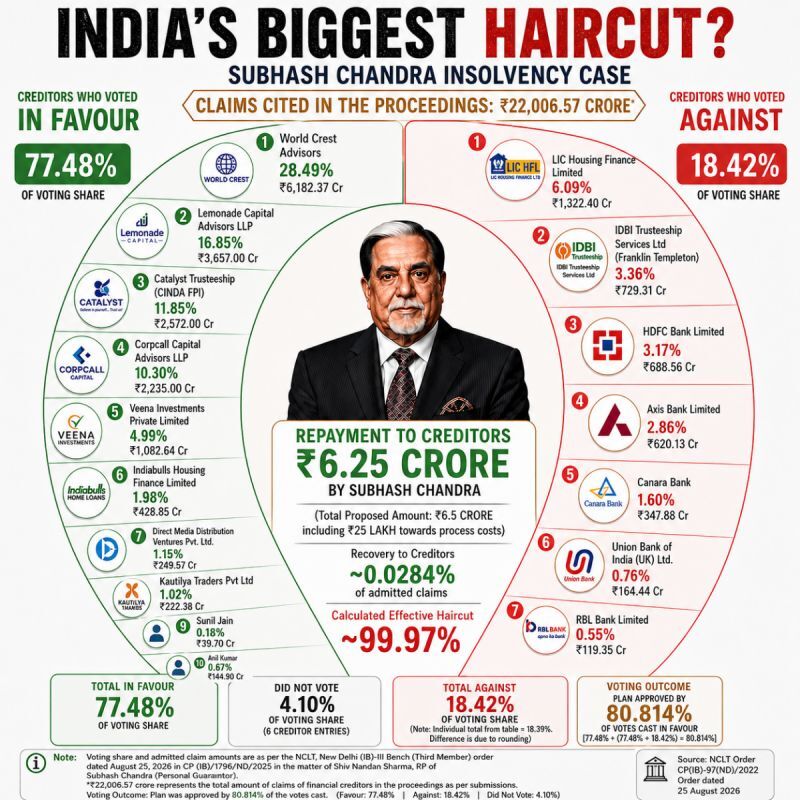
The recent developments in the personal insolvency proceedings of Subhash Chandra, Chairman Emeritus of Zee and Chairman of Essel Group, have reignited discussions around creditor rights, voting power, and the effectiveness of India’s insolvency framework. But beyond the headlines lies a striking set of numbers:
- Admitted Claims: INR 22,006.57 Crore
- Proposed Repayment: INR 6.25 Crore
- Estimated Recovery: ~0.028%
- Effective Haircut: ~99.97%
The bigger question is not merely the size of the haircut.
Conclusion
- The Subhash Chandra personal guarantor insolvency case is likely to become a landmark reference in discussions on creditor rights, personal guarantor liability, and the extent of judicial intervention under the Insolvency and Bankruptcy Code. The decision demonstrates that under the IBC, the focus is not on the size of the haircut but on whether the statutory process has been properly followed and whether creditors have exercised their commercial judgment in accordance with the law.
- For insolvency professionals, lenders, resolution professionals, and legal practitioners, this case reinforces a critical lesson: IBC prioritizes collective creditor decision-making and procedural compliance over judicial assessment of commercial outcomes.
**********************************************************
If this article has helped you in any way, i would appreciate if you could share/like it or leave a comment. Thank you for visiting my blog.
Legal Disclaimer:
The information / articles & any relies to the comments on this blog are provided purely for informational and educational purposes only & are purely based on my understanding / knowledge. They do noy constitute legal advice or legal opinions. The information / articles and any replies to the comments are intended but not promised or guaranteed to be current, complete, or up-to-date and should in no way be taken as a legal advice or an indication of future results. Therefore, i can not take any responsibility for the results or consequences of any attempt to use or adopt any of the information presented on this blog. You are advised not to act or rely on any information / articles contained without first seeking the advice of a practicing professional.